
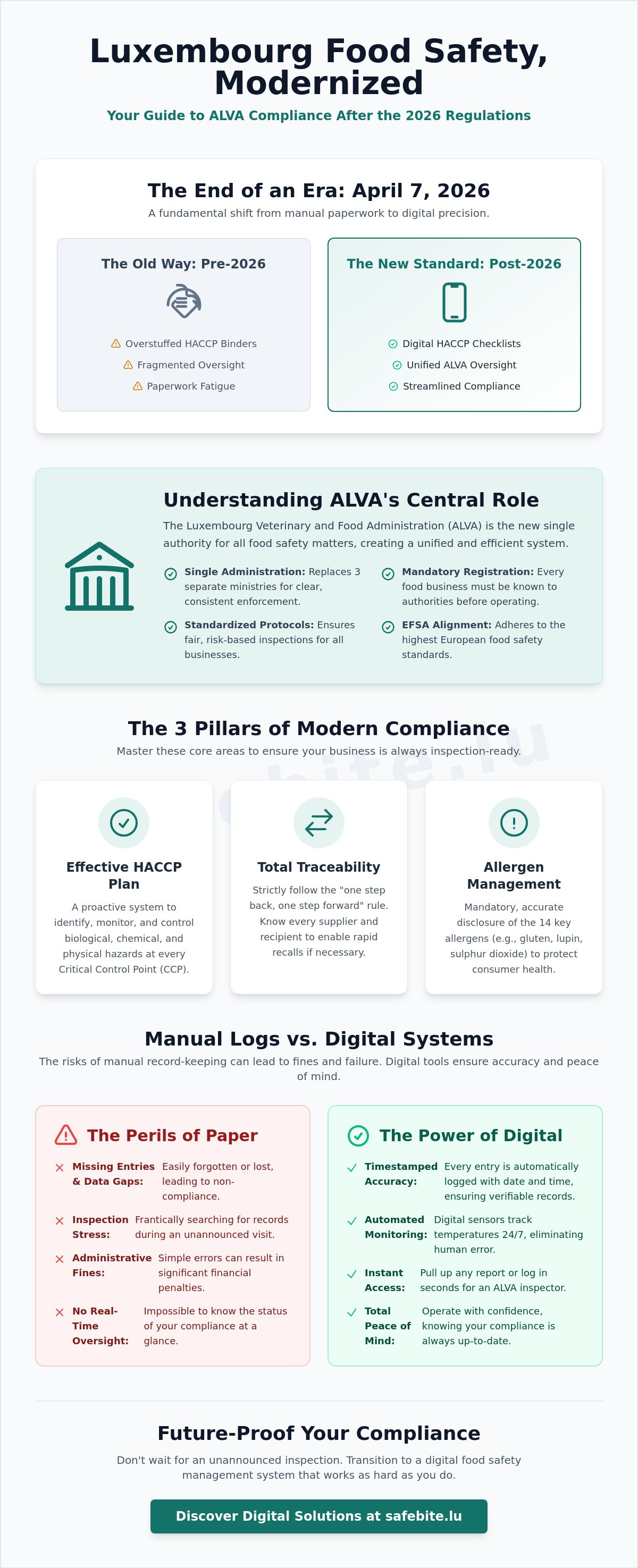
The era of the overstuffed HACCP binder ended on April 7, 2026, when the Grand Duchy’s new legal framework redefined what it means to be a compliant food business. You likely feel the mounting pressure of the Loi du 2 avril 2026 and the meticulous standards now enforced by the Luxembourg Veterinary and Food Administration (ALVA). It’s exhausting to manage a busy kitchen while worrying if a single missing entry will lead to a breach of Luxembourg food safety regulations and an administrative fine. You deserve a system that works as hard as your team does.
This guide helps you master the current regulatory framework and move toward a future of digital precision. You’ll learn how to maintain an inspection-ready facility that satisfies ALVA’s centralized oversight without the traditional paperwork fatigue. We will break down the essential pillars of the 2026 compliance landscape, including the shift toward total operator responsibility and the specific digital tools, such as automated temperature monitoring and allergen management systems, that ensure your business remains beyond reproach during unannounced inspections.
Key Takeaways
- Understand the central role of ALVA and how the unified enforcement model impacts your adherence to Luxembourg food safety regulations.
- Identify the critical requirements for HACCP and the "one step back, one step forward" rule to maintain flawless traceability.
- Learn how to transition from manual logs to digital precision to avoid common pitfalls like missing entries and administrative sanctions.
- Prepare for unannounced inspections with a structured checklist that ensures all essential documentation is accessible within minutes.
- Explore how automated temperature monitoring and digital checklists streamline your daily operations while ensuring total accuracy.
The Landscape of Luxembourg Food Safety Regulations in 2026
The regulatory environment in the Grand Duchy has undergone a decisive transformation. On April 7, 2026, the publication of the new law on foodstuffs solidified a shift toward a more integrated and transparent system. This modernization ensures that Luxembourg food safety regulations are now managed under a single, cohesive framework. Whether your establishment is a small local grocery shop or a large, high-end restaurant, the objective remains the same: protecting human health through rigorous oversight of every stage of production and distribution. This "farm to fork" approach means that no link in the chain is left to chance.
The Role of ALVA in National Oversight
The establishment of the Luxembourg Veterinary and Food Administration (ALVA) represents a strategic move toward administrative efficiency. Previously, oversight was fragmented across three different ministries. This often led to overlapping jurisdictions or inconsistent inspection standards that frustrated business owners. By consolidating these controls, the government has created a "single administration" logic. It's a system designed to provide clarity. Every food business operator now interacts with a unified body that follows standardized protocols. This national rigor aligns with the broader scientific guidelines established by the European Food Safety Authority (EFSA), ensuring that Luxembourg remains a leader in consumer protection. The 2023 draft law on official food controls served as the blueprint for this transition. It replaced a patchwork of rules with a modern, results-based hygiene obligation.
Mandatory Registration for Food Business Operators
Compliance begins with visibility. Every establishment in the food chain must be officially known to the authorities before starting operations. This isn't just a formality; it's the foundation of the national safety network. During the registration process, you'll need to provide specific details. These include the identity of the operator, the type of activity, and the physical location of the premises. If your business involves certain high-risk products, you might even require specific authorization from the relevant minister. Registration is the first step in your "audit-ready" journey. It allows ALVA to categorize your risk profile and schedule inspections that are fair and based on your specific operational reality. Without this registration, you're not just operating in the dark; you're risking immediate administrative sanctions. Staying proactive here ensures your business starts on solid legal ground.
The Core Pillars of Compliance: HACCP, Traceability, and Hygiene
Compliance isn't a static requirement. It's a continuous commitment to operational excellence. To satisfy the Luxembourg Veterinary and Food Administration (ALVA), your business must stand on three robust pillars: HACCP, traceability, and rigorous hygiene. These frameworks don't just prevent illness; they provide a structured defense during unannounced inspections. When you understand how these elements interact, the complexity of Luxembourg food safety regulations becomes a manageable, daily routine.
Implementing an Effective HACCP Plan
Hazard Analysis and Critical Control Points (HACCP) is the mandatory management system for all food operators in Luxembourg. It requires a proactive approach to risk. You must first identify where biological, chemical, or physical hazards could compromise food safety. It's vital to distinguish between Critical Control Points (CCPs) and general hygiene measures. A CCP is a specific stage where you can prevent or eliminate a hazard, such as the minimum internal temperature for cooked poultry. General hygiene, like regular surface sanitization, supports the environment but doesn't replace the need for specific CCP monitoring. Success depends on continuous verification. You can't rely on memory or sporadic checks. Using digital HACCP checklists ensures that every critical limit is monitored and recorded with timestamped accuracy, removing the guesswork from your daily safety protocols.
Traceability and Allergen Management
The Grand Duchy enforces a strict "one step back, one step forward" rule for traceability. This means you must be able to identify the immediate supplier of every ingredient and, where applicable, the immediate recipient of your products. If a health risk is identified, you must be prepared to execute an immediate recall. This level of precision is equally critical for allergen management. Under EU and local law, you're required to disclose the presence of 14 key allergens, including gluten, lupin, and sulphur dioxide. Confusion here isn't just a compliance risk; it's a life-threatening hazard. Maintaining digital ingredient logs allows for instant retrieval of data, which is far more reliable than searching through paper invoices during an active ALVA audit.
Hygiene standards extend beyond the plate. Your premises must be designed to prevent cross-contamination, and equipment must be maintained in a state of repair that allows for thorough disinfection. Staff personal conduct, from handwashing frequency to the use of protective clothing, remains a top priority for inspectors. Finally, your labeling and packaging must provide total transparency. Consumers need to know exactly what they're eating, especially regarding storage conditions and expiration dates. When these details are handled with precision, your kitchen becomes a model of modern safety.
Navigating Sanctions and the Risks of Manual Record-Keeping
The legal landscape for food businesses in the Grand Duchy has changed. With the 2026 regulatory updates, the enforcement of Luxembourg food safety regulations has shifted from a slow criminal process to a fast-acting administrative penalty regime. This means the Luxembourg Veterinary and Food Administration (ALVA) can now issue immediate sanctions without waiting for a court ruling. For an operator, this change necessitates a higher level of vigilance. You're no longer just avoiding a potential lawsuit; you're protecting your daily cash flow and your reputation from immediate administrative action.
The New Catalogue of Progressive Sanctions
ALVA now utilizes a structured hierarchy of enforcement measures designed to encourage rapid correction. Minor infractions often result in an "avertissement taxé" or a taxed warning. This is essentially an on-the-spot fine for non-compliance that doesn't immediately threaten your health mark but serves as a formal record of failure. If these minor issues persist, or if an inspector identifies a direct risk to consumer health, the sanctions escalate. Heavy administrative fines can be levied, and in extreme cases, the administration has the power to order a total business closure. Enforcement officers are now more methodical in their follow-ups. They don't just point out a problem; they schedule return visits to ensure every infringement has been resolved. This persistent oversight makes it impossible to ignore even the smallest deviation from hygiene standards.
Why Manual Logs Fail Modern Inspections
Paper-based records are the weakest link in a modern kitchen. One of the biggest red flags for an ALVA auditor is "dry-labbing." This is the practice of filling out multiple days of temperature or cleaning logs all at once, often using the same pen and identical handwriting, rather than recording data in real time. It's a clear sign of a failing safety culture. Beyond the risk of falsification, manual logs are incredibly inefficient. The time-cost of having a chef stop their work every two hours to manually check a fridge and find a clipboard adds up to dozens of lost hours every month.
Manual systems also fail because they're reactive. If a freezer fails at 11 PM on a Saturday, a paper log won't tell you until Monday morning when the stock is already ruined. Digital management provides the real-time corrective actions that paper simply can't offer. In Luxembourg, the burden of proof lies entirely on the operator. If a foodborne illness is traced back to your kitchen, you must demonstrate that you were compliant at the time of the incident. Illegible, stained, or missing paper entries are rarely accepted as valid proof. Precision is your only true defense.
Preparing for an ALVA Inspection: A Step-by-Step Checklist
The arrival of an inspector shouldn't trigger a panic. In fact, unannounced visits from the Luxembourg Veterinary and Food Administration (ALVA) are simply an opportunity to demonstrate your daily mastery of Luxembourg food safety regulations. An audit-ready kitchen is one where compliance is a constant state, not a last-minute scramble. Success during an inspection depends on two factors: the physical state of your premises and the speed at which you can produce verified documentation. If you can't provide proof of safety within minutes, an inspector may assume the controls don't exist at all.
The "First 15 Minutes" Documentation Pack
When an officer enters your facility, they'll immediately ask for your safety records. You must ensure that your HACCP plan, recent temperature logs, and staff training records are centralized and accessible. Don't leave this responsibility to a single manager who might be off-site. Every senior staff member should know how to access your multi-site management dashboard to pull up traceability data and health mark authorizations instantly. Having a digital "pack" ready ensures the audit starts on a professional, high-confidence note.
Physical Kitchen Standards to Verify Daily
Documentation is only half the battle. Your physical environment must match your digital records. Use a daily checklist to verify these critical areas before every shift:
- Cold Chain Integrity: Check that all refrigerators are at or below 5°C and freezers are below -18°C. Ensure your temperature monitoring system hasn't flagged any overnight deviations.
- Sanitation and Chemicals: Verify that cleaning schedules are signed off and that all detergents and disinfectants are stored in a dedicated area, away from food preparation surfaces.
- Staff Readiness: Ensure all employees are in clean uniforms, hand-washing stations are fully stocked with soap and single-use towels, and health declarations are up to date.
During the audit, your staff should remain professional and honest. If an inspector observes a minor non-conformity, such as a misplaced container or a slightly cluttered dry store, take immediate corrective action in their presence. This proactive attitude shows that you value safety over ego. By documenting the correction instantly in your digital log, you provide a clear trail of accountability. This transparency is often the difference between a simple verbal advice and a formal administrative warning. Maintaining this level of readiness ensures that your kitchen remains a safe, compliant, and profitable environment every day of the year.
Future-Proofing Compliance with Digital Management Systems
Adopting a digital mindset is no longer optional for businesses aiming for long-term growth in the Grand Duchy. The administrative burden of the April 2026 law shouldn't dictate your kitchen's daily workflow. While manual record-keeping was once the industry standard, the modern regulatory environment demands a digital-first approach. Transitioning to a digital HACCP platform like SafeBite transforms compliance from a stressful obligation into a seamless background process. This shift ensures you're always aligned with Luxembourg food safety regulations without sacrificing operational speed or culinary creativity.
Precision Through Automation
Human error is the most common cause of non-compliance during ALVA inspections. A chef might forget a temperature check during a busy lunch rush; a cleaning log might be signed off without the work being completed. Digital sensors eliminate these risks by providing constant, automated oversight. These systems monitor your cold chain 24/7. If a refrigerator deviates from its set limit, you receive an automated alert on your phone immediately. This allows for corrective action before stock is lost or consumer health is compromised. Smart reminders also ensure that recurring kitchen tasks, from probe calibrations to allergen updates, are never overlooked. Generating an audit-ready report becomes a matter of a single click, providing inspectors with the precise, timestamped data they respect.
Scaling Excellence Across Multiple Locations
Managing a single kitchen is challenging. Overseeing a group of restaurants across different cantons is a different level of complexity entirely. Multi-site management dashboards provide owners with a bird's-eye view of their entire operation from a single screen. You can benchmark compliance levels between a location in Diekirch and one in Luxembourg City, identifying which teams need more support or training. This centralized oversight ensures that high standards are uniform across your brand, regardless of who is running the shift. It builds a culture where food safety is integrated into the user-friendly technology your staff already knows how to use. By removing the friction of paperwork, you empower your team to focus on excellence. Discover how SafeBite simplifies Luxembourg food safety compliance and protects your business from the inherent risks of manual oversight.
Mastering the New Standard of Operational Excellence
The landscape of Luxembourg food safety regulations has evolved into a unified, digital-first standard. With ALVA providing centralized oversight, your business must prioritize accuracy and immediate data retrieval to remain compliant. Moving away from manual record-keeping isn't just about efficiency; it's about protecting your reputation and avoiding the progressive sanctions introduced in April 2026. You now have the strategic knowledge to transform your kitchen into a truly audit-ready facility.
SafeBite provides the technology to make this transition friction-free. Our system is built specifically for Luxembourgish regulatory standards, offering automated real-time alerts and centralized, inspection-ready dashboards. Streamline your compliance with SafeBite’s digital HACCP system to ensure your operation is always one step ahead of the next unannounced visit. You have the tools to build a culture of safety that supports your team and protects your guests. Your commitment to precision today ensures a more resilient and successful business tomorrow.
Frequently Asked Questions
What is ALVA and what is its role in Luxembourg food safety?
ALVA is the Luxembourg Veterinary and Food Administration, the single authority responsible for official controls throughout the entire food chain. It centralizes oversight previously split between multiple ministries to ensure a unified and efficient application of Luxembourg food safety regulations across the country.
Is HACCP mandatory for all restaurants in Luxembourg?
Yes, implementing a Hazard Analysis and Critical Control Points (HACCP) system is a legal requirement for every food business operator in the Grand Duchy. You must have a functional system to identify, evaluate, and control specific food safety hazards to comply with the Loi du 2 avril 2026.
What documents do I need to show during a food safety inspection?
You need to present your HACCP plan, recent temperature monitoring logs, cleaning schedules, and staff hygiene training records. Traceability data, including supplier invoices and delivery notes, must also be available for immediate review by the inspector.
How long must I keep my food safety and traceability records?
You should generally keep food safety and traceability records for at least six months after the product's shelf life has expired. You shouldn't discard these logs prematurely, as they provide essential evidence of compliance during retrospective audits or health investigations.
What are the penalties for non-compliance with food hygiene laws?
Penalties follow a progressive administrative regime, starting with "taxed warnings" for minor infractions identified during an audit. Persistent non-compliance or serious hygiene risks can lead to significant administrative fines or the total suspension of your operating authorization.
Can I use digital records instead of paper logs for my HACCP plan?
Yes, digital records are an excellent alternative to paper logs and are highly effective during ALVA inspections. Digital systems provide timestamped accuracy and prevent the risk of "dry-labbing," which helps build professional trust with enforcement officers.
How do I register my food business with the Luxembourgish authorities?
You must notify ALVA of your business activities through an official registration process before you commence operations. This involves detailing your operator identity, the nature of your food handling, and the specific physical location of your premises.
What are the specific allergen labelling requirements in Luxembourg?
You are legally required to inform customers about the 14 mandatory allergens present in your food, such as gluten, lupin, and dairy. This information must be clearly documented and easily accessible to consumers at the point of sale or on your menu.