

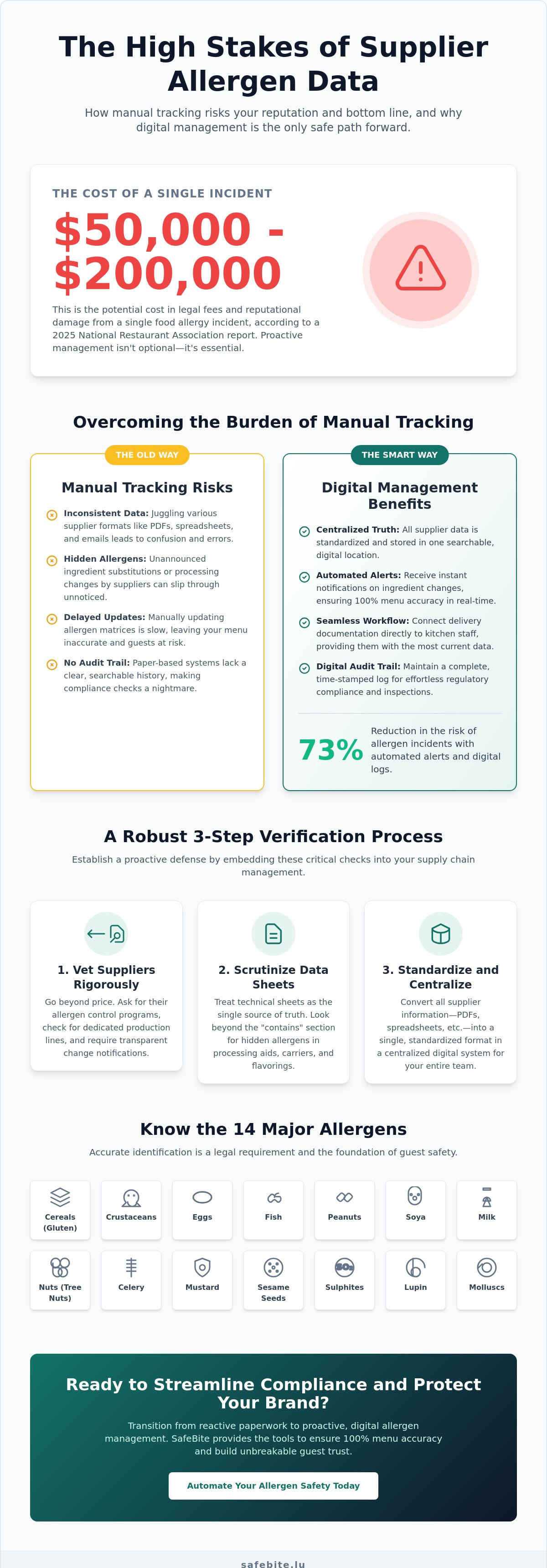
A single food allergy incident can cost a restaurant between $50,000 and $200,000 in legal fees and reputational damage, according to a 2025 report from the National Restaurant Association. Despite these high stakes, many operators still grapple with inconsistent data formats and the constant fear of a hidden allergen slipping through during an unannounced ingredient substitution. Effectively managing supplier allergen information isn't just a back-office task; it's a critical layer of proactive defense for your guests and your brand's longevity.
It's exhausting to spend hours manually updating allergen matrices only to have a supplier change their processing methods without a clear notification. You deserve a more reliable way to maintain oversight without sacrificing your team's operational efficiency. This guide will show you how to master the complexities of supplier data to ensure 100% menu accuracy and seamless regulatory compliance. We'll outline a streamlined process for vetting suppliers, building a digital audit trail, and transitioning to automated systems that keep your kitchen ready for any health inspection.
Key Takeaways
- Learn how to implement a rigorous verification process using technical data sheets to ensure every raw ingredient is accurately vetted before it enters your kitchen.
- Master the complexities of managing supplier allergen information to maintain 100% menu accuracy even when faced with unexpected ingredient substitutions.
- Identify the operational risks of manual tracking and explore how digital solutions provide the real-time oversight required for modern regulatory compliance.
- Establish a seamless link between delivery documentation and kitchen workflows to ensure staff always have access to the most current allergen data.
- Discover how automated alerts and centralized digital logs can reduce the risk of allergen incidents by as much as 73%, protecting both your guests and your brand.
What is Supplier Allergen Management and Why is it Critical?
Supplier allergen management is the systematic process of gathering, verifying, and recording precise data for every raw ingredient that enters your facility. It isn't just about reading a label at the back door. It involves a rigorous oversight of the entire supply chain to ensure that what arrives in your kitchen matches what you tell your guests. Effectively managing supplier allergen information is the foundation of a safe dining environment. Without this data, your menu's accuracy is essentially guesswork.
The stakes are high because supplier errors account for a significant percentage of undeclared allergen incidents. A vendor might change a recipe or switch processing facilities without notifying you. If your team isn't actively monitoring these changes, a "safe" dish can become a liability overnight. Shifting from a reactive to a proactive stance is essential for modern operators. Waiting for a health inspector to point out a discrepancy is a high-stakes gamble that few businesses can afford to lose. A proactive system ensures you catch errors at the point of delivery, not at the point of consumption.
The Legal Framework for Allergen Labelling
The responsibility for accurate disclosure rests entirely with the Food Business Operator (FBO). While you rely on your vendors for data, national regulations hold your business accountable for the final product served. In many regions, this includes clear identification of the 14 major allergens. Understanding What is a Food Allergy? and its physiological impact highlights why these laws are so stringent. For those operating in Europe, staying aligned with Luxembourg food safety regulations is a prime example of the high standards required for 2026 compliance. These laws demand that managing supplier allergen information stays a top priority to avoid heavy fines and legal action.
The Financial and Reputational Risks of Inaccurate Data
A single error in a supplier's technical sheet can trigger a chain reaction of financial loss. Beyond the immediate cost of wasted inventory, a food recall can devastate your margins. Industry data indicates that food allergy incidents can cost restaurants an average of $50,000 to $200,000 per event in legal fees and settlements. There is also the matter of Precautionary Allergen Labelling (PAL). When suppliers use "may contain" statements, it's your job to assess that risk and communicate it clearly. If you ignore these warnings or fail to update your records, you risk a permanent blow to your brand's reputation. Trust is the hardest asset to rebuild once it's broken by a preventable safety failure.
Establishing a Robust Supplier Verification Process
Vetting a new vendor requires more than just price comparisons and delivery schedules. You need to understand their allergen control programs from the start. Ask specific questions: Do they have dedicated production lines? How do they manage ingredient changeovers? Managing supplier allergen information effectively starts with the technical specification sheet. You should never accept a product into your inventory without a current, detailed data sheet that lists every component. This document is the only verifiable source of truth for your kitchen.
Standardizing this data is your next hurdle. Suppliers send information in various formats, from complex PDFs to simple Excel sheets. Converting these into a single internal standard ensures your chefs aren't trying to interpret different terminologies during a busy service. Annual audits or re-verifications upon contract renewal are also critical. If a supplier changes their source for a spice blend, that change must be captured in your system immediately. Utilizing a dedicated allergen management tool can help centralize these disparate data points into a cohesive, searchable database.
Decoding Technical Data Sheets
Technical sheets often hide allergens in plain sight. Processing aids, carriers, and flavourings can contain traces of soy or wheat that aren't immediately obvious on a basic ingredient list. You must look beyond the "contains" section and scrutinize the full ingredient breakdown. Understanding the distinction between "contains" and "may contain" is equally vital. While "contains" indicates a deliberate ingredient, "may contain" signals a cross-contact risk that requires a different level of communication with your guests. If a local producer provides vague information, don't hesitate to request a formal declaration or seek an alternative vendor who values transparency.
Managing Cross-Contact Transparency
Evaluating a supplier's cleaning and segregation protocols provides insight into their true risk profile. Many large-scale manufacturers use the VITAL (Voluntary Incidental Trace Allergen Labelling) program to quantify these risks. This data helps you determine if a precautionary label is actually necessary. Establish a "Red Flag" system for your procurement team. If a supplier's reporting is inconsistent or if they fail to provide updated specs after multiple requests, it's a clear signal that their safety culture may be lacking. Proactive oversight ensures that your kitchen remains a controlled environment, regardless of external supply chain fluctuations.
Digital vs. Manual Tracking: Overcoming the Paperwork Burden
While manual logs were once the industry standard, they're increasingly viewed as a liability in high-volume environments. Paper systems suffer from inherent failure points that no amount of filing can fix. Lost specification sheets, illegible handwriting, and outdated folders create a fragmented view of your safety status. In contrast, digital systems offer the real-time agility needed for managing supplier allergen information during daily deliveries. When a vendor swaps a product at the loading dock, a digital record allows for an instant update that ripples through your entire operation. This ensures that the chef in the kitchen isn't working from data that's three months old.
Centralized oversight is another significant advantage for operators managing multiple locations. A single dashboard allows a food safety manager to verify compliance across ten sites simultaneously. You don't have to travel to each unit to check if their allergen folders are current. This level of transparency also simplifies audit readiness. During a surprise inspection, digital logs provide instant proof of due diligence. You can present a timestamped history of every supplier specification review with a few clicks, demonstrating a level of proactive vigilance that paper binders simply can't match.
The Hidden Costs of Manual Allergen Logs
The time your team spends updating manual matrices is time stolen from the floor. Manually transcribing data from supplier PDFs into a kitchen spreadsheet is labor-intensive and prone to human error. There's also the persistent risk of "version confusion." If a paper sheet is updated in the office but the old version remains on the kitchen wall, your staff is set up for failure. This is why digital food safety checklists are the modern solution. They eliminate the lag time between receiving data and implementing it, ensuring every team member sees the same "source of truth" at the same time.
Efficiency Gains with Automated Systems
Automated allergen tracking can reduce the risk of incidents by up to 73%, according to the Food Allergy Research & Education (FARE) organization. Smart reminders ensure that supplier specifications are reviewed on a strict schedule, so nothing expires or goes unnoticed. By integrating allergen tracking into your standard digital HACCP workflows, you make safety a seamless part of the daily routine rather than an extra chore. This reduces staff stress significantly. Instead of hunting through a dusty folder for a specific ingredient carrier, they can find the answer on a tablet in seconds. It's about building a system that supports your people while protecting your guests.
Best Practices for Integrating Supplier Data into Kitchen Workflows
Data is only as valuable as its accessibility. In a fast-paced kitchen, managing supplier allergen information isn't just about collecting technical sheets; it's about ensuring that information reaches the person holding the tongs. If a delivery driver drops off a case of flour and the data stays in a manager's inbox, the system has failed. You must create a direct link between the delivery bay and the chef’s station. This ensures that every ingredient used in a recipe matches the current safety profile on record.
A "Substitution Protocol" is your most vital defense against supply chain fluctuations. When a supplier sends an alternative brand due to stock shortages, it's a high-risk event. Your receiving team shouldn't just check the quantity; they must verify the allergen profile immediately. If the new brand contains an allergen not present in the usual product, the menu matrix must be updated before the first plate leaves the kitchen. Integrating these changes into daily briefings ensures front-of-house staff can confidently answer guest questions during service.
Maintaining a Dynamic Allergen Matrix
Static wall charts are often outdated the moment they're printed. To maintain 100% accuracy, your matrix must be a living document. This starts with a clear step-by-step process for creating an accurate allergen matrix that evolves with your inventory. Assigning a specific "Allergen Champion" to verify new delivery labels provides a layer of accountability. Digital tools allow you to push these updates to staff devices instantly, eliminating the risk of someone using an old version of the menu guide.
Staff Training and Delivery Verification
Receiving staff are your first line of defense. They must be taught to look beyond the front of the packaging and spot "secret" allergen changes in the fine print. This level of vigilance requires consistent training staff on food allergen awareness to ensure they understand the consequences of a missed label change. Implementing a "Double Check" system for high-risk ingredients, like sauces or spice blends, adds an extra safety margin. One person verifies the spec, and a second person confirms the entry in the digital log.
Ready to move beyond paper binders and manual errors? Streamline your kitchen's safety with our Allergen Management Tool today.
Streamlining Compliance with SafeBite’s Allergen Management Tool
The SafeBite Allergen Management Tool transforms the theoretical requirements of food safety into a practical, daily reality. Our platform automates the most labor-intensive aspects of managing supplier allergen information, allowing you to focus on culinary excellence rather than paperwork. By digitizing your supplier logs, you create a secure repository for every technical data sheet; this ensures your team isn't hunting through emails or physical binders when an inspector arrives. It's about centralizing your data so that accuracy becomes an automated standard rather than a manual chore.
Smart alerts provide a layer of proactive vigilance that manual systems cannot replicate. You'll receive instant notifications when a supplier specification is due for review or if a vendor reports an ingredient change. This prevents the "hidden" allergen risks discussed earlier from entering your kitchen unnoticed. The tool also offers instant matrix generation. With one click, the system converts raw supplier data into a clear, customer-facing allergen matrix. For multi-site operators, our synchronization features ensure every location uses the same verified information, maintaining brand consistency across your entire network.
Preparation for National Health Inspections
SafeBite simplifies the audit process by allowing you to generate "Proof of Compliance" reports in seconds. These digital logs demonstrate a clear chain of custody from the supplier's initial specification to the guest's plate. This level of transparency is essential for aligning with the Luxembourg food safety authority guidelines. When you can show an inspector a timestamped history of your allergen checks, you project an image of calm authority and total control. It's the most effective way to prove that your kitchen operates with disciplined precision.
Reducing Food Waste and Operational Friction
Human error is the primary driver of food waste in allergen management. If a chef uses the wrong ingredient carrier because they couldn't find the current spec, the entire batch must be discarded. SafeBite reduces this operational friction by providing an intuitive digital interface that makes the correct information impossible to miss. This also shortens the onboarding time for new kitchen staff, as they don't need to learn complex filing systems to stay safe. Precision in the back-of-house leads to confidence in the front-of-house. Optimize your allergen management with SafeBite today and ensure your business is ready for the challenges of 2026.
Securing Your Kitchen's Future with Digital Precision
Transitioning away from fragmented paper logs is the only way to ensure guest safety in an increasingly complex supply chain. By establishing a robust vetting process and integrating technical data directly into your daily workflows, you eliminate the high-stakes guesswork associated with ingredient substitutions. Effectively managing supplier allergen information requires a system that is as dynamic as your menu. It's about building a digital-first culture where safety and operational efficiency work in tandem to protect your guests and your brand's reputation.
SafeBite is trusted by leading hospitality brands across Luxembourg to provide inspection-ready documentation in one click. Our platform replaces error-prone manual paper logs with a streamlined, digital audit trail that satisfies national health inspectors and simplifies your daily oversight. Book a demo of SafeBite’s Allergen Management Tool to see how we can help you master your data and maintain 100% menu accuracy. You already have the expertise to lead a safe kitchen; now you have the technology to support it. Start building a more resilient and compliant operation today.
Frequently Asked Questions
How often should I verify allergen information from my regular suppliers?
You should verify allergen data at least once a year or whenever a supplier changes their recipe, sourcing, or production facility. High risk ingredients or those from complex supply chains may require more frequent reviews. Proactive monitoring ensures that your internal records remain a true reflection of the ingredients currently in your pantry.
What should I do if a supplier fails to provide a technical data sheet?
You shouldn't accept the product into your inventory without a formal technical data sheet. These documents are the only verifiable source of truth for your kitchen's safety protocols. Accepting an unverified ingredient introduces an unacceptable level of risk to your guests and can lead to significant legal liability if an incident occurs.
Are "May Contain" statements from suppliers legally required on my menu?
While laws vary by region, transparency regarding cross-contact risks is the safest professional standard for 2026 compliance. If your process for managing supplier allergen information identifies a credible risk of cross-contamination, you have a duty of care to inform your guests. Providing this information protects your brand and empowers diners to make informed choices.
How do I manage allergens when using small, local suppliers who don’t have formal specs?
Request a formal, signed declaration that lists all allergens present in their products and processing environment. If they lack a standard template, provide them with a simple form to complete and sign. This creates a documented audit trail that satisfies health inspectors and ensures you aren't relying on verbal assurances for food safety.
Can digital HACCP software replace my physical allergen folder for inspections?
Yes, digital records are widely accepted by national health inspectors as long as they are easily accessible and provide a clear history of due diligence. Digital systems are often preferred because they offer timestamped proof of updates and reviews. Ensure your management team can navigate the digital dashboard quickly during a surprise visit.
What is the best way to handle a last-minute ingredient substitution during service?
Halt the use of the substituted ingredient until its allergen profile is verified against your current menu matrix. Receiving staff must flag any brand changes immediately upon delivery. Once verified, use your digital management tool to push an instant update to all staff devices so the front-of-house team can inform guests before orders are taken.
How can I ensure my front-of-house staff are always aware of supplier changes?
Integrate allergen updates into mandatory pre-service briefings and use digital alerts that appear on POS terminals or tablets. Effective communication is the final link in managing supplier allergen information successfully. When the kitchen and the floor work from the same real-time data, the risk of miscommunication with the guest is virtually eliminated.
Is it enough to just rely on the ingredients listed on the product packaging?
No, packaging labels can sometimes omit processing aids or sub-ingredients that are only disclosed in a full technical specification. Packaging also might not reflect recent changes in the manufacturer's facility that could introduce cross-contact risks. Always cross-reference the physical label with the supplier's technical data sheet to ensure 100% accuracy for your allergen matrix.