
What if the greatest risk to your business isn't a slow night, but a single misunderstood ingredient during a peak dinner service? With millions of diners now managing severe food allergies, the margin for error has effectively disappeared. Implementing a rigorous restaurant allergen management plan is no longer a luxury; it's a fundamental requirement for operational survival and safety. You likely feel the pressure of high staff turnover and the persistent challenge of language barriers in the kitchen, both of which make consistent training feel nearly impossible to maintain.
We recognize that keeping every team member aligned is a complex task, especially when legal liabilities and customer health are on the line. This guide provides a clear roadmap to mastering a digital-first allergen training program that ensures total regulatory compliance and operational peace of mind. We'll examine how to bridge the communication gap between your front-of-house and kitchen teams, utilize digital records to simplify health inspections, and build a certified culture that handles every order with proactive vigilance.
Key Takeaways
- Understand the evolving EU and Luxembourg regulatory landscape to ensure your business meets its legal Duty of Care and maintains compliance.
- Identify the EU 14 major allergens and uncover hidden risks in common kitchen staples to prevent accidental exposure.
- Develop a robust restaurant allergen management plan that bridges the communication gap between front-of-house and kitchen teams for seamless service.
- Implement practical strategies to eliminate cross-contact by establishing dedicated allergen-safe zones and equipment protocols.
- Transition from paper-based logs to digital records to maintain 100% accountability and ensure total readiness for national health inspections.
The Legal and Ethical Stakes of Allergen Awareness in 2026
In the modern hospitality sector, managing food safety has shifted from a back-of-house checklist to a core pillar of brand integrity. A robust restaurant allergen management plan is no longer just a defensive measure against litigation; it's a commitment to guest safety that defines your professional reputation. As we move through 2026, the expectations from both regulators and consumers in Luxembourg have reached a new peak of scrutiny. Proactive vigilance is the only way to ensure your business remains both compliant and profitable.
Legal Requirements and Compliance Standards
EU Regulation 1169/2011 remains the foundational law governing food information for consumers. It mandates the clear declaration of 14 specific allergens in all food products, including non-prepacked meals served in restaurants. In Luxembourg, national health inspectors from the ALVA (Administration luxembourgeoise vétérinaire et alimentaire) have increased the depth of their HACCP audits. They no longer accept vague verbal assurances. Inspectors now look for a verifiable digital trail that tracks allergens from the initial supplier delivery to the final plate served to the customer.
The consequences of failing these standards are severe. Beyond administrative fines that can quickly escalate to several thousand Euros, businesses face the risk of immediate operational suspension. In a tight-knit market like Luxembourg, the reputation damage from a single documented safety failure is often permanent. Legal liability also extends to individual managers if it's proven that a restaurant allergen management plan was either absent or poorly enforced. Compliance is the baseline, but true safety requires a culture of total transparency.
The Human Element: Why Awareness Saves Lives
Beyond the legal framework lies a profound ethical responsibility to protect your guests. To truly understand the stakes, this comprehensive overview of food allergies explains the complex physiological responses involved in these reactions. While a food intolerance might cause digestive discomfort, a true allergy can trigger anaphylaxis, a life-threatening emergency that occurs within minutes of ingestion. Staff must understand that for a guest with a severe allergy, "just a little bit" is never an acceptable answer.
Training your team to recognize early symptoms is vital. These often include:
- Sudden swelling of the lips, tongue, or throat
- Difficulty breathing or audible wheezing
- Rapidly spreading hives or skin redness
- Dizziness or a sudden drop in blood pressure
Establishing a proactive food safety culture means every employee feels empowered to double-check an ingredient or stop a plate from leaving the kitchen if they have any doubt. This level of care builds immense trust with the growing "free-from" consumer segment. These diners don't just look for a meal; they look for a safe environment. When your team demonstrates mastery over allergen protocols, you turn a high-risk operational challenge into a significant competitive advantage.
Mastering the EU 14: Identifying Risks and Hidden Allergens
Precision is the cornerstone of any effective restaurant allergen management plan. While the previous section outlined the legal necessity of awareness, operational success depends on your team's ability to identify specific risks within a complex kitchen environment. In the European Union and Luxembourg, the law identifies 14 major allergens that must be declared. However, the challenge for modern kitchens isn't just knowing the list; it's identifying these substances when they are disguised under technical names or hidden within processed staples.
The EU 14: A Critical Reference for Staff
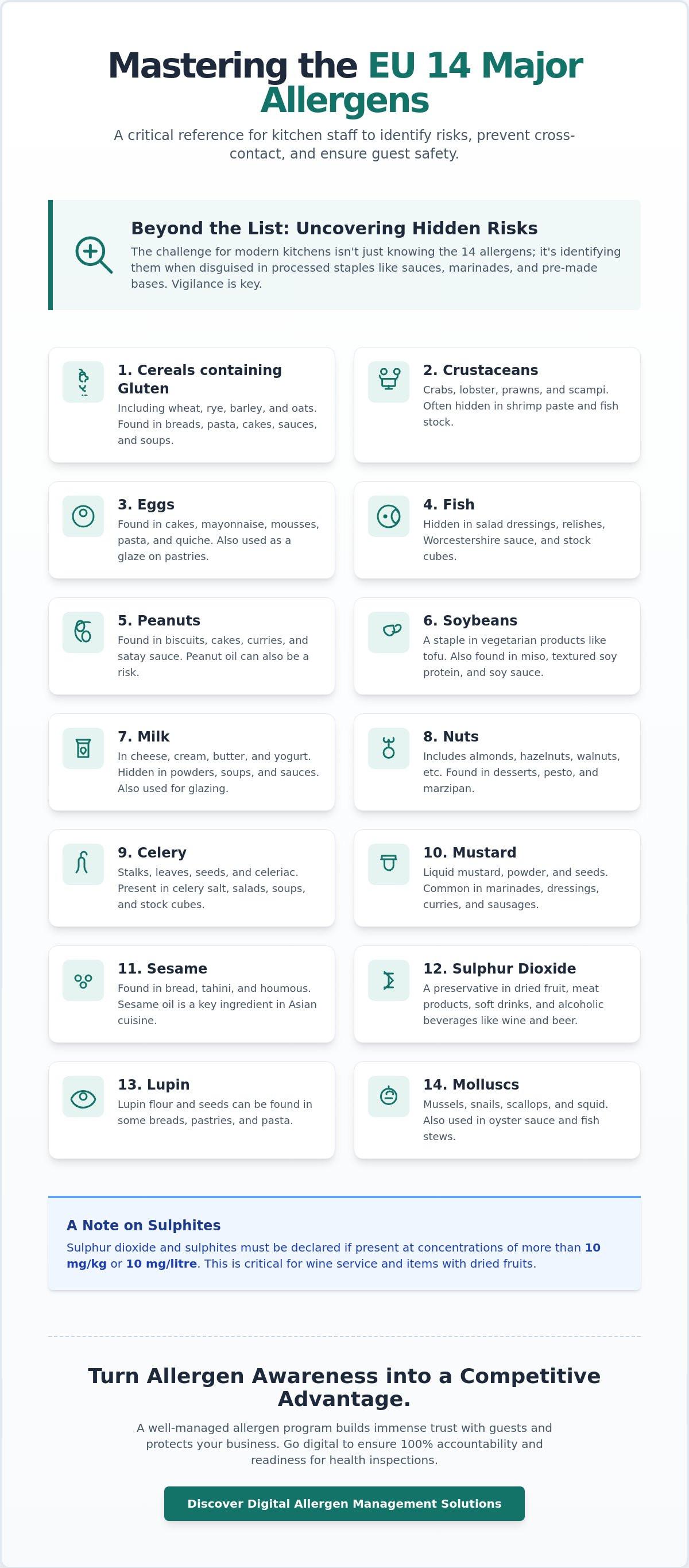
Your staff must be fluent in the 14 allergens mandated by EU Regulation 1169/2011. This list includes cereals containing gluten, crustaceans, eggs, fish, peanuts, soybeans, and milk. While these are common, several others are frequently overlooked during high-pressure service. Celery, mustard, sesame seeds, and lupin (often found in flour) require equal vigilance. Molluscs, such as snails or mussels, are particularly relevant in Luxembourg's culinary landscape. Additionally, sulphur dioxide and sulphites must be monitored at concentrations above 10mg/kg or 10mg/litre, making them a critical consideration for wine service and dried fruit preparations.
Global standards are tightening in response to rising allergy rates. For example, the rigorous Massachusetts food allergen regulations highlight a growing international trend toward mandatory staff education and clear menu labeling. In Luxembourg, meeting these expectations requires more than a poster on the wall. It requires a systematic approach to ingredient verification that leaves no room for assumptions.
Hidden Ingredients and Label Reading
The most dangerous allergens are often the ones you cannot see. Professional kitchen staples like bouillon bases, spice blends, and pre-made sauces frequently contain "hidden" allergens such as soy, celery, or gluten. Natural flavorings can also be a source of concern. A common mistake is assuming that a product's composition remains static. Manufacturers often change recipes or production lines without prominent notice. This makes it vital to check the label of every delivery, regardless of how long you've used a specific brand.
Handling "may contain" statements requires a clear communication protocol. These precautionary labels indicate a risk of cross-contact at the manufacturing level. When a guest discloses an allergy, your team should be trained to provide this information transparently. If a customer requests information on a non-regulated allergen, such as kiwi or strawberries, your process should remain the same. Using a digital Allergen Management Tool allows your team to access up-to-date ingredient data instantly, ensuring that the information shared with a guest is always accurate and verified.
Establishing a strict protocol for new products is essential. Before any new ingredient enters the pantry, it must be vetted against your existing records. This proactive stance prevents accidental exposure and reinforces the integrity of your safety culture. By mastering the nuances of the EU 14 and the complexities of modern food labeling, your team moves from basic compliance to true expertise.
Designing a High-Impact Allergen Training Program for Kitchen Teams
Effective education in a professional kitchen is not a one-time lecture. It is a continuous process of verification and empowerment that ensures every team member understands their specific role in protecting the guest. To be successful, your restaurant allergen management plan must move beyond generic advice and provide role-specific instructions that can be executed under the pressure of a busy service. A structured training program reduces the risk of human error and builds a culture where safety is a shared priority rather than a managerial burden.
Role-Specific Training Strategies
Front-of-house (FOH) and back-of-house (BOH) teams face different challenges, so their training should reflect their daily realities. For FOH staff, training must focus on the art of the allergen conversation. They are the first line of defense. They need to know how to ask the right questions, listen for specific disclosures, and communicate those needs to the kitchen with absolute clarity. They don't need to be biochemists, but they must be experts in your menu's specific risks.
For the BOH team, the focus shifts to execution. Training here centers on safe preparation and the physical prevention of cross-contact. Managers, meanwhile, require a higher level of oversight. They must be trained in emergency response planning and the meticulous maintenance of documentation. While Luxembourg adheres to EU standards, looking at global benchmarks such as the ServSafe Allergen Training Regulations can provide a framework for structuring your internal curriculum to meet international best practices.
Pedagogical Best Practices for Kitchens
Long training sessions rarely work in the hospitality industry. Instead, utilize "toolbox talks"-short, five-minute briefings held before a shift to keep safety top-of-mind. These sessions are ideal for highlighting a new ingredient or reviewing a specific protocol. Because Luxembourg's workforce is famously diverse, leveraging multi-lingual resources is essential. Providing training materials in French, German, Portuguese, and English ensures that language barriers don't become safety hazards.
Active learning is far more effective than passive reading. Use "What If" scenarios to test staff readiness during quiet periods. For example, ask a server, "What if a guest tells you they have a lupin allergy but the kitchen is currently out of the gluten-free bread?" These exercises reveal gaps in knowledge before they become real-world mistakes. By implementing regular, bite-sized knowledge checks, you ensure that allergen awareness remains a living part of your operations, not just a forgotten module in an onboarding folder.
Operationalizing Awareness: Preventing Cross-Contact in the Kitchen
A comprehensive restaurant allergen management plan is only as effective as the physical protocols that support it. While your team may understand the theory of the EU 14, the daily reality of a high-volume kitchen requires rigorous operational discipline. The most critical distinction your staff must master is the difference between cross-contamination and cross-contact. While cross-contamination refers to the spread of bacteria that can often be "cooked out," cross-contact involves the transfer of proteins. These proteins remain dangerous regardless of cooking temperature. Even a microscopic trace can trigger a life-threatening reaction.
Operational Protocols for Cross-Contact Prevention
Preventing cross-contact requires a combination of dedicated equipment and strict behavioral habits. Many professional kitchens in Luxembourg now utilize color-coded systems; purple is the industry standard for allergen-safe cutting boards, knives, and tongs. This visual cue provides an immediate layer of protection during a busy service. Beyond equipment, your protocols must mandate specific actions for every "allergy" ticket that enters the system.
- Handwashing: Staff must wash their hands and change gloves before preparing an allergen-specific order.
- Dedicated Zones: If space permits, establish a permanent allergen-safe prep area that is thoroughly sanitized between uses.
- Sealed Storage: Store high-risk ingredients, such as flour or crushed nuts, in sealed containers on lower shelves to prevent accidental spills or airborne dust from reaching other components.
The "Golden Rule" of kitchen communication is that an allergen order never moves in silence. The server must verbally confirm the allergy with the chef, and the chef must acknowledge the specific requirements before a single ingredient is touched. This verbal handshake ensures that the entire line is aware of the heightened risk.
The Importance of the Allergen Matrix
Precision requires a single source of truth. Every kitchen needs a dynamic, updated allergen matrix that serves as a quick-reference guide for both the BOH and FOH teams. This document lists every menu item against the 14 major allergens, leaving no room for guesswork. You can learn more about creating an accurate allergen matrix to ensure your staff has the tools they need for instant verification.
Before any plate leaves the kitchen pass, a final verification step is essential. The expeditor or head chef should double-check the order against the matrix and the original ticket. This final "eyes-on" moment is your last opportunity to catch a mistake. To streamline this process and ensure your data is always current, consider implementing a digital Allergen Management Tool. Transitioning to a digital-first approach eliminates the risk of outdated paper charts and provides your team with the confidence to handle complex dietary requests with total accuracy.
Digitizing Training Records for Total Inspection Readiness
The final pillar of a resilient restaurant allergen management plan is the ability to prove your team's competence at a moment's notice. While the previous sections focused on the physical and pedagogical aspects of safety, this section addresses the administrative burden of compliance. In a professional kitchen, action without documentation is a significant legal risk. If you cannot produce a clear record of who was trained, when they were trained, and what they learned, your operational safety remains an unverified claim in the eyes of the law.
Paper logs are a liability. They rely on manual signatures that are often illegible, easily lost, or, in the worst cases, backdated during a moment of panic before an audit. This "paper trail" often fails during a surprise inspection by the ALVA. Digital platforms replace this uncertainty with 100% accountability. By moving your records to a cloud-based system, you gain real-time oversight across all your sites. You no longer have to wonder if the night shift in a secondary location completed their allergen briefing; you can see the timestamped confirmation on your dashboard instantly.
The Benefits of Digital Documentation
Digital records offer a level of proactive vigilance that paper simply cannot match. Automated reminders ensure that training renewals never slip through the cracks. When a staff member's initial allergen awareness certificate is nearing its expiration, the system flags it, allowing you to schedule a refresher before a gap in compliance occurs. This centralized approach also provides staff with instant access to Standard Operating Procedures (SOPs) via their mobile devices, ensuring the latest safety protocols are always in their pockets.
During a national health inspection, the ability to produce digital proof of training changes the dynamic of the visit. Instead of scrambling through overstuffed binders, you can present a clean, organized report. This transparency demonstrates to inspectors that your business values precision and is one step ahead of regulatory requirements. It transforms a high-stress event into a routine verification of your existing excellence.
Implementing a Modern Safety System
Integrating allergen oversight into your daily workflow shouldn't feel like an additional chore. This is why your kitchen needs digital food safety checklists in 2026. By embedding allergen alerts directly into your digital HACCP workflow, you ensure that safety checks are performed as part of the natural rhythm of the kitchen. Every time a chef opens a checklist for a specific station, the system can prompt a reminder of the allergen-safe zones established in your restaurant allergen management plan.
SafeBite streamlines this entire process by consolidating allergen management and staff oversight into a single, intuitive interface. Our Allergen Management Tool and Multi-site Management Dashboard allow owners to monitor compliance levels across multiple locations from a single screen. You don't just hope your team is following the rules; you have the data to prove it. This digital-first culture of continuous verification protects your guests, your staff, and the long-term viability of your brand.
Future-Proofing Your Food Safety Operations
Mastering allergen awareness is a journey from basic compliance to operational excellence. By focusing on the nuances of the EU 14 and implementing role-specific training, you protect both your guests and your professional reputation. A rigorous restaurant allergen management plan ensures that every team member, from the kitchen pass to the dining floor, acts with precision and proactive vigilance. Moving away from fragmented paper logs toward a unified digital system is the final step in securing your business against regulatory risks and human error.
Ready to modernize your safety protocols? Discover how SafeBite simplifies allergen management and staff training logs through automated allergen alerts and digital record management. Our platform is designed specifically for the unique needs of Luxembourg businesses, ensuring national compliance readiness with every service. You have the tools to build a safer, more efficient kitchen. We're here to help you deploy them with confidence.
Frequently Asked Questions
Is food allergen training mandatory for all restaurant staff in Luxembourg?
Food allergen training is a legal requirement for all staff involved in food preparation and service under EU Regulation 1169/2011. In Luxembourg, the ALVA expects businesses to demonstrate that employees understand allergen risks as part of their HACCP obligations. While the level of detail varies by role, everyone must be able to provide accurate information to guests. This ensures your restaurant allergen management plan remains legally sound and operationally safe.
How often should staff receive allergen awareness refresher training?
We recommend providing allergen awareness refresher training at least once every 12 months to maintain high safety standards. However, you should conduct immediate briefings whenever you introduce new menu items or change ingredient suppliers. High staff turnover also necessitates a continuous onboarding process for new hires. Regular "toolbox talks" help keep these critical protocols fresh in the minds of both front and back-of-house teams without overwhelming them.
What are the 14 allergens that must be declared under EU law?
EU law identifies 14 major allergens: cereals containing gluten, crustaceans, eggs, fish, and peanuts. The list continues with soybeans, milk, nuts, celery, mustard, and sesame seeds. Finally, you must declare sulphur dioxide or sulphites at concentrations above 10mg/kg, lupin, and molluscs. Your team must be able to identify these ingredients in all menu items, including hidden sources like stocks, dressings, or pre-made spice blends that arrive from external suppliers.
How should servers handle a customer who mentions a non-standard allergy?
Servers should treat non-standard allergies, such as kiwi or strawberries, with the same level of caution as the EU 14. While these aren't legally mandated for menu declarations, your Duty of Care requires you to provide accurate information upon request. The server must consult the chef and verify every ingredient in the dish before confirming safety. If the kitchen can't guarantee a safe meal, the staff must inform the guest transparently and suggest alternatives.
What is the difference between cross-contamination and cross-contact?
Cross-contamination refers to the transfer of bacteria, which can often be neutralized by thorough cooking. In contrast, cross-contact occurs when an allergen protein is transferred from one food or surface to another. Cooking doesn't remove these proteins. This distinction is vital for your restaurant allergen management plan, as even trace amounts of a protein can cause a severe reaction. Prevention requires dedicated equipment and strict sanitization protocols that go beyond standard hygiene practices.
How can I maintain accurate training records for a health inspection?
Maintaining accurate records is easiest when you utilize digital training logs that provide timestamped proof of completion. National health inspectors in Luxembourg look for verifiable evidence that your team has received up-to-date instruction. Move away from paper binders that are easily lost or damaged during a busy shift. Digital dashboards allow you to present a clean, organized report that demonstrates 100% accountability across all operational sites instantly during an unannounced audit.
Can digital tools replace traditional allergen training certificates?
Digital tools complement official certificates by providing a record of ongoing internal training and daily compliance. While formal certification proves a baseline of knowledge, digital platforms track the practical application of that knowledge in the kitchen. They offer real-time monitoring of who has completed their shift-specific allergen checks. This level of detail provides a more comprehensive view of your safety culture than a single, static certificate hanging in a manager's office.
What should staff do if they suspect a customer is having an allergic reaction?
Staff must call emergency services immediately by dialing 112 if they suspect a customer is experiencing anaphylaxis. They shouldn't move the guest and should ask if the individual carries an adrenaline auto-injector. One team member must stay with the guest while another clears a path for paramedics and meets them at the entrance. Every second counts. Your emergency response plan should be clearly documented and practiced regularly during monthly staff safety meetings.