

A paper allergen list is no longer a safety tool; it's a liability waiting to happen. As international regulations tighten and food allergy awareness reaches new heights, the margin for error in a professional kitchen has effectively vanished. You likely feel the constant pressure of supplier substitutions that change your ingredient profiles overnight, or the lingering dread of a hidden allergen lurking in a complex reduction. Creating an accurate allergen matrix shouldn't feel like a high-stakes guessing game that consumes your limited operational time.
We recognize that you need 100% confidence during health inspections and the absolute certainty that every plate served is safe. This definitive 2026 guide provides the roadmap to mastering a compliant, audit-ready system that evolves alongside your menu. You'll learn how to move away from chaotic manual records toward a streamlined digital process that ensures zero incidents of allergen cross-contact. We'll explore the essential steps to building a live ecosystem that provides regulatory peace of mind and protects your guests with every order.
Key Takeaways
- Understand the direct link between documentation accuracy and guest safety within the evolving regulatory landscape of Luxembourg.
- Learn to identify hidden sub-allergens in processed ingredients by standardizing your supplier specification collection process.
- Master a structured, step-by-step methodology for creating an accurate allergen matrix that remains audit-ready despite frequent menu changes.
- Compare the risks of manual spreadsheets against the efficiency of real-time digital synchronization for handling supplier substitutions.
- Discover how to centralize allergen data across multi-site operations to maintain uniform safety standards and eliminate manual update errors.
The High Stakes of Allergen Accuracy: Why a Matrix is Mandatory
An allergen matrix is a centralized repository of ingredient data that maps every dish on a menu against the 14 mandatory allergens. It provides a visual, easy-to-read reference that ensures staff can communicate ingredient safety to guests with absolute precision. By creating an accurate allergen matrix, food businesses move beyond guesswork, establishing a single source of truth that protects both the consumer and the establishment.
The connection between documentation and safety is absolute. When a kitchen relies on memory or fragmented notes, the risk of a life-threatening error increases. For a comprehensive overview of food allergies, it's clear that even trace amounts of a substance can trigger severe reactions. A professional matrix removes the burden of memorization from your team. This reduction in staff anxiety leads to a more focused, efficient service where servers can answer guest inquiries instantly and confidently. It transforms a high-pressure safety requirement into a streamlined operational advantage.
The Legal Landscape and National Standards
In Luxembourg, compliance is governed by strict EU regulations that mandate the clear disclosure of 14 specific allergens, including celery, gluten, lupin, and molluscs. Local authorities now expect more than just a list; they require a verifiable system. As we move through 2026, the shift toward digital proof of compliance has become the industry standard. Inspections are increasingly focused on how quickly and accurately a business can produce its data. Relying on outdated folders is no longer sufficient for modern regulatory expectations in the LU market.
The Operational Risks of Approximate Data
Approximate data is often more dangerous than no data at all. "Hidden" allergens frequently enter kitchens through pre-made sauces, stocks, or spice blends where sub-ingredients aren't immediately obvious. If your process for creating an accurate allergen matrix doesn't account for these deep-level ingredients, you remain vulnerable to non-compliance. A single incident can result in significant financial penalties and irreversible reputational damage. Furthermore, managing "may contain" warnings requires a proactive strategy. These labels shouldn't be ignored; they must be integrated into your management system to ensure that cross-contact risks are communicated transparently to every guest who walks through your doors.
The Structural Components of a Professional Allergen Matrix
A professional matrix is more than a list; it's a logical grid that translates complex recipe data into actionable safety information. When creating an accurate allergen matrix, you must build a structure that accounts for every component of a dish, from the primary protein to the smallest garnish. This grid serves as the bridge between the kitchen's technical execution and the front-of-house team's communication with guests.
Standardizing terminology is essential for operational fluidity. If the kitchen refers to "wheat" while the service team looks for "gluten," the risk of miscommunication rises. Your matrix should use clear, bold icons or standardized text that leaves no room for interpretation. Integrating cross-contact warnings directly into the structure is also vital. Rather than treating "may contain" risks as footnotes, they should be clearly visible within the grid to ensure staff can provide transparent advice to diners with severe sensitivities.
Mapping the 14 Mandatory Allergens
While most teams are vigilant about gluten, dairy, and nuts, compliance often falters with less common requirements. Under EU and Luxembourgish standards, you must track 14 specific allergens. This includes often overlooked items like Lupine (frequently found in flour blends), molluscs, and sulfur dioxide used in preserved fruits or wine. For those looking to align with international safety benchmarks, referencing FDA guidelines on food allergens provides a solid foundation for understanding major triggers and labeling best practices. Using a visual legend with distinct colors or symbols accelerates staff recognition during busy service periods.
Managing Hidden Ingredients and Compound Products
The greatest threat to accuracy lies in compound products. Pre-made stocks, curry pastes, and spice blends often contain "secret" ingredients that don't appear in the dish's title. To maintain the integrity of your records, you must deconstruct supplier specification sheets and map every sub-ingredient. This is where manual systems often fail, as a single supplier change can invalidate an entire menu's data. Utilizing a dedicated allergen management tool allows you to update these components centrally, ensuring that when a base ingredient changes, every linked recipe updates automatically. This proactive approach also helps you address the "hidden 15th" allergen, which refers to those unique customer sensitivities that fall outside the mandatory 14 but still require careful management.
Comparing Manual Spreadsheets vs. Digital Allergen Management
Traditional methods of creating an accurate allergen matrix often rely on Excel spreadsheets or printed binders. While these seem cost-effective initially, they create a dangerous lag between recipe changes and staff awareness. This is the "Paperwork Trap." A static file is outdated the moment a supplier delivers a substitute brand with a slightly different ingredient profile. In a modern kitchen, agility is a safety requirement, not a luxury. Digital management ensures that when a chef updates a single ingredient, that change reflects across every terminal and handheld device in the building instantly. It's a proactive shield against human error.
Effective Allergen Management in Commercial Kitchens requires absolute version control. With paper records, there's no guarantee that a server isn't looking at a version from three months ago. Digital systems eliminate this risk by providing a single, synchronized source of truth. Precision matters. Accessibility at the point of service means front-of-house teams can answer guest questions without running back to a dusty office binder. This transparency builds trust. It significantly reduces the chance of a miscommunication during peak hours when the kitchen is at its loudest.
The Hidden Costs of Manual Tracking
Manual tracking carries significant invisible expenses. Managers often spend hours re-typing data or re-printing logs whenever a menu item evolves. Beyond the labor cost, the risk of transcription errors is high. A single missed checkbox can lead to a serious incident. There's also the practical reality of the kitchen environment. Paper records degrade quickly when exposed to heat, steam, and spills. This makes them difficult to read and unprofessional during a surprise inspection. Digital records stay clean, legible, and organized.
Advantages of a Centralized Digital Dashboard
A centralized digital dashboard offers proactive oversight that manual files can't match. You can set automated alerts that trigger whenever a high-risk ingredient is added to a standardized recipe. This oversight is crucial for staying aligned with Luxembourg food safety regulations, which demand rigorous, up-to-date documentation. By creating an accurate allergen matrix within a digital ecosystem, you ensure your business remains compliant and audit-ready. Most importantly, you keep your guests safe. Real-time synchronization handles last-minute supplier substitutions without the stress of manual updates.
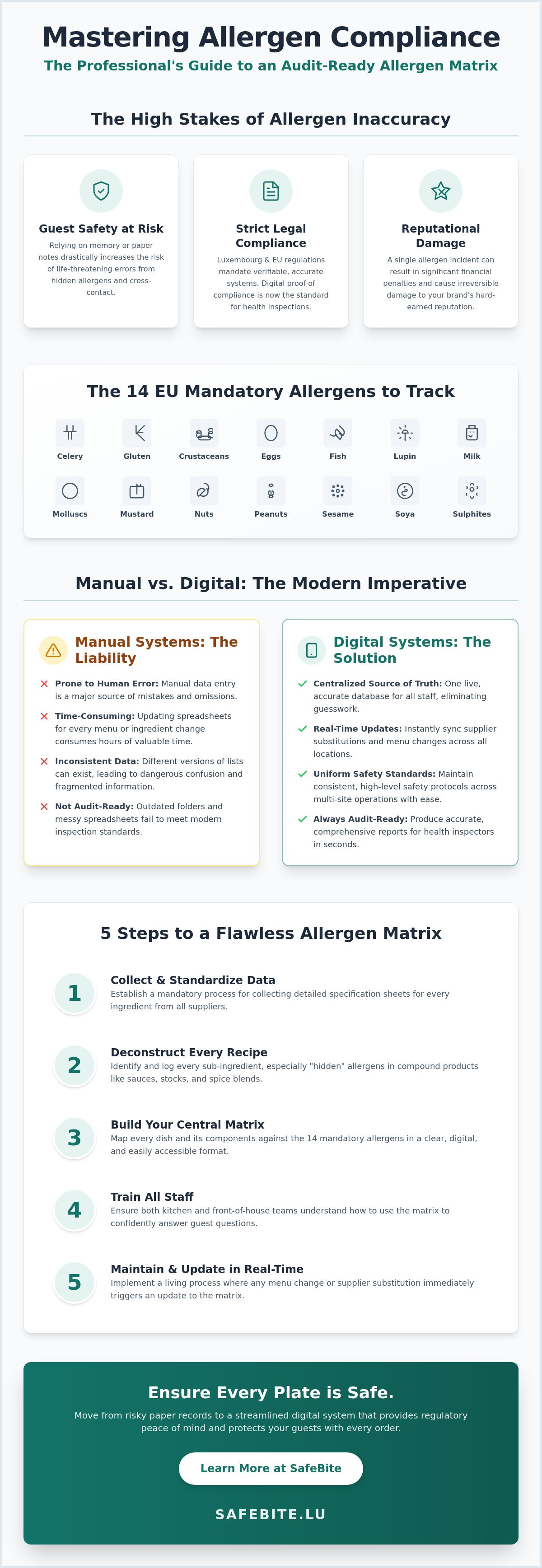
Step-by-Step Guide: Creating an Accurate Allergen Matrix
Mastering the process of creating an accurate allergen matrix requires a disciplined, sequential approach. It isn't a one-time task but a professional standard that demands ongoing precision. By following a structured workflow, you move from reactive guessing to proactive control. This ensures that your kitchen remains a safe environment for every guest, regardless of the complexity of your menu.
To win the featured snippet and establish a gold-standard workflow, follow these five essential steps:
- Audit Raw Ingredients: Collect up-to-date supplier specification sheets for every item in your inventory.
- Standardize Recipes: Document every ingredient and sub-component to eliminate "off-book" variations by kitchen staff.
- Map Mandatory Allergens: Cross-reference every recipe against the 14 mandatory allergens on a centralized digital grid.
- Verify Accuracy: Conduct a double-blind verification cycle to ensure the physical dish matches the documented record.
- Implement Digital Controls: Transition to a real-time management tool to automate updates and facilitate staff training.
Ingredient Auditing and Supplier Verification
Phase 1 begins with the raw data. You must establish a protocol for checking every delivery against your existing records. It's common for suppliers to send substitute brands when their primary stock is low. These substitutes often carry different allergen profiles. By utilizing restaurant food safety software, you can track these batches and receive immediate alerts if a specification changes. This prevents high-risk ingredients from entering the prep cycle unnoticed.
Establishing a Verification Cycle
The most critical, yet often overlooked, phase is the verification cycle. "Recipe drift" occurs when chefs slowly alter a dish's preparation over time without updating the documentation. To combat this, set a monthly "Matrix Audit" to catch these discrepancies before they become a liability. Validating the matrix against actual kitchen practices involves observing live prep and checking open containers. Documenting this verification process is essential. It provides health inspectors with clear, chronological evidence of your proactive vigilance and commitment to safety standards. If you want to eliminate the stress of manual updates, discover how our allergen management tool simplifies compliance.
Finally, Phase 4 focuses on digital integration. Training your staff on how to access and interpret the matrix is just as important as the data itself. When the front-of-house team can provide instant, accurate answers at the point of service, guest confidence increases. This seamless flow of information is the ultimate goal of creating an accurate allergen matrix in a modern, professional kitchen.
Optimizing Allergen Workflows with SafeBite’s Digital Platform
Moving from a manual system to a digital ecosystem represents a fundamental shift in operational safety. While the previous sections outlined the structural requirements for creating an accurate allergen matrix, the SafeBite platform provides the engine to maintain those standards without the administrative burden. It centralizes multi-site allergen data, ensuring that a recipe update at one location is instantly reflected across all your other sites. This consistency eliminates the risk of "safety silos" where different branches operate under conflicting ingredient information.
The platform automates the transition from fragmented paper records to integrated digital food safety checklists. By embedding allergen verification into daily routines, safety becomes a byproduct of the workflow rather than an additional task. Real-time alerts notify kitchen staff during prep if a high-risk ingredient is introduced, providing a proactive safety net that manual binders simply cannot offer. It's a disciplined approach to precision that protects your guests and your brand reputation simultaneously.
Inspection Readiness and Digital Proof
When an inspector walks through the door, the time for searching through binders is over. SafeBite allows you to generate instant, comprehensive allergen reports that demonstrate full compliance with national standards. Guided digital entry reduces human error by forcing a standardized verification process during the initial data input. This ensures the matrix remains the "Single Version of Truth" for the entire organization. You no longer have to worry about whether the front-of-house team is using an outdated printout; the most current data is always at their fingertips.
Scalable Solutions for Growing Hospitality Brands
For hospitality groups looking to expand, scalability is often the biggest hurdle to safety. SafeBite solves this by synchronizing menu changes across multiple locations instantly. You can manage complex ingredient profiles from a central dashboard while providing customizable views for different kitchen roles. A sous-chef sees technical prep requirements, while a server sees clear, icon-based allergen warnings. This level of proactive vigilance keeps you one step ahead of evolving national regulations. Creating an accurate allergen matrix becomes a streamlined, friction-free process that supports your growth instead of slowing it down. The result is a professional, audit-ready kitchen that operates with quiet confidence and absolute transparency.
Future-Proofing Your Kitchen Through Digital Precision
The transition from static paper records to a dynamic digital ecosystem is the most significant step you can take toward operational excellence. By mastering the process of creating an accurate allergen matrix, you protect your guests from hidden risks while shielding your business from regulatory penalties. You've seen how recipe standardization and rigorous supplier verification form the foundation of a safe kitchen. Now, the focus shifts to maintaining those standards without the constant burden of manual updates.
True safety requires a system that is as fast as your service. SafeBite provides the tools you need to stay ahead of the curve through automated allergen alerts and inspection-ready digital reporting. Our platform is specifically designed for Luxembourg hospitality compliance, ensuring your records are always precise and audit-ready. Digitize your allergen management with SafeBite today and experience the confidence that comes with absolute control. Your team deserves the peace of mind that only professional precision can provide.
Frequently Asked Questions
What are the 14 mandatory allergens I must include in my matrix?
The 14 mandatory allergens you must track include celery, cereals containing gluten, crustaceans, eggs, fish, lupin, milk, molluscs, mustard, nuts, peanuts, sesame seeds, soya, and sulphur dioxide. These specific categories are defined by EU and Luxembourgish regulations and must be clearly disclosed for every menu item. Failure to document even one of these can lead to non-compliance during a health inspection.
How often should I update my allergen matrix?
You should update your matrix immediately whenever a recipe is modified or a supplier substitutes an ingredient. While real-time updates are the professional standard, we recommend conducting a formal monthly audit to catch any "recipe drift" that might have occurred. This proactive approach ensures your documentation reflects the actual ingredients currently in your kitchen stores.
Is a digital allergen matrix legally accepted in Luxembourg?
Digital allergen records are fully recognized and accepted by Luxembourgish health authorities. Inspectors often prefer digital formats because they provide a clear, legible, and searchable audit trail that paper binders lack. The primary requirement is that the information remains instantly accessible to both your staff and your guests at the point of service.
What happens if a supplier changes an ingredient without telling me?
Undisclosed supplier changes are a significant operational risk that you must manage through a strict goods-in protocol. Your team should verify the allergen labels on every delivery against your current specification sheets. Using a digital management tool allows you to update these changes centrally, instantly pushing the new safety data to all kitchen and service terminals.
How do I handle "may contain" traces on my allergen matrix?
You should include "may contain" information as a distinct category or with a specific visual indicator on your grid. While these aren't intentional ingredients, disclosing potential cross-contact is vital for guests with high sensitivity. This level of transparency builds trust and ensures that your front-of-house team can provide accurate, life-saving advice to diners.
Do I need a separate matrix for seasonal or daily specials?
Every dish served requires full documentation, which means creating an accurate allergen matrix for seasonal items and daily specials is mandatory. You cannot skip this step for temporary menu additions. Digital platforms simplify this by allowing you to quickly map ingredients from your existing database to new recipes, ensuring safety standards remain consistent.
How can I ensure my staff actually uses the allergen matrix correctly?
Accessibility is the key to ensuring your staff utilizes the data. If the information is hidden in a bulky binder, it will be ignored during a busy service. By using digital displays or tablets in the kitchen and service areas, you make safety data a natural part of the workflow. Regular, concise training sessions help reinforce the importance of precision in guest communication.
Can I use a template for my allergen matrix, or must I build it from scratch?
While you can start with a basic template, creating an accurate allergen matrix usually requires a more specialized, dynamic tool. Static templates often fail to account for complex sub-ingredients or last-minute supplier changes. A professional digital solution provides the necessary structure to keep your records audit-ready and synchronized across multiple sites without the risk of manual entry errors.