Did you know the U.S. restaurant industry spends over $162 billion every year on food that ends up in the trash? You've likely felt the weight of those losses when reviewing your inventory or preparing for a high-stakes health inspection. It's frustrating to watch your food cost percentage climb because of inconsistent temperature checks or staff who struggle to follow FIFO protocols. Learning how to reduce food spoilage in restaurants is no longer just about saving pennies; it's about maintaining a modern, compliant, and efficient operation.
This guide will show you how to master the strategies needed to eliminate waste by transitioning from manual logs to a proactive, digital waste management plan. You'll gain total control over your kitchen's efficiency and ensure your documentation is always inspection-ready. We'll explore modern methods to ensure regulatory compliance with current 2026 standards, reduce human error through automation, and build a structured system that protects both your reputation and your bottom line.
Key Takeaways
- Identify the hidden economic impact of waste, including energy and disposal fees, while staying ahead of 2026's stricter organic recycling regulations.
- Master advanced inventory oversight and precision temperature controls to understand exactly how to reduce food spoilage in restaurants.
- Eliminate 'ghost logging' and human error by transitioning from inconsistent manual records to automated digital tracking systems.
- Implement a structured, two-section waste management template designed to streamline inventory receiving and daily monitoring procedures.
- Leverage real-time alerts and digital HACCP checklists to intervene proactively before inventory reaches critical spoilage thresholds.
The Economic and Regulatory Impact of Food Spoilage in 2026
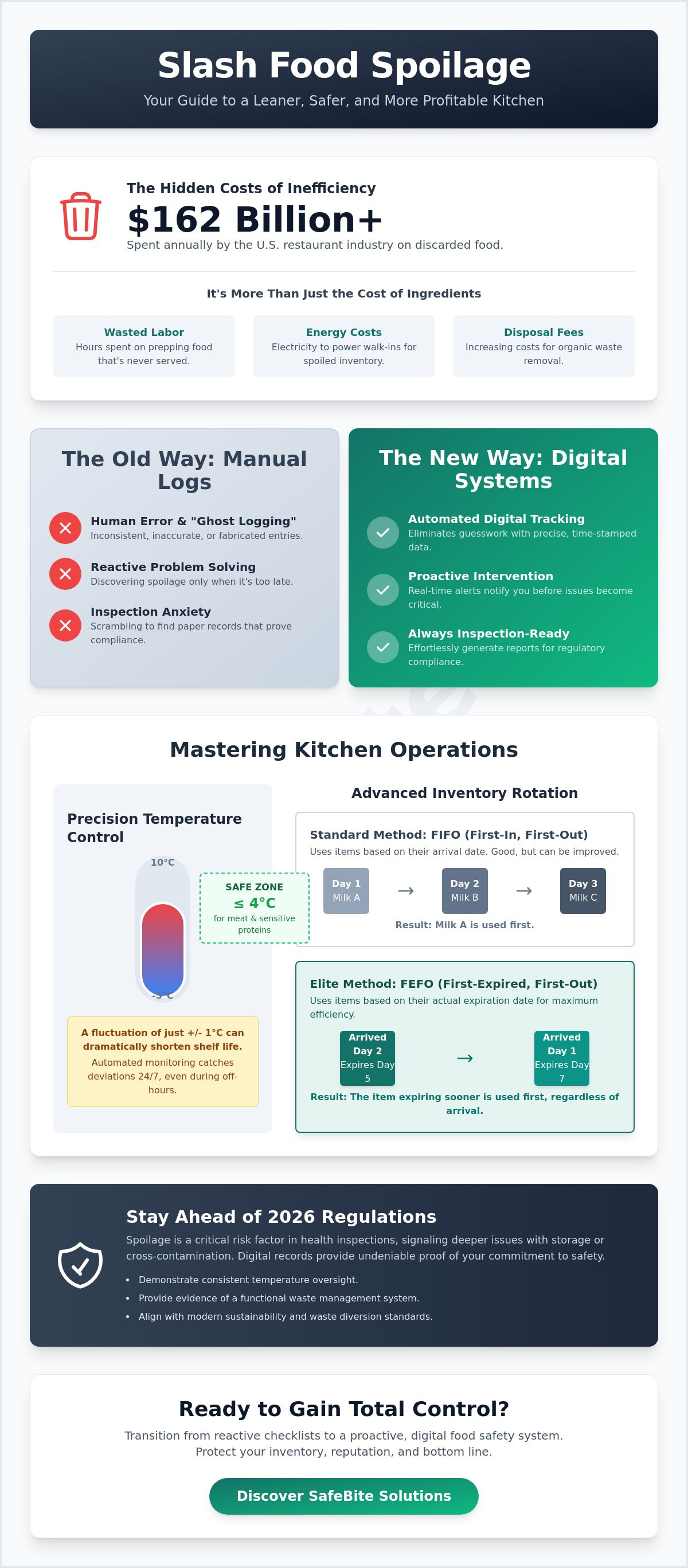
Financial losses in the hospitality sector often stem from invisible inefficiencies. While most operators track their cost of goods sold, many overlook the secondary expenses associated with inventory that never reaches a plate. When food spoils, you aren't just losing the raw ingredient price; you're losing the labor hours spent on prep, the energy used to power walk-ins, and the increasing fees for organic waste disposal. According to global food waste statistics, the scale of this issue is immense, with global costs projected to reach $540 billion in 2026 alone. Understanding how to reduce food spoilage in restaurants is therefore a financial imperative that protects your margins from these compounding costs.
Spoilage vs. Waste: Identifying the Culprits
Distinguishing between different types of waste is the first step toward operational control. Post-consumer waste, or plate waste, often results from portion sizes or menu design. In contrast, pre-consumer waste, specifically spoilage, is often preventable through better internal systems. Over-ordering remains a primary driver of this cycle, as kitchens often stock surplus inventory to compensate for unpredictable demand. Food spoilage is a failure in the cold chain or inventory rotation. When these systems fail, the resulting loss is a direct hit to your profitability. By categorizing your waste, you can pinpoint whether the issue lies in your ordering habits or your storage protocols.
Compliance and the Luxembourg Food Safety Authority
Regulatory bodies have shifted their focus toward proactive waste management as a marker of kitchen safety. The Luxembourg food safety authority guidelines categorize spoilage as a critical risk factor during inspections. This is because spoilage is rarely an isolated event; it often signals deeper issues with cross-contamination or improper storage temperatures. Maintaining an inspection-ready kitchen requires a disciplined approach to waste reduction that aligns with 2026 sustainability standards. These standards have made waste diversion a legal necessity in many jurisdictions. A restaurant that demonstrates precise control over its inventory rotation not only avoids fines but also builds a reputation for safety and professional excellence. Learning how to reduce food spoilage in restaurants ensures that your business remains compliant while meeting the growing consumer demand for sustainable dining practices.
Precision in your documentation is your best defense against regulatory scrutiny. In 2026, inspectors look for more than just clean surfaces; they look for evidence of a functioning waste management system. Automated records that prove consistent temperature oversight and inventory turnover demonstrate a level of professional vigilance that manual logs simply cannot match. This proactive stance transforms compliance from a stressful hurdle into a seamless part of your daily workflow.
Optimizing Inventory Management and Temperature Controls
Precision is the hallmark of a high-performing kitchen. While most managers understand the basic FIFO (First-In, First-Out) method, true efficiency in 2026 requires a more granular approach. The National Strategy for Reducing Food Loss and Waste emphasizes that systemic changes in handling are vital for long-term sustainability. Transitioning to a First-Expired, First-Out (FEFO) model ensures that high-risk perishables are used based on actual shelf life rather than just arrival dates. This shift is a core component of how to reduce food spoilage in restaurants because it accounts for the variability in supplier handling before the product even reaches your door.
The Cold Chain: Your First Line of Defense
Maintaining the cold chain is a non-negotiable requirement for food safety. Even a minor fluctuation of +/- 1 degree can significantly shorten the shelf life of sensitive proteins and dairy. Meat should be kept at or below 4°C, while certain produce requires slightly higher humidity levels to prevent wilting. The real danger often lies in the "blind spots" that occur during off-hours or holiday closures. A compressor failure at 2:00 AM can lead to thousands of euros in lost stock if it isn't detected immediately. Implementing automated temperature monitoring provides the proactive vigilance needed to catch these deviations before they become catastrophic. It's about moving from reactive crisis management to steady, controlled oversight.
Advanced Stock Rotation Strategies
Organization within your cooling units is just as important as the temperature setting itself. Overcrowding shelves restricts airflow, creating warm pockets where bacteria can thrive. Ensure that items are stored at least six inches off the floor and away from walls to facilitate proper circulation. Beyond physical placement, your labeling protocols must be rigorous. Move beyond simple "date and name" stickers and adopt color-coded systems that allow staff to identify items nearing expiration at a glance. Training your team to recognize early organoleptic signs, such as changes in texture or subtle odors, adds an extra layer of human oversight. This combination of digital precision and staff expertise is the most effective way to understand how to reduce food spoilage in restaurants while maintaining peak quality.
Consider how a Multi-site Management Dashboard could centralize these checks across all your locations, ensuring uniform standards without manual intervention.
Transitioning from Manual Logs to Digital Waste Tracking
Manual paper logs often fail because of a significant psychological barrier. In a fast-paced commercial kitchen, stopping to record a wasted tray of produce feels like an unnecessary chore that slows down the line. This often leads to "ghost logging," where staff fill in missing data at the end of a shift based on hazy memories. It's an inaccurate practice that leaves your business vulnerable to both financial loss and regulatory scrutiny. Digital systems eliminate this friction by providing instant, timestamped entries that ensure data integrity and accountability across the entire team.
Understanding how to reduce food spoilage in restaurants requires more than just a list of rules; it requires actionable data. When you digitize your waste tracking, you gain real-time analytics that turn simple observations into smarter ordering decisions. If your logs consistently show spoilage in the same category every Tuesday, you can adjust your prep levels or order quantities immediately. This proactive oversight is supported by the EPA guide for food services, which highlights that rigorous tracking is the foundation of any successful waste reduction strategy. It's about moving away from guesswork and toward a culture of precision.
Beyond operational efficiency, the environmental ROI of going paperless in 2026 serves as a significant marketing asset. Consumers increasingly value businesses that demonstrate a commitment to sustainability through modern technology. Removing physical binders from the kitchen not only clears physical clutter but also aligns your brand with the precision-driven standards of the modern industry. It's a clear signal to both staff and patrons that your operation values accuracy and resource conservation.
The Failure of Paper-Based HACCP
Traditional paper logs are prone to being lost, stained, or simply ignored during peak service hours. This creates a massive liability during surprise health inspections where missing data can lead to immediate citations. Switching to digital HACCP record keeping ensures that your compliance documentation is always up to date and accessible from any device. It transforms a reactive burden into a steady, automated process that protects your operating license and your reputation.
Choosing Restaurant Food Safety Software
Not all platforms are created equal. When selecting restaurant food safety software, prioritize features like automated alerts, cloud syncing, and multi-site management dashboards. These tools should integrate with your daily workflows rather than adding new layers of complexity. An intuitive interface reduces staff training time and ensures that learning how to reduce food spoilage in restaurants becomes a seamless part of your kitchen's natural rhythm. This technological integration allows your team to focus on culinary excellence while the software handles the complexities of oversight.
A Comprehensive Waste Management Plan Template for Commercial Kitchens
Transitioning from theory to practice requires a structured framework that your team can follow every day. A professional waste management plan provides the necessary oversight to ensure that every ingredient is accounted for from the moment it enters the building. This document serves as the central nervous system of your kitchen operations. It bridges the gap between high-level sustainability goals and the granular reality of daily prep. By following a standardized template, you can master how to reduce food spoilage in restaurants through consistent, repeatable actions.
Your waste management plan should be divided into five critical sections to ensure comprehensive coverage:
- Section 1: Inventory Oversight. Focus on precision during ordering, receiving, and storage. Precision starts at the loading dock.
- Section 2: Monitoring Procedures. Establish the frequency for temperature logs and rotation checks. Consistency here prevents small errors from becoming large losses.
- Section 3: Corrective Actions. Define exactly what happens when a fridge fails or a cold chain is broken. Clear protocols reduce panic and minimize stock loss.
- Section 4: Staff Responsibility Matrix. Detail who is accountable for specific tasks. When everyone is responsible, no one is; clarity in assignments ensures completion.
- Section 5: Review and Audit. Schedule regular intervals to analyze your waste data. Use these insights to refine your ordering and prep levels for the next period.
Drafting Your Waste Policy
Your policy should begin with clear, measurable goals. Aiming to "reduce produce spoilage by 15% in Q3" is far more effective than a vague commitment to "waste less." Establish a waste hierarchy that prioritizes reduction first, followed by reuse, donation, and finally, composting. This hierarchy guides staff decision-making when inventory nears its expiration date. A waste management plan is a living document, not a static folder. It must evolve as your menu changes and your team grows, ensuring it remains relevant to your kitchen's specific needs.
Standard Operating Procedures (SOPs) for Spoilage
Effective SOPs remove the guesswork from inventory management. Your receiving SOP should empower staff to reject sub-standard deliveries immediately if the quality or temperature does not meet your specifications. Similarly, an "End of Shift" inventory sweep ensures that any items nearing their limit are flagged for immediate use the following morning. Integrating these SOPs into digital food safety checklists ensures that these checks are actually performed rather than just initialed on a paper log. This digital integration is the most reliable way to understand how to reduce food spoilage in restaurants while maintaining a high standard of professional vigilance.
Start building your digital infrastructure today with SafeBite’s Digital HACCP Checklists and transform your waste management plan into an automated, inspection-ready system.
Scaling Efficiency with SafeBite’s Digital HACCP Solutions
Implementing a manual waste management plan is a significant first step, but maintaining that momentum across a busy kitchen requires a more robust infrastructure. SafeBite transforms your static document into an active, digital engine that drives daily operations. By digitizing your protocols, you ensure that the strategies for how to reduce food spoilage in restaurants are executed with surgical precision. This transition moves your team away from reactive habit-tracking and toward a model of proactive oversight that scales effortlessly as your business grows.
The core of this efficiency lies in our Temperature Monitoring System. While manual checks only capture a single moment in time, our automated sensors provide continuous data streams. If a walk-in cooler deviates from its set threshold, the system sends real-time alerts to your mobile device immediately. This allows you to intervene and save thousands of euros in inventory before spoilage occurs. For operators managing multiple locations, the Multi-site Management Dashboard centralizes this data. You can monitor compliance across every kitchen from a single interface, ensuring that your high standards are met whether you're on-site or across the country.
Automated Compliance and Peace of Mind
The "binder of doom" is a relic of the past that creates unnecessary friction during busy shifts. SafeBite replaces physical folders with cloud-based documentation that's always organized and ready for the Luxembourg Food Safety Authority. Our Digital HACCP Checklists include smart reminders that keep your staff accountable without the need for constant micromanagement. When a task is missed, the system flags it, allowing you to address the gap before it becomes a compliance risk. This future-proof platform is designed to navigate the 2026 regulatory landscape with ease, providing the calm authority you need to lead a professional kitchen.
Next Steps: Implementation
Modernizing your kitchen shouldn't be a months-long project. You can set up your first digital checklist in under 10 minutes, tailoring the waste management template to your specific menu and storage layout. This customization ensures that the software feels like a natural extension of your team rather than a rigid, third-party requirement. By integrating your SOPs directly into the digital workflow, you provide your staff with the tools they need to succeed while you focus on culinary innovation and guest satisfaction. It's time to move beyond the limitations of paper and embrace a system built for the demands of the modern industry.
Simplify your food safety compliance with SafeBite today.
Securing Your Kitchen’s Future Through Digital Oversight
Mastering how to reduce food spoilage in restaurants is a journey from reactive crisis management to steady, data-driven control. By implementing a structured waste management plan and prioritizing precision temperature management, you protect your margins from the compounding costs of inventory loss. Transitioning away from unreliable manual logs ensures your documentation is always accurate and ready for the Luxembourg Food Safety Authority. This proactive approach doesn't just save money; it builds a culture of excellence and professional vigilance across your entire team.
SafeBite provides the tools you need to maintain this standard effortlessly. With automated real-time temperature alerts and an intuitive multi-site management dashboard, you can oversee your operations with confidence from any location. Our platform is built to ensure national compliance with Luxembourg food safety standards, giving you peace of mind while you focus on culinary innovation. It's time to replace the "binder of doom" with a streamlined, digital system that works as hard as you do.
Start your digital transition and reduce spoilage with SafeBite today and take the first step toward a more efficient, sustainable future.
Frequently Asked Questions
What are the most common causes of food spoilage in restaurants?
Improper temperature control and poor inventory rotation are the primary drivers of preventable loss. Other frequent culprits include over-ordering beyond actual demand and inadequate storage organization that restricts essential airflow. Addressing these systemic root causes is the most effective way to understand how to reduce food spoilage in restaurants while protecting your bottom line.
How does a waste management plan help with HACCP compliance?
A waste management plan provides the documented evidence of monitoring and corrective actions required by HACCP principles. It ensures that every instance of spoilage is recorded, analyzed, and addressed systematically. This structured approach proves to inspectors that your kitchen maintains a proactive stance on food safety rather than just reacting to individual crises.
Can digital temperature monitoring really prevent food spoilage?
Yes, digital monitoring prevents spoilage by providing real-time alerts before temperatures reach the critical danger zone. Unlike manual checks that only occur a few times each day, automated systems catch equipment failures at any hour. This constant vigilance allows you to move stock to a functioning unit before it becomes unsafe for consumption or profit.
What should be included in a restaurant waste management plan template?
A comprehensive template must include inventory oversight protocols, specific monitoring frequencies, and clear corrective action steps for equipment failure. It should also feature a responsibility matrix that assigns specific tasks to individual team members. Finally, include a section for regular data audits to refine your ordering strategies based on historical waste patterns and prep volumes.
How often should a restaurant audit its food waste logs?
Restaurants should perform a weekly review of waste logs to identify immediate trends in spoilage or prep errors. A more detailed monthly audit allows management to adjust ordering volumes and supplier choices based on long-term data. Frequent audits ensure that your waste management strategies remain relevant to your current menu and seasonal volume changes.
Is it better to use manual or digital logs for inventory rotation?
Digital logs are far superior because they eliminate human error and provide timestamped accuracy that manual paper logs lack. Digital systems can send automated reminders to staff when specific items are nearing their expiration date. This ensures that your team follows FIFO or FEFO protocols consistently, even during the most demanding service periods.
How do Luxembourg food safety regulations affect waste management?
Luxembourg regulations require precise documentation of food storage conditions and the safe, recorded disposal of spoiled goods. Authorities often view high levels of spoilage as a signal of poor operational control, which can trigger more frequent or rigorous inspections. Maintaining a digital waste log demonstrates compliance with 2026 standards and a commitment to professional food safety.
What are the benefits of using a digital HACCP checklist for waste tracking?
Using a digital HACCP checklist ensures that waste tracking becomes a mandatory, non-negotiable part of the daily kitchen workflow. These checklists provide instant visibility for management and simplify the reporting process for busy staff members. It's a vital tool for those learning how to reduce food spoilage in restaurants by making accountability both transparent and effortless.