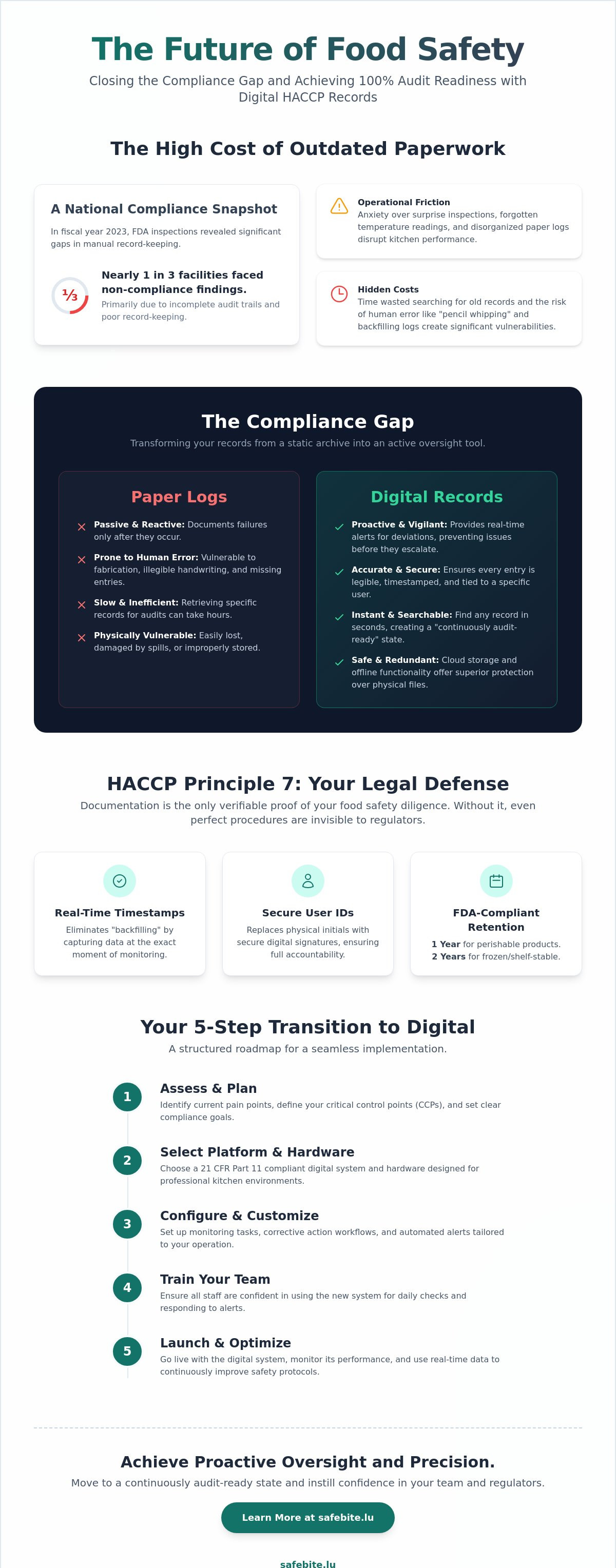
In fiscal year 2023, the FDA conducted 18,539 inspections, and nearly one-third of those facilities faced non-compliance findings largely due to incomplete audit trails and inadequate record keeping. You've likely felt the familiar spike of anxiety during a surprise inspection, wondering if a staff member forgot a temperature reading or if a critical paper log is buried under a stack of invoices. It's a common operational challenge that creates unnecessary friction in an otherwise high-performing kitchen. Maintaining food safety standards shouldn't feel like a constant battle against paperwork.
The transition to digital HACCP record keeping replaces these manual burdens with a system of proactive vigilance and precision. By moving your documentation to a cloud-based environment, you ensure that every entry is legible, timestamped, and fully compliant with 21 CFR Part 11 standards. This guide provides a clear roadmap for replacing cumbersome paper logs with a streamlined digital system that ensures 100% audit readiness and peak kitchen efficiency. We will examine the essential steps for a successful transition, from meeting specific retention requirements for perishable goods to automating your most repetitive safety checks.
Key Takeaways
- Understand why HACCP Principle 7 makes documentation your primary legal defense and how to ensure every safety protocol is verifiable.
- Identify the hidden operational costs of manual logs and how to bridge the compliance gap between paper and modern technology.
- Follow a structured five-step roadmap to implement digital HACCP record keeping while selecting hardware designed for the professional kitchen.
- Learn why cloud redundancy and offline functionality offer superior protection for your records compared to traditional physical storage.
- Discover how automated alerts and real-time dashboards allow you to manage multiple sites with proactive oversight and precision.
Understanding HACCP Principle 7: The Standards for Record-Keeping
Principle 7 serves as the final, essential pillar of the Hazard Analysis and Critical Control Points (HACCP) framework. It requires every food business to maintain documented proof that safety protocols are followed with absolute consistency. Without these records, even the most rigorous safety procedures are invisible to regulators. Documentation serves as the only legal evidence of your food safety diligence. If a foodborne illness investigation occurs, your logs are the primary defense that demonstrates you maintained control over critical limits during every shift.
The evolution of record-keeping requirements in 2026 focuses on real-time accuracy rather than retrospective logging. Traditional paper systems often fail because they rely on memory rather than immediate action. Adopting digital HACCP record keeping ensures that your essential data is captured at the moment of monitoring, creating a transparent and reliable history of your operations. Essential records for any compliant system include:
- Monitoring logs for Critical Control Points (CCPs) such as cook temperatures and cooling times.
- Detailed documentation of corrective actions taken when a deviation occurs.
- Verification reports that prove your monitoring equipment is calibrated and your system is functioning as intended.
What Constitutes a Compliant HACCP Record?
Accuracy is the foundation of compliance. One of the highest risks in food safety is "backfilling" logs, a practice where staff fill in missing data hours or days later. Auditors easily identify these patterns, which often lead to formal warnings. A compliant record must feature precise timestamp accuracy that proves data was collected in real-time. Modern standards also demand secure signature requirements. Moving from physical initials to digital user IDs ensures that every entry is linked to a specific, trained individual. Legally, you must retain these records for at least one year for perishable products and two years for frozen or shelf-stable items to remain compliant with FDA standards.
The Role of Documentation in National Inspections
Inspectors evaluate more than just the numbers on a page; they use your logs to gauge your "culture of safety." When an auditor sees consistent, legible, and timely entries, it projects a sense of proactive vigilance and professional control. Common pitfalls, such as illegible handwriting or missing signatures, suggest a lack of oversight that invites deeper scrutiny. Transitioning to a digital system moves your kitchen to a "continuously audit-ready" state. Instead of scrambling to organize folders during a surprise visit, you can provide a clean, filtered report in seconds. This level of organization instills confidence in the inspector and allows your team to focus on food quality rather than administrative stress.
Paper vs. Digital HACCP Record Keeping: The Compliance Gap
Many professional kitchens still manage their safety protocols using binders filled with stained, curled thermal paper. While this has been the standard for decades, it creates a significant compliance gap that leaves your business vulnerable. Paper records are passive. They don't alert you to a deviation in real-time; they merely document a failure after it's occurred. Transitioning to digital HACCP record keeping transforms your data from a static archive into an active oversight tool that works alongside your team.
The hidden costs of paper extend far beyond the price of printing and physical storage space. The true cost lies in human error and the time lost during regulatory reviews. When an inspector requests a specific cooling log from six months ago, finding it in a physical folder can take hours of stressful searching. In a digital system, that same record is retrievable in seconds. This speed doesn't just save time; it projects a level of professional control that paper simply cannot match. According to the official HACCP guidelines, records must be accessible for review, and digital timestamps provide the gold standard of integrity that inspectors now expect.
The Risk of Manual Entry Errors
Manual entry is often plagued by "pencil whipping," the dangerous practice of staff fabricating temperature readings to save time. Paper logs can't detect if a reading was actually taken or just guessed. Digital systems eliminate this risk by requiring real-time inputs and providing immediate notifications if a check is skipped. This ensures every staff member follows the same standardized format, removing the ambiguity of illegible handwriting or incomplete entries. Implementing digital checklists ensures that your safety standards are met without exception every single day.
Efficiency Gains for Kitchen Managers
For kitchen managers, the shift to digital can reduce administrative hours by up to 50% by automating data collection and report generation. Instead of manually reviewing hundreds of entries, you can view a centralized dashboard that highlights only the exceptions that need your attention. This is particularly valuable for multi-site operators who need oversight across several locations simultaneously. By integrating your records with an automated temperature monitoring system, you remove the burden of manual checks entirely, allowing your team to focus on culinary excellence while the technology handles the vigilance.
How to Implement Digital HACCP Record Keeping in 5 Steps
Transitioning to a modern system requires a methodical approach to ensure no safety data is lost during the shift. It's not just about replacing paper with a screen; it's a strategic move toward proactive vigilance. To move your kitchen into a state of permanent audit readiness, follow these five disciplined steps.
First, audit your current paper-based flow. Review every binder and clipboard to identify your Critical Control Points (CCPs). This audit ensures your new digital structure mirrors the practical realities of your kitchen without leaving gaps in your documentation history. Next, select hardware that can survive the professional kitchen environment. Standard consumer tablets often fail due to heat, moisture, or frequent drops. Invest in IP-rated hardware that withstands spills and can be easily sanitized during a busy shift.
The third step involves customization, followed by comprehensive staff onboarding. Finally, you must execute a parallel run. Don't discard your paper binders immediately. Maintain both systems for at least two weeks to verify that digital HACCP record keeping entries match your physical logs. This period allows you to identify any technical dead zones in your Wi-Fi or areas where staff need additional support before you go 100% paperless.
Customizing Your Digital Checklists
Standard templates rarely cover the unique nuances of a specialized menu. You should move beyond generic lists to create site-specific safety tasks that reflect your actual daily operations. Setting smart reminders is a vital part of this process. These triggers ensure checks happen during peak service hours when manual logs are most likely to be forgotten. Integrating digital food safety checklists for non-CCP tasks, such as opening and closing procedures, creates a comprehensive and friction-free record of all kitchen activity.
Staff Onboarding and Culture Shift
A successful transition depends entirely on your team's buy-in. Focus on the "why" behind the shift, emphasizing how digital tools reduce their administrative burden and protect the business. A simplified UI is essential for kitchens with non-native speakers, as it reduces friction and prevents entry errors. Position the system as a training tool rather than a policing mechanism. When staff see that 100% compliance scores lead to recognition and a smoother workflow, the culture shifts from reluctant logging to genuine, proactive safety management.
Overcoming the #1 Objection: Is Digital Safe Enough for Audits?
The transition from physical binders to a screen often triggers a specific concern: what happens if the technology fails? While paper feels tangible, it's actually incredibly fragile. A single kitchen fire, a burst pipe, or even a misplaced folder can destroy years of compliance history in an instant. In contrast, digital HACCP record keeping utilizes cloud redundancy to ensure your data is stored across multiple secure servers. This means your records aren't just safe; they're indestructible and accessible from any authorized device at any time.
Digital signatures and electronic records carry the same legal weight as their paper counterparts within European food safety frameworks. Regulatory bodies recognize that digital systems offer a higher level of integrity because they prevent retrospective editing. If the internet connection drops during a busy service, professional systems provide offline capabilities. Staff can continue to log temperatures and complete checklists locally on the device. Once the connection is restored, the data syncs automatically to the cloud with the original, accurate timestamps intact. This ensures your operations never stop, even if your Wi-Fi does.
Data Security and Backup Protocols
Protecting your business data requires more than just a password. Modern systems use encrypted storage to shield your safety logs from external threats, ensuring that sensitive operational data remains confidential. Automated backups eliminate the risk of accidental record deletion, a common issue with manual filing systems. This level of technical oversight is essential for ensuring that Luxembourg food safety regulations are met with precision. You don't have to worry about the human factor of filing; the system manages the archive for you. To see how these security layers work in practice, you can explore our digital HACCP tools today.
Presenting Digital Evidence to Inspectors
The true test of any system is the health inspection. When an official enters your kitchen, the goal is to project calm authority. Digital systems allow you to generate one-click PDF reports for any specific date range an inspector requests. Instead of handing over a messy binder, you provide a clean, professional document that includes a full corrective action history. This transparency proves you aren't just recording data; you're actively managing it. Showing an inspector exactly how you responded to a temperature deviation builds immediate trust. It demonstrates a level of proactive management that paper logs simply can't convey, turning a stressful audit into a showcase of your operational excellence.
Streamlining Compliance with SafeBite’s Digital HACCP Platform
SafeBite transforms the complexity of regulatory requirements into a manageable, transparent process. Instead of reacting to problems after they occur, you gain a birds-eye view of your kitchen safety through an intuitive dashboard. This centralized hub allows you to monitor every Critical Control Point across your entire operation in real-time. If a staff member misses a scheduled reading or a refrigerator exceeds its temperature threshold, the system triggers automated alerts immediately. This proactive vigilance ensures that deviations are corrected before they become compliance failures or safety risks.
The platform integrates an Allergen Management Tool directly into the daily digital HACCP record keeping flow. This integration ensures that allergen information is never treated as a separate, forgotten task but as a core component of your safety documentation. For multi-site operators, the Multi-site Management Dashboard provides the essential tools to standardize safety protocols across every location. You can push updates to checklists or review performance reports for any site from a single login. This level of oversight ensures a consistent culture of safety regardless of the size of your enterprise or the number of kitchens you manage.
Features Designed for Professional Kitchens
Operational accountability often suffers during peak service hours when staff are focused on production. SafeBite solves this challenge with smart reminders that keep your team on track without requiring constant micromanagement from leadership. These reminders act as a helpful extension of your management team, prompting action only when it's necessary. Additionally, the Temperature Monitoring System provides continuous oversight of fridge and freezer units. It protects your inventory from costly stock loss by identifying fluctuations before they ruin your product. Centralized allergen matrices update across all digital logs instantly, so your team always has access to the most current and accurate safety data.
Why SafeBite is the Choice for 2026 Compliance
Modern hospitality standards in 2026 demand a level of precision that manual systems simply can't provide. SafeBite is built specifically to meet these evolving requirements, offering a platform that is as technologically savvy as it is rooted in the practical realities of the industry. We provide ongoing support and regular updates to ensure your system remains aligned with the latest regulatory changes and industry best practices. Transitioning to a digital future doesn't have to be an overwhelming hurdle when you have a reliable, expert partner by your side. To see the platform's efficiency and ease of use for yourself, book a demo to see SafeBite in action and take the first step toward a friction-free kitchen.
Securing Your Kitchen’s Future with Digital Precision
The shift from traditional paper binders to a streamlined digital system is more than just a technological upgrade; it's a commitment to operational excellence. By embracing digital HACCP record keeping, you eliminate the vulnerabilities of manual entry and ensure your documentation is always accurate, legible, and secure. You've learned how a structured transition moves your team toward a culture of proactive vigilance, turning the stress of a surprise inspection into a professional showcase of control.
Maintaining high food safety standards shouldn't be a burden that distracts from your culinary craft. With the right tools, your kitchen becomes a model of efficiency where compliance happens automatically in the background. You can generate inspection-ready reports in one click and receive real-time alerts for missed checks, ensuring your business is perfectly aligned with the 2026 regulatory environment. Take control of your documentation and protect your business from the risks of incomplete data. Digitise your HACCP records today with SafeBite and experience the confidence that comes with total audit readiness. Your team is ready for a smarter way to work.
Frequently Asked Questions
What are the legal requirements for documentation and record-keeping in HACCP?
Legal requirements center on HACCP Principle 7, which mandates that businesses provide documented proof of their food safety protocols. For those using electronic systems, regulations such as the FDA's 21 CFR Part 11 establish the standards for trustworthy and reliable digital records. These records must be equivalent to paper logs, featuring secure access controls and unalterable audit trails to ensure data integrity during inspections.
Can I use a tablet for HACCP record keeping instead of paper?
Yes, tablets are an excellent tool for digital HACCP record keeping. However, you shouldn't use standard consumer-grade tablets in a professional kitchen. It's best to select IP-rated hardware that is specifically designed to withstand heat, steam, and accidental spills. These durable devices ensure that your staff can record data accurately in the middle of a busy service without the risk of hardware failure.
How long do I need to keep my digital HACCP records?
The standard legal retention period is at least one year for perishable products and two years for frozen, preserved, or shelf-stable items. Digital systems simplify this requirement by automatically archiving your logs in the cloud. This removes the need for physical storage space and ensures that your historical data remains accessible for auditors even years after the initial entry was recorded.
What happens to my HACCP records if the internet goes out in the kitchen?
Professional digital platforms include offline capabilities to prevent data loss during connectivity issues. When your Wi-Fi drops, the software stores your entries locally on the tablet or device. Once the connection is restored, the system automatically syncs the data to the cloud. This process preserves the original, accurate timestamps, ensuring your compliance history remains continuous and trustworthy for any future audit.
Are digital signatures legally accepted by food safety inspectors?
Digital signatures are widely accepted and often preferred by food safety inspectors in most jurisdictions, including European frameworks. Because digital signatures are linked to unique user IDs and feature secure timestamps, they provide a higher level of accountability than physical initials. This transparency makes it easier for auditors to verify that the person responsible for the check actually performed it at the required time.
How much time can digital record-keeping save my kitchen staff?
Adopting a digital system can reduce administrative tasks for kitchen managers by up to 50%. Automation eliminates the need to print, distribute, and file hundreds of paper logs every month. Instead of spending hours manually reviewing binders for missed entries, managers can use a centralized dashboard to identify exceptions in seconds. This allows the team to refocus their energy on food quality and customer service.
What is the first step to moving from paper HACCP to digital?
The first step is to conduct a comprehensive audit of your current paper-based workflow to identify all Critical Control Points (CCPs). You need a clear understanding of every safety check currently performed to ensure the digital transition captures all necessary data. Once your CCPs are mapped, you can customize your digital checklists to mirror your specific kitchen operations, ensuring a seamless shift for your staff.
Do I need a separate system for allergen management and HACCP logs?
Using an integrated platform is much more efficient than managing separate systems. When your allergen management tools are built directly into your digital HACCP flow, you reduce the risk of oversight and fragmented data. A centralized system provides a single source of truth for all safety protocols, making it easier to maintain compliance and provide a complete picture of your safety culture to inspectors.