
Since the Law of April 2, 2026, officially took effect, the margin for error in your kitchen has effectively vanished. You've likely felt the increased pressure of the new administrative penalty regime, where the Luxembourg Veterinary and Food Administration (ALVA) now holds the power to issue immediate sanctions during a surprise visit. It's exhausting to manage a high-pressure service while worrying if your paper-based records are sufficient to meet the latest Luxembourg food safety authority guidelines.
We understand that the shift from a criminal process to direct administrative fines feels like a weight on your shoulders. This guide is designed to remove that burden by helping you master the current ALVA regulations and streamline your kitchen's compliance through a digital-first approach. You'll gain a clear understanding of the 2026 legal pillars and discover a faster way to document hygiene tasks. By the end of this manual, you'll have a roadmap for stress-free inspection readiness that replaces wasted hours of paperwork with precision and confidence.
Key Takeaways
- Understand the unified role of ALVA and how the 2026 legal framework prioritizes immediate administrative sanctions over lengthy criminal processes.
- Identify the core pillars of the Luxembourg food safety authority guidelines to ensure your establishment meets all mandatory registration and traceability requirements.
- Recognize the operational risks of paper-based HACCP logs and the strategic advantages of transitioning to a digital record-keeping system.
- Utilize a comprehensive inspection checklist covering daily hygiene protocols and precise temperature monitoring to maintain constant audit-readiness.
- Learn how integrating digital checklists and automated monitoring tools can reduce labor hours while significantly improving documentation accuracy.
Navigating the 2026 Luxembourg Food Safety Landscape
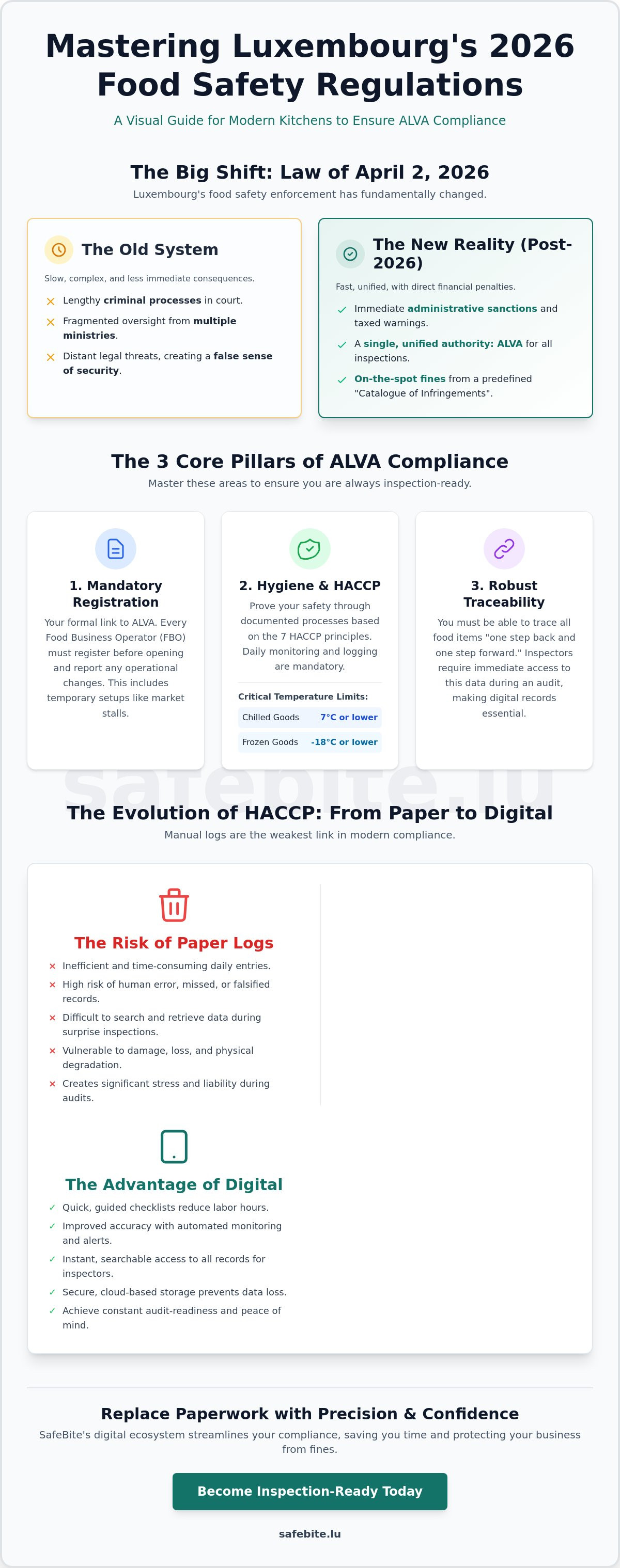
The transition to a unified regulatory environment in the Grand Duchy is now complete. With the Law of April 2, 2026, the Luxembourg Veterinary and Food Administration (ALVA) has moved beyond its initial 2022 setup to become the definitive arbiter of kitchen compliance. This "Single Administration" logic removes the historical confusion of dealing with multiple ministries. Instead, it creates a harmonized system where inspections are more frequent, more consistent, and significantly more rigorous. The margin for error has narrowed as the administration seeks to centralize every data point across the food chain.
This shift is heavily influenced by Regulation (EU) 2017/625. This European mandate dictates exactly how national authorities must conduct official controls to ensure the application of food and feed law. While many international food safety bodies focus primarily on advisory roles, ALVA uses these EU standards to enforce a strict, data-driven oversight model. Operators must realize that the era of negotiating compliance during an inspection has ended. The current Luxembourg food safety authority guidelines prioritize immediate corrective actions and total administrative transparency.
The Role of ALVA in Modern Kitchens
ALVA has successfully consolidated the functions of the former veterinary services and the health directorate. For a modern kitchen manager, this means inspectors now possess broad, cross-functional powers. They can arrive unannounced, access all areas of production, and demand immediate proof of traceability. Because the administration is centralized, your establishment's compliance history is accessible to inspectors in real-time. Maintaining accurate, digital records is the only way to meet the contemporary expectation for high-speed data retrieval during an audit.
Legal Framework and 2026 Updates
The legal foundation rests on the Law of 8 September 2022, but the 2026 updates have introduced a critical change in enforcement. We've seen a move away from the slow-moving criminal court system toward a regime of administrative sanctions. Inspectors now have the authority to issue "taxed warnings" on the spot for specific violations. These are tied to a predefined "Catalogue of Infringements" that leaves little room for subjective interpretation. If an establishment fails to meet the Luxembourg food safety authority guidelines, the penalty is often immediate and financial, replacing the distant legal threats of the past with proactive, administrative accountability.
Core Pillars of the Luxembourg Food Safety Authority Guidelines
Operating a food business in the Grand Duchy requires a disciplined commitment to three primary areas: administrative registration, hygiene management, and robust traceability. These pillars aren't merely suggestions. They form the legal backbone of the Luxembourg food safety authority guidelines. By mastering these requirements, you move from a state of reactive panic to one of proactive readiness.
Mandatory Registration and Administrative Compliance
Every Food Sector Operator (FBO) must register their establishment with ALVA prior to opening. This registration creates a formal link between your business and the regulatory body, allowing for efficient oversight. It's a requirement that extends to every physical location you operate. If your business model changes, such as adding a delivery service or shifting from retail to wholesale, you must notify the authority immediately. This rule also applies to seasonal or temporary setups like Christmas market stalls or summer food festivals. You can access the necessary forms and stay updated on regulatory shifts through Luxembourg's Official Food Safety Portal.
Hygiene Standards and HACCP Implementation
Hygiene in 2026 is defined by your self-checking system. This system must be built on the seven principles of HACCP. It's no longer enough to "be clean"; you must prove your safety through documented processes. This includes:
- Identifying biological, chemical, and physical hazards.
- Establishing critical limits for storage temperatures. Chilled goods typically require 7°C or lower, while frozen items must remain at -18°C.
- Monitoring these limits and documenting the results daily.
- Creating Sanitation Standard Operating Procedures (SSOPs) that define exactly how and when equipment is sanitized.
Maintaining these logs manually is often the weakest link in a kitchen's defense. Switching to a digital HACCP checklist ensures that your team stays compliant without the burden of physical paperwork.
Traceability and Labelling Requirements
Traceability operates on the "one step back, one step forward" principle. You must maintain records of every supplier and every professional client you serve. If a product is found to be unsafe, ALVA requires notification within 24 hours. This rapid response is essential for effective recalls and public safety. Your labelling must also be precise. All 14 major allergens must be clearly highlighted, and any materials coming into contact with food must meet strict safety standards. During an inspection, the speed at which you can produce these records often determines the inspector's level of scrutiny.
The Evolution of HACCP: From Paper Logs to Digital Readiness
The traditional binder system is no longer a reliable defense against the rigors of a modern audit. While paper logs were once the industry standard, the Law of April 2, 2026, has shifted the expectation toward digital record-keeping. The hidden costs of maintaining a paper-based HACCP system are substantial, involving both physical storage space and significant labor hours. In a typical kitchen, staff can spend 15 to 20 minutes per shift simply filling out forms. Over a year, this represents hundreds of hours lost to administrative tasks rather than food preparation. Transitioning to a digital approach is the most effective way of aligning with the latest Luxembourg food safety authority guidelines.
Digital verification also helps operators distinguish between validation and verification. Validation is the proof that your safety plan is capable of controlling hazards. Verification is the ongoing proof that the plan is actually being followed. Digital systems provide this proof through time-stamped entries and unalterable data logs. This level of precision is exactly what ALVA inspectors look for when determining if a business is in full control of its Critical Control Points (CCPs).
The Problem with Manual Record-Keeping
Manual logs are frequently the primary reason establishments fail inspections. Common errors like illegible handwriting, missing signatures, or "fudged" data—where numbers are written in bulk at the end of a shift—are immediate red flags for ALVA. During a surprise audit, retrieving a specific temperature log from six months ago can take several minutes of frantic searching through dusty folders. This delay suggests a lack of organization to the inspector. Incomplete or illegible manual logs create a direct legal vulnerability for kitchen managers, as they provide no credible evidence of safety during an ALVA audit.
The Digital Advantage for Compliance
Modern digital systems replace guesswork with precision. Real-time monitoring allows managers to see exactly when checks are completed and by whom. If a fridge temperature deviates from its set limit or a cleaning checklist is missed, automated notifications alert the team before the issue becomes a safety risk. This proactive vigilance is a core tenet of current Luxembourg food safety authority guidelines. By adopting these tools, you ensure that your documentation is always audit-ready. For a deeper look at making this transition, explore our guide on Mastering Documentation and Record-Keeping in HACCP to see how digital tools simplify the entire process.
Preparing for an ALVA Inspection: A Comprehensive Checklist
Preparing for an ALVA inspection requires more than a quick tidy-up before the doors open. It demands a systematic approach to documentation that proves you meet the Luxembourg food safety authority guidelines every hour of every day. When an inspector enters your kitchen, they aren't just looking at the floors; they're looking for evidence of a functioning safety culture. Preparation turns a surprise visit into a routine verification of your existing standards.
Your daily compliance checklist should be comprehensive and easily accessible. It must include:
- Daily hygiene checks: Detailed cleaning schedules for every piece of equipment and signed personal hygiene logs for each staff member.
- Temperature monitoring: Twice-daily fridge and freezer logs, alongside core temperature readings for high-risk cooked foods to ensure they've reached safe levels.
- Staff training records: Up-to-date proof of hygiene instruction and certifications for every person handling food in your establishment.
- Supplier management: Records of delivery temperatures to ensure the cold chain remained intact, plus a list of approved vendors to maintain total traceability.
- Pest control: Documentation of professional monitoring, including service reports and bait station maps provided by certified contractors.
What Inspectors Look for First
First impressions are decisive. An inspector often starts by asking for your compliance documentation. If this folder is disorganized or incomplete, it signals that safety might be an afterthought. They specifically watch for immediate red flags like overflowing waste bins, broken seals on prep fridges, or raw and cooked foods stored in close proximity. If they find a deviation, they'll immediately look for your corrective action logs. Demonstrating that you've caught and corrected a temperature spike or a cleaning lapse proves you're in control of your environment and committed to proactive vigilance.
Maintaining Inspection-Ready Documentation
Maintaining records is a legal necessity in the Grand Duchy. You must keep your food safety data accessible for the duration of the legal retention period. While physical binders take up valuable kitchen space and are prone to damage, digital proof of compliance allows you to present a clean, filtered dashboard on a tablet or computer. This level of transparency builds immediate trust with ALVA officials. For more information on staying ahead of these requirements, see our guide on Luxembourg Food Safety Regulations: 2026 Compliance.
To ensure your kitchen remains audit-ready without the manual stress, consider integrating a dedicated Temperature Monitoring System into your daily workflow to automate your most critical data points.
Streamlining Compliance with SafeBite’s Digital Ecosystem
Meeting the rigorous demands of the Luxembourg food safety authority guidelines doesn't have to be a manual burden that pulls your focus away from the pass. SafeBite provides a comprehensive digital ecosystem designed specifically to automate the administrative weight of ALVA compliance. By replacing static paper logs with a dynamic platform, we help you transform regulatory requirements into a streamlined daily workflow. Our Digital HACCP Checklists allow you to transition from cluttered paper binders to a fully digital, audit-ready system in under 24 hours.
Managing compliance across several establishments presents unique challenges, especially under the new "Single Administration" logic where consistency is key. The SafeBite Multi-site Management Dashboard offers a bird's-eye view of every location in your portfolio, allowing you to monitor hygiene standards from a single interface. Simultaneously, our Allergen Management Tool ensures that your menu information remains accurate and legally compliant, protecting both your customers and your reputation from the risks of mislabelling.
Automated Alerts and Real-Time Oversight
Precision is the cornerstone of passing a surprise inspection. SafeBite’s Temperature Monitoring System removes the risk of human error by providing smart reminders and real-time data logging. You'll never miss a fridge check again because the system alerts your team the moment a deviation is detected. This proactive vigilance empowers kitchen staff with intuitive, mobile-first checklists that make compliance a natural part of their routine rather than a chore. Beyond simple record-keeping, these tools help reduce food waste by ensuring optimal storage conditions and supporting strict First-In, First-Out (FIFO) tracking protocols.
Your Partner in National Food Safety
Hospitality leaders across the Grand Duchy are increasingly switching to digital HACCP to secure their operations against the new administrative penalty regime. The shift toward immediate sanctions means you can't afford to have gaps in your data. A centralized, cloud-based compliance folder offers the peace of mind that comes with knowing your records are complete, legible, and instantly retrievable. When an ALVA inspector walks through your door, you won't be searching for lost folders; you'll be presenting a professional, transparent dashboard that proves your commitment to safety. It's time to replace the stress of manual documentation with a system built for the future of the industry. Start your digital compliance journey with SafeBite today and ensure your kitchen stays ahead of the latest Luxembourg food safety authority guidelines.
Future-Proofing Your Compliance Strategy
The shift toward a unified, digital-first regulatory environment in the Grand Duchy is no longer a future projection but a present reality. Successfully navigating the Luxembourg food safety authority guidelines requires moving beyond reactive measures and embracing a system of constant, verifiable oversight. By consolidating your registration, hygiene, and traceability records into a centralized digital format, you eliminate the legal vulnerabilities inherent in manual logs and ensure your establishment is prepared for the rigors of the 2026 enforcement model.
SafeBite stands as your partner in this transition, providing the tools necessary to meet ALVA's rigorous standards with absolute precision. Our platform offers 100% paperless compliance, automated temperature alerts, and inspection-ready dashboards that turn regulatory pressure into operational confidence. Don't wait for a surprise inspection to discover the gaps in your documentation. Book a Demo of SafeBite’s Digital HACCP System today and take full control of your kitchen's safety standards. With the right technology, maintaining excellence becomes a seamless part of your daily success.
Frequently Asked Questions
Which authority is responsible for food safety inspections in Luxembourg?
The Luxembourg Veterinary and Food Administration (ALVA) is the central authority responsible for all food safety inspections. Established in 2022 to consolidate oversight, ALVA monitors the entire food chain from production to point of sale. Their inspectors have the power to conduct unannounced visits to ensure every operator adheres to the Luxembourg food safety authority guidelines. This unified structure ensures consistent enforcement across the Grand Duchy.
Is it mandatory to have a written HACCP plan for a small restaurant?
Yes, every food sector operator must maintain a documented self-checking system based on HACCP principles. While the complexity of the plan may scale with the size of your business, the legal requirement for a safety framework is universal. Small restaurants must still identify critical control points and document their corrective actions. This ensures that food safety is managed systematically rather than left to chance or memory.
How often does ALVA conduct routine food safety inspections?
ALVA determines inspection frequency using a risk-based assessment of your establishment. Factors such as the type of food served, the volume of customers, and your past compliance record influence how often inspectors arrive. High-risk businesses or those with previous violations will face more frequent oversight. It's important to remember that all routine inspections are unannounced to ensure you maintain high standards at all times.
What are the specific temperature requirements for food storage in Luxembourg?
Standard cold storage requirements in Luxembourg generally mandate that chilled products remain at or below 7°C. Frozen goods must be kept at a constant temperature of -18°C or lower to prevent bacterial growth. For cooking, reaching a core temperature of 75°C is a recognized standard for ensuring high-risk foods are safe to serve. Maintaining these precise limits is a core pillar of the Luxembourg food safety authority guidelines.
Can I store my HACCP records digitally for an ALVA inspector?
You can absolutely maintain your HACCP records digitally as long as they are readily accessible during an audit. The Law of April 2, 2026, supports the transition from paper to digital logs to improve data accuracy and transparency. Digital records must be time-stamped, unalterable, and organized so that an inspector can filter and review historical data without delay on a tablet or computer screen.
What happens if my business fails an ALVA hygiene inspection?
Failing an inspection now leads to immediate administrative sanctions under the new legal framework. Instead of waiting for a criminal court ruling, ALVA can issue taxed warnings or fines on the spot for non-compliance. In cases where a direct threat to public health is identified, the authority has the power to seize products or temporarily close the establishment until the safety issues are fully resolved.
How long must I keep my food safety and traceability records?
You are generally required to retain traceability records for five years to comply with European and national standards. For daily HACCP logs, such as temperature checks and cleaning schedules, records should be kept for at least the shelf-life of the product plus a reasonable buffer period. Keeping organized archives ensures you can provide proof of past safety protocols if a retrospective investigation or customer complaint occurs.
Does ALVA provide official HACCP certification for kitchen staff?
ALVA does not provide official HACCP certification or training for kitchen staff. While the administration defines the standards you must follow, it's the responsibility of the food business operator to ensure all employees receive appropriate hygiene instruction. You must maintain internal records of this training as proof that your team understands the safety protocols required to operate legally within the Grand Duchy.