Could your current operations withstand a surprise ALVA inspection where a single missing log triggers an immediate administrative fine? For those managing multi-site restaurant compliance Luxembourg, the implementation of the Loi du 2 avril 2026 has transformed food safety from a periodic checklist into a requirement for real-time data transparency. It's understandable if you feel overwhelmed by the shift toward centralized oversight. Maintaining consistent manual logs across various shifts and locations is a daunting task that often leaves room for human error.
This comprehensive guide is designed to help you master the complexities of the 2026 regulatory framework with confidence. You'll gain a clear understanding of the Luxembourg Veterinary and Food Administration's expectations and learn how to implement efficient traceability systems that reduce the risk of inspection failure. We'll explore the transition to digital records, the specific temperature thresholds for chilled and hot-held foods, and the strategic advantages of moving away from paper-based compliance to ensure your business remains both ready and resilient.
Key Takeaways
- Navigate the centralized oversight of ALVA by mastering the rigorous administrative requirements mandated by the Loi du 2 avril 2026.
- Identify and manage Critical Control Points unique to retail environments to maintain safety from the loading dock to the display shelf.
- Implement digital allergen matrices and centralized traceability to simplify multi-site restaurant compliance Luxembourg across your entire portfolio.
- Construct a specialized documentation pack to ensure your team remains audit-ready and can respond to inspectors within the first 15 minutes.
- Transition from manual logs to automated temperature monitoring to eliminate paperwork fatigue and proactively prevent food waste.
Retail Food Compliance Luxembourg: The 2026 Regulatory Landscape
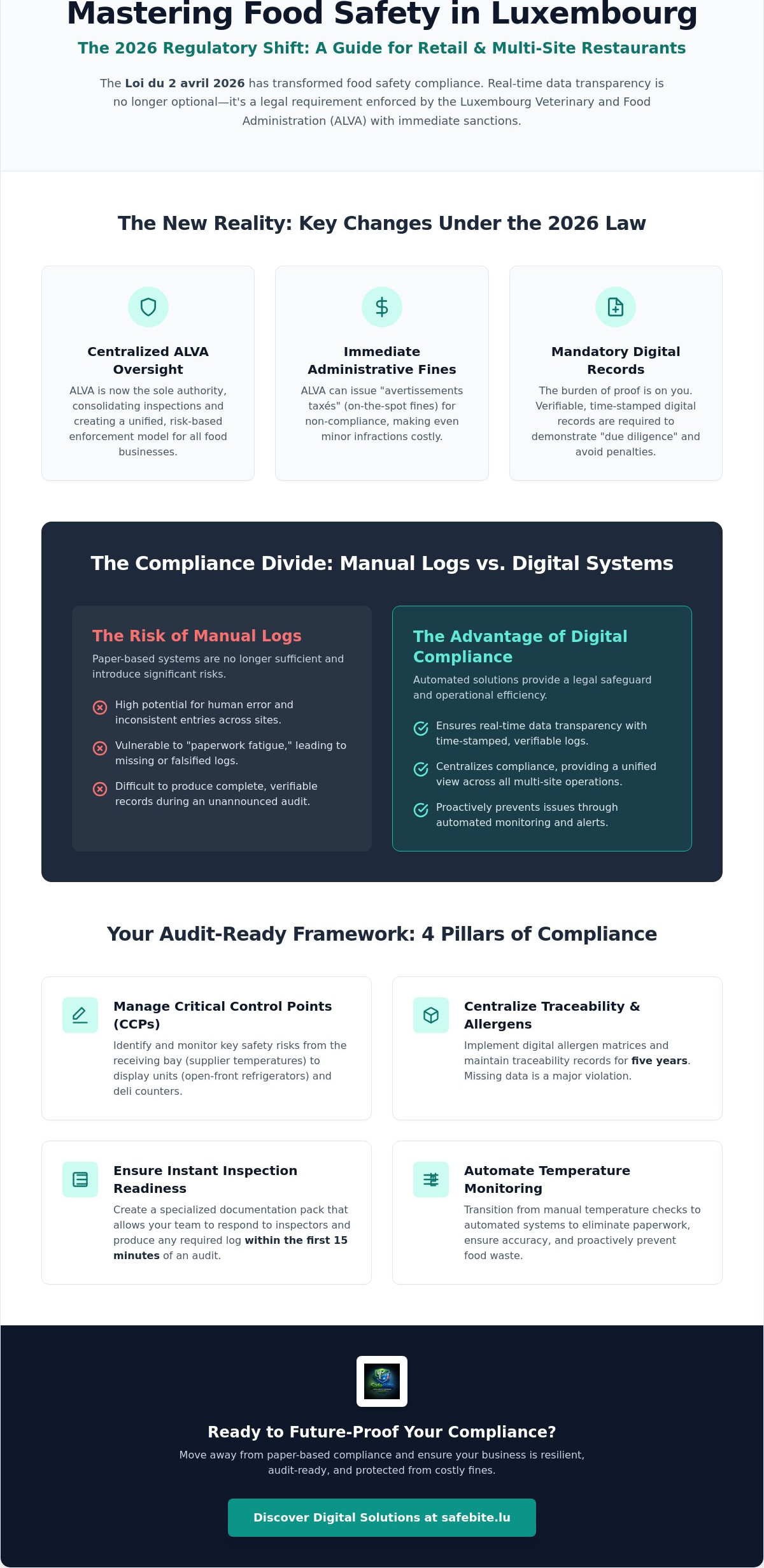
The regulatory environment in Luxembourg underwent a seismic shift on April 7, 2026. With the implementation of the Loi du 2 avril 2026, the Grand Duchy transitioned to a unified, more stringent framework that places the burden of proof squarely on the food business operator. This change is particularly impactful for those managing multi-site restaurant compliance Luxembourg, as the law mandates a level of data transparency and real-time oversight that manual systems simply cannot sustain. Compliance is no longer defined by a successful annual check; it is now a continuous state of readiness verified through centralized data streams.
The Role of ALVA in Retail Oversight
The Luxembourg Veterinary and Food Administration (ALVA) now serves as the sole authority for food safety inspections and enforcement. By consolidating the roles of several former ministries, ALVA has eliminated the fragmented oversight of the past. Retailers and supermarkets are now subject to a unified inspection frequency model that prioritizes establishments based on their risk profile and historical performance. Every food business operator must register through the national portal to remain legal. This centralized oversight ensures that retail shops and supermarkets across the country adhere to the same rigorous HACCP Principles that govern the entire food chain. If you operate multiple locations, ALVA expects a standardized approach to safety that is visible across your entire network.
Loi du 2 avril 2026: Sanctions and Compliance
One of the most significant changes introduced by the new law is the system of administrative sanctions. ALVA now possesses the authority to issue "avertissements taxés," or on-the-spot fines, for non-compliance without requiring a court ruling. This shift toward immediate enforcement means that minor infractions can lead to cumulative financial penalties very quickly. To establish a defense of "due diligence," retailers must provide verifiable, time-stamped digital records that prove consistent monitoring of safety protocols. Under the 2026 framework, missing traceability data or inaccurate allergen information carries heavy legal implications. Traceability records must be maintained for five years, and the inability to produce these documents during an unannounced audit is considered a major violation. For those overseeing multi-site restaurant compliance Luxembourg, the risk of a single site failing an inspection now has broader implications for the administrative standing of the entire organization. Maintaining digital logs is no longer an optional efficiency; it's a legal safeguard against the progressive fine structure of the new law.
HACCP Principles for Retailers: Managing Safety from Delivery to Display
Retail environments present a unique set of operational challenges that differ significantly from a standard commercial kitchen. While a restaurant manages a controlled menu, a supermarket or grocery store oversees thousands of SKUs, each with varying risk profiles. Adapting the 7 HACCP principles to this high-volume context requires a shift in focus from preparation to movement and display. For those overseeing multi-site restaurant compliance Luxembourg, the priority is creating a standardized safety protocol that remains consistent whether a product is on the loading dock or in a grab-and-go cooler.
The European Food Safety Authority provides the scientific foundation for these standards, emphasizing that safety is a shared responsibility across the food chain. In a retail setting, this means your Hazard Analysis must account for customer behavior, such as the frequent opening of refrigerator doors or the handling of non-prepackaged goods at deli counters. By identifying the specific moments where food safety is most vulnerable, you can implement controls that are both practical and compliant.
Retail-Specific Critical Control Points
The first Critical Control Point (CCP) in any retail operation is the receiving bay. Validating supplier temperatures upon arrival is a non-negotiable step to prevent compromised goods from entering your inventory. Once accepted, the challenge shifts to storage management. You must distinguish between bulk inventory held in back-of-house walk-ins and floor-level stock. Display units, particularly open-front refrigerated displays, represent a significant CCP because they are susceptible to ambient temperature fluctuations. Maintaining safety in these self-service units requires constant vigilance to ensure the cold chain remains unbroken while products are accessible to consumers.
Monitoring Procedures for Retail Display
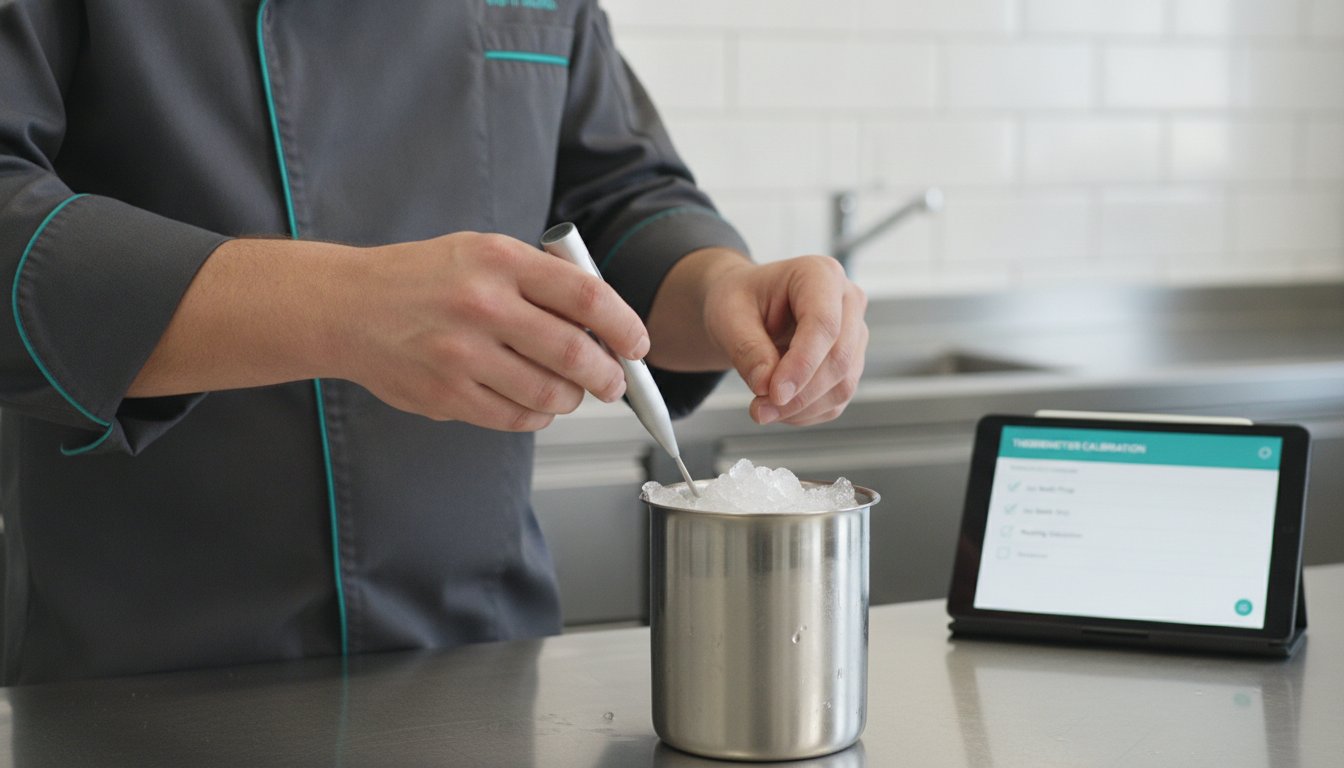
Effective monitoring in a retail environment depends on frequency and accuracy. Perishable goods in display units should be checked multiple times per day to ensure they stay within legal limits. If a display unit deviates from its set range, your staff must have clear, pre-defined corrective actions, such as moving stock to a secondary chiller or discarding items that have exceeded safe time-temperature thresholds. It's vital to follow the specific food storage temperature requirements Luxembourg, which mandate that chilled goods stay at or below 7°C and frozen items at or below -18°C.
Managing these checks manually across several locations often leads to data gaps. Implementing an automated Temperature Monitoring System provides the real-time oversight needed to protect your inventory and your reputation. This proactive approach is essential for multi-site restaurant compliance Luxembourg, as it allows managers to identify equipment failures before they result in significant food waste or administrative fines. By digitizing these monitoring procedures, you transform a burdensome requirement into a streamlined operational advantage.
Traceability and Allergen Management: Luxembourg Retail Standards
Inventory management in a retail setting is a complex exercise in data coordination. Unlike a static menu, a retail inventory involves a rotating selection of products from dozens of different suppliers. The "One Step Back, One Step Forward" rule serves as the operational backbone for these environments. It mandates that you must identify the immediate supplier of every ingredient and the immediate recipient of any bulk-sold goods. For those managing multi-site restaurant compliance Luxembourg, this requirement becomes even more demanding. You must maintain a transparent trail of lot numbers and expiration dates across every location to ensure that a safety issue at one site doesn't compromise the entire brand.
Traceability in the Retail Supply Chain
Manual tracking of lot numbers is a significant operational vulnerability. Typing errors or illegible handwriting can lead to critical failures during a product recall. Automating these records allows you to isolate affected batches in minutes rather than hours. This speed is essential because ALVA expects immediate action when a safety alert is issued. Digital systems ensure that your records are time-stamped and easily searchable, which is a core expectation of the Luxembourg food safety regulations for 2026. Since the law requires you to keep traceability data for five years, moving away from physical paperwork is a logical step toward long-term administrative stability. It's about building a system that is resilient enough to handle high-volume retail receiving without the risk of human error.
Allergen Information for Retail Customers
Retailers face a unique challenge when managing allergens, particularly at non-prepackaged food counters like bakeries and delis. While pre-packaged goods come with fixed labels, counter-service items require a dynamic approach to information delivery. You must provide clear, up-to-date allergen data for every item sold. A digital allergen matrix serves as a single source of truth that your team can update instantly if a supplier changes an ingredient. This tool is vital for multi-site restaurant compliance Luxembourg, as it ensures that a customer at your Kirchberg location receives the same accurate information as a customer in Esch-sur-Alzette. Training floor staff to use these digital tools is just as important as the data itself. When an employee can confidently answer a query using an Allergen Management Tool, it demonstrates a level of professional vigilance that satisfies both the consumer and the inspector. This proactive stance transforms a complex legal requirement into a seamless part of your customer service experience.
The Retail Inspection Readiness Framework: Navigating ALVA Audits
An unannounced ALVA inspection shouldn't cause panic. It should be a routine verification of the high standards you already maintain. The most successful operators use a "First 15 Minutes" strategy. This involves having a pre-assembled documentation pack ready the moment an inspector identifies themselves. For those managing multi-site restaurant compliance Luxembourg, this level of organization is vital. It ensures that even if a senior manager isn't present, the floor staff can demonstrate professional vigilance and provide the necessary proof of due diligence immediately.
Essential Documentation for Retail Inspectors
When an inspector arrives, they'll first ask for your HACCP plan and historical monitoring logs. You must be able to produce time-stamped evidence of temperature checks and cleaning routines. A disorganized stack of papers often signals deeper operational issues. Instead, your documentation pack should include:
- HACCP Plan Verification: A clear outline of your safety protocols and CCPs.
- Cleaning Schedules: Detailed logs for all retail and storage areas, paired with Chemical Safety Data Sheets (SDS) for all cleaning agents.
- Staff Hygiene Records: Centralized illness reporting logs and proof of hygiene training for every employee on the schedule.
Centralizing these records through a digital dashboard allows you to verify readiness across all locations from a single point of oversight. You can simplify this process by implementing Digital HACCP Checklists that keep your team accountable in real-time.
Retail Floor Hygiene Standards
In a retail environment, hygiene extends beyond the food prep area to the public floor. High-touch surfaces like shopping trolleys, checkout counters, and self-service screens require frequent sanitization. Inspectors will look for documented proof that these areas are cleaned according to a set schedule. Waste management is another critical focus. You must have a clear protocol for the immediate removal and documentation of expired or damaged stock to prevent cross-contamination.
Pest control is equally important in both display areas and back-of-house warehouses. ALVA requires a proactive monitoring plan that includes regular inspections by qualified professionals. If you manage multi-site restaurant compliance Luxembourg, ensuring that every site follows the same waste and pest protocols is essential for brand protection. Maintaining a clean, well-maintained premises doesn't just satisfy the law; it builds trust with your customers. By treating inspection readiness as a daily operational habit rather than a sporadic event, you eliminate the stress of regulatory oversight and ensure your business remains resilient under the 2026 framework.
Future-Proofing Retail Operations with Digital Compliance Solutions
High-turnover retail environments often struggle with the heavy administrative burden of manual record-keeping. Paperwork fatigue isn't just an employee morale issue; it's a significant operational risk that leads to missed logs and inaccurate data. Digital solutions resolve this by automating the most repetitive tasks, ensuring that your safety records remain complete and accurate without constant manual intervention. Real-time alerts from an automated Temperature Monitoring System can prevent massive food waste by notifying managers the moment a chiller deviates from its safe range. This proactive stance is essential for surviving the next era of digital-first ALVA inspections, where speed and data integrity are the primary metrics of success.
The Multi-site Management Advantage
Managing multi-site restaurant compliance Luxembourg requires a bird's-eye view of every location's safety status. A Multi-site Management Dashboard allows operators to oversee compliance across multiple retail units from a single interface. You can standardize Standard Operating Procedures (SOPs) across your entire brand, ensuring that every shop follows the same high standards regardless of local management changes. This centralized oversight makes it easy to identify performance gaps in specific locations before they lead to ALVA sanctions or administrative fines. It transforms compliance from a localized headache into a manageable, brand-wide asset.
Data-Driven Food Safety
Beyond simple legal adherence, digital logs provide valuable business intelligence. By analyzing historical data from your Digital HACCP Checklists, you can identify recurring equipment failures in specific display units or warehouses. This allows for scheduled maintenance rather than costly emergency repairs. A verifiable compliance history also serves as a powerful tool for risk management, potentially assisting in the reduction of insurance premiums by providing objective proof of your safety commitment. It's time to move beyond the filing cabinet and embrace a more resilient operational model. Discover how SafeBite streamlines retail food compliance Luxembourg to protect your business and your bottom line.
Securing Your Operational Resilience in the 2026 Regulatory Landscape
The transition to the Loi du 2 avril 2026 has fundamentally changed the stakes for food safety in the Grand Duchy. Relying on fragmented, manual systems is no longer a viable strategy when faced with ALVA's centralized oversight and immediate administrative sanctions. Success now depends on your ability to provide transparent, time-stamped data at a moment's notice. By masterfully managing multi-site restaurant compliance Luxembourg through digital integration, you transform a complex legal burden into a streamlined operational advantage. You're not just avoiding fines; you're building a culture of precision that protects your inventory and your brand's reputation.
Staying one step ahead of inspectors requires the right tools to monitor Critical Control Points across every location. Digitize your retail compliance with SafeBite’s Multi-site Dashboard to ensure your business is inspection-ready in minutes. With automated temperature alerts and a system already used by leading Luxembourg food businesses, you can maintain total control over your operations. It's time to replace paperwork fatigue with the confidence of proactive vigilance. Your journey toward a more secure and efficient future starts with a single, decisive step toward digital excellence.
Frequently Asked Questions
Who is the main authority for retail food safety in Luxembourg in 2026?
The Luxembourg Veterinary and Food Administration (ALVA) is the primary regulatory body responsible for food safety oversight. Established as a unified authority under the Loi du 2 avril 2026, it consolidates previous ministerial roles to ensure consistent enforcement across the entire food chain. Retailers and managers overseeing multi-site restaurant compliance Luxembourg must register through the national portal to remain visible to this central agency and its inspection teams.
Is a digital HACCP plan mandatory for small grocery stores in Luxembourg?
Implementing a Hazard Analysis and Critical Control Points (HACCP) system is a legal requirement for every food business, regardless of its size. While the current law doesn't strictly mandate a digital format, ALVA strongly encourages digital record-keeping for its superior transparency and accuracy. Small grocery stores find that digital logs reduce the risk of human error and simplify the presentation of historical data during unannounced audits.
How long must retailers keep food safety records under the 2026 law?
Food safety and traceability records must be archived for a period of five years under the current regulatory framework. This duration applies to all lot numbers, supplier invoices, and daily temperature logs. Maintaining these documents digitally ensures they remain legible and accessible for the duration required by ALVA, preventing the physical storage issues and degradation risks associated with traditional paper filing systems.
What are the penalties for non-compliance in retail food shops?
Non-compliance can lead to immediate administrative sanctions, including on-the-spot fines known as "avertissements taxés." These penalties allow ALVA to address violations without the need for a court ruling, making enforcement faster and more frequent. Repeated infractions or missing documentation can lead to progressive fines that impact both the financial health and the professional standing of a retail establishment within the national registry.
Do supermarkets need automated temperature monitoring by law?
While the law specifies strict temperature thresholds, such as 7°C for chilled goods and -18°C for frozen items, it doesn't explicitly mandate automation. However, retailers must provide verifiable proof that these limits are maintained consistently. Automated temperature monitoring is the most reliable method for multi-site restaurant compliance Luxembourg, as it provides real-time alerts and time-stamped logs that satisfy ALVA’s requirements for verifiable due diligence.
How does the "one step back, one step forward" rule apply to retailers?
This rule requires retailers to identify the immediate supplier of their inventory and, where applicable, the immediate recipient of bulk products. It's the foundation of effective traceability, ensuring that any safety concern can be traced to its source or contained before it reaches the consumer. Maintaining a digital database of lot numbers and expiration dates allows for rapid responses to recall alerts issued by the central administration.
What is required for allergen labeling on non-prepackaged bakery items?
Retailers must provide clear allergen information for all non-prepackaged items, such as loose bread or deli products. This data can be displayed on signage at the counter or maintained in a digital matrix that floor staff can reference upon customer request. The key is ensuring that the information is accurate, up-to-date, and easily accessible to prevent accidental exposure to high-risk ingredients for consumers.
What should a retailer do during an unannounced ALVA inspection?
Cooperation and organization are your best assets during an unannounced visit. You should immediately present your documentation pack, which includes your HACCP plan, recent monitoring logs, and staff training records. Demonstrating that your team follows established hygiene checklists and cleaning schedules shows the inspector that safety is an integrated part of your daily operations rather than a reactive measure taken only during audits.