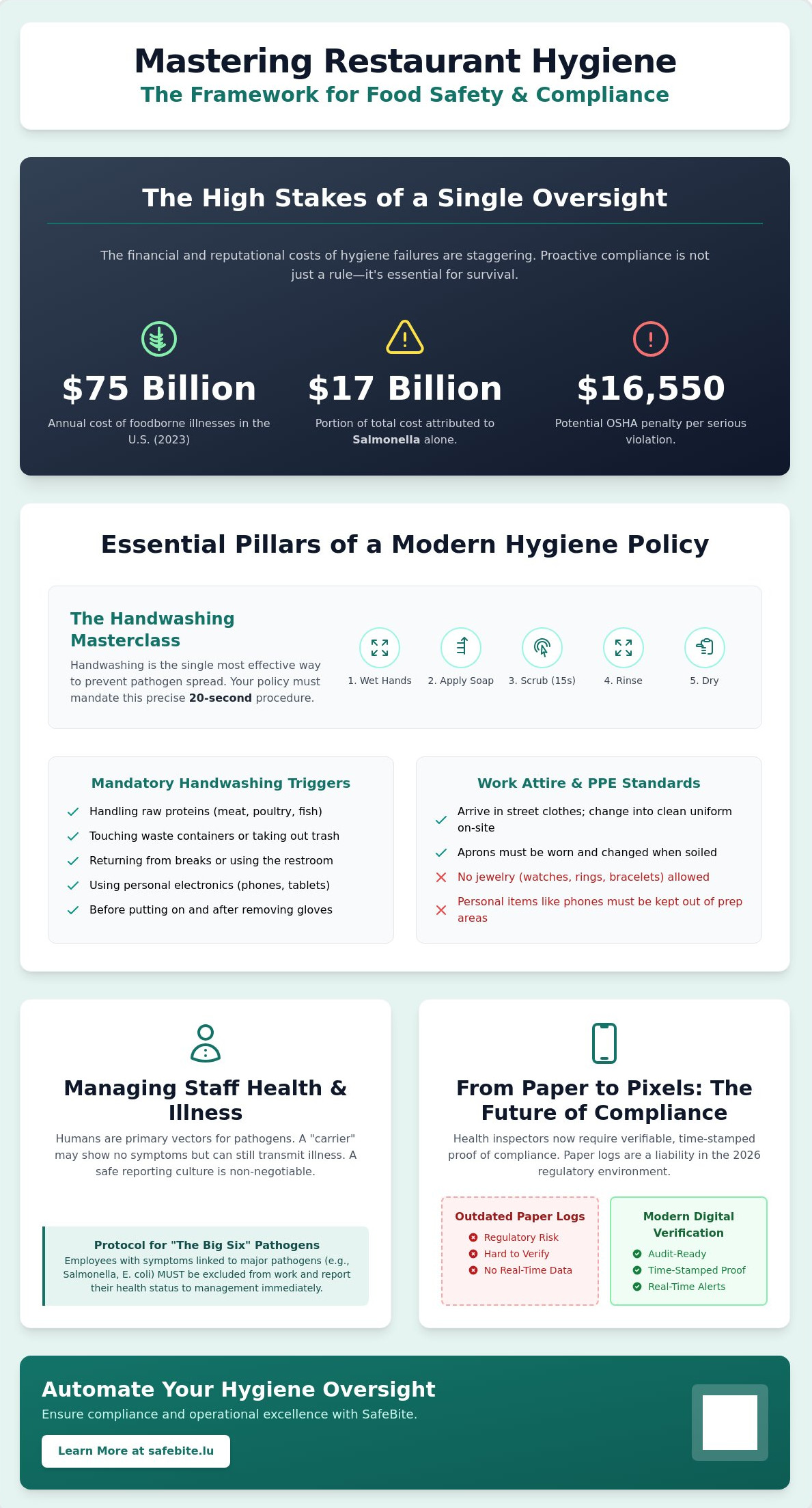
Did you know that foodborne illnesses cost the United States nearly $75 billion in 2023, with Salmonella alone accounting for $17 billion of that total? With OSHA penalties for serious violations reaching up to $16,550 as of January 2026, the financial stakes of a single oversight are higher than ever. You likely face the daily frustration of high staff turnover and the persistent worry that a missed handwashing protocol will lead to a failed inspection. It's difficult to maintain a consistent personal hygiene policy for restaurant employees when compliance feels like a moving target rather than a standard procedure.
This guide empowers you to master the essential components of a modern hygiene policy to ensure food safety, regulatory compliance, and operational excellence. By the end of this article, you'll have a clear, enforceable framework designed for the 2026 regulatory environment. We will examine the specific rules required to satisfy health inspectors, the latest updates to the FDA Food Code, and how digital tools can track compliance and illness reporting without the need for constant micromanagement.
Key Takeaways
- Learn why a comprehensive personal hygiene policy for restaurant employees is the bedrock of your HACCP plan and how to move beyond surface-level cleanliness.
- Identify the specific "trigger" events that mandate handwashing and the updated 2026 standards for protective clothing and uniforms.
- Understand the exclusion protocols for "The Big Six" pathogens and how to foster a workplace culture where staff feel safe reporting health symptoms.
- Discover why paper-based logs are a regulatory risk and how digital verification provides time-stamped proof of compliance.
- Explore how to automate your hygiene oversight with digital checklists and real-time alerts to ensure operational excellence across multiple sites.
The Critical Role of Personal Hygiene in Professional Food Safety
A personal hygiene policy is a formalized set of standards designed to prevent biological, chemical, and physical contamination via food handlers. This document is not merely a list of rules; it's a core component of your HACCP plan that transforms abstract safety goals into daily operational habits. When you formalize a personal hygiene policy for restaurant employees, you establish a defensive perimeter against the most common source of foodborne illness: the human element. Without these standards, even the most advanced kitchen equipment cannot guarantee a safe final product.
While a chef with a crisp, white apron might look professional to a guest, visual cleanliness is merely the first layer of a multi-dimensional safety strategy. Microscopic pathogens don't care about a pressed uniform. Proper food safety principles dictate that the most dangerous contaminants are invisible to the naked eye. Bacteria like Salmonella can survive on skin for hours, waiting for a single lapse in protocol to enter the food chain. If your policy only addresses what is visible, you're leaving your kitchen vulnerable to the threats that guests can't see.
The economic impact of hygiene failures is immediate and often irreversible. In a highly connected market like Luxembourg, reputation loss travels fast. Beyond the damage to your brand, hygiene failures lead to significant fines from the Luxembourg Food Safety Authority or even permanent closure. The cost of a single outbreak far outweighs the investment in rigorous training and oversight. Precision in hygiene isn't just a regulatory requirement; it's a strategic necessity to protect your bottom line and your community.
Regulatory Expectations in 2026
Regulatory bodies have significantly increased their scrutiny regarding staff conduct. Aligning with the Luxembourg Food Safety Authority guidelines is now the baseline for any professional kitchen. In 2026, hygiene records serve as primary evidence during a national health audit. There's a clear, industry-wide shift toward digital-first documentation in European food safety standards. Inspectors no longer accept vague verbal assurances; they require verifiable, chronological data that proves active managerial control over staff hygiene and health reporting.
Pathogens and the Human Element
Humans are the primary vectors for many foodborne diseases. Pathogens like Salmonella and E. coli transfer effortlessly from skin to food surfaces through even momentary contact. This risk is compounded by the "carrier" – an employee who appears perfectly healthy but is still shedding pathogens. Strict protocols must apply to every team member, regardless of whether they feel ill. Cross-contamination also occurs through personal items; phones and jewelry harbor bacteria that can easily bypass prep-surface sanitation if your personal hygiene policy for restaurant employees isn't strictly enforced.
Essential Pillars of an Effective Employee Hygiene Policy
A robust personal hygiene policy for restaurant employees requires more than just a list of rules. It demands a culture of precision where every team member understands the specific actions required to maintain a sterile environment. While the previous section highlighted the regulatory and biological risks of failure, this section focuses on the operational pillars that prevent those risks from manifesting in your kitchen. Success depends on clear, non-negotiable standards that are verified daily through active oversight.
The Handwashing Masterclass
Handwashing is the single most effective way to stop the spread of pathogens, yet it's often the most inconsistently performed task. Your policy must mandate a specific 20-second procedure: wet hands with warm water, apply soap, lather and scrub for at least 15 seconds, rinse thoroughly, and dry with a single-use towel. Beyond the technique, you must define "trigger" events that require immediate washing. These include handling raw proteins, touching waste containers, returning from breaks, or using personal electronics. Dedicated handwashing sinks must be used exclusively for this purpose and should never be blocked by prep equipment or used for rinsing produce.
Work Attire and PPE Standards
Uniforms act as a barrier between the outside world and your food preparation areas. Staff should arrive in street clothes and change into clean, laundered uniforms in a designated changing area. Aprons are a critical piece of protective equipment, but they can become a source of contamination if worn outside the kitchen. They must be removed before leaving the food preparation zone. According to European food hygiene standards, jewelry and nail polish are also high-risk factors. Watches, rings with stones, and artificial nails harbor bacteria and can physically contaminate dishes. Hair restraints and beard snoods are equally essential to prevent physical hazards from entering the final product.
Personal Habits and Prohibited Actions
Gloves often provide a false sense of security that leads to cross-contamination. They are not a substitute for handwashing and must be changed as frequently as hands would be washed. Personal habits like eating, drinking, or smoking must be restricted to designated areas far from prep surfaces. Personal items, especially mobile phones, should remain in lockers. Phones are frequently touched and rarely sanitized, making them a significant vector for bacteria. To ensure these standards are met without constant oversight, many Luxembourgish managers use Digital HACCP Checklists to verify compliance in real-time. By codifying these habits into your personal hygiene policy for restaurant employees, you create a professional environment where food safety is an automatic reflex rather than a chore.
Managing Staff Health and Illness Reporting Protocols
Your personal hygiene policy for restaurant employees is only as strong as your team's health on any given day. Even a perfect handwashing routine can't stop a virus if a staff member is actively shedding pathogens while working. Effective management requires a shift from passive observation to a structured system of health oversight. You must ensure your staff understands that showing up while sick isn't a sign of dedication; it's a significant liability that could lead to heavy sanctions from the Luxembourg Food Safety Authority (ALVA).
Regulatory bodies focus heavily on "The Big Six" pathogens: Norovirus, Hepatitis A, Shigella, Shiga toxin-producing E. coli (STEC), Salmonella Typhi, and non-typhoidal Salmonella. These are highly contagious and can cause severe outbreaks with minimal exposure. When any of these are suspected or confirmed, immediate exclusion from the kitchen is the only acceptable response. This isn't just a best practice. It's a legal mandate that protects your operation from the severe penalties and public health warnings associated with non-compliance in Luxembourg.
Symptom-Based Exclusion Criteria
Staff must be trained to recognize and report specific excludable symptoms before they ever step into the food preparation area. These include vomiting, diarrhea, jaundice, and a sore throat accompanied by a fever. Additionally, any infected wounds or lesions on the hands or arms must be properly covered with a waterproof bandage and a glove. If the wound can't be securely covered, the employee must be restricted from handling food. A comprehensive employee illness reporting policy for restaurants is mandatory for preventing outbreaks and ensuring your team knows exactly when to stay home.
The return-to-work criteria must be non-negotiable. For most gastrointestinal illnesses, employees should be symptom-free for at least 48 hours before returning to duty. This buffer period ensures they're no longer contagious, as many pathogens continue to shed even after the person feels better. Clear communication of these rules reduces the anxiety staff might feel about missing shifts and helps maintain a transparent, safety-first culture where honesty is valued over presence during illness.
The Manager’s Responsibility in Health Oversight
Managers serve as the final filter for kitchen safety. Implementing daily health checks during pre-shift briefings allows you to spot visible signs of illness, like frequent coughing or a pale complexion, before work begins. It's your responsibility to maintain illness logs that are confidential yet ready for an unannounced audit. These records demonstrate the active managerial control that inspectors now demand as a standard of operational excellence. Training your team on their individual reporting obligations ensures your personal hygiene policy for restaurant employees remains a living part of your daily operations rather than a forgotten document.
Moving from Paper to Digital: Auditing Hygiene Compliance
Manual oversight is a gamble you don't need to take. Paper checklists are static; they tell you what happened, or what someone claims happened, hours after the fact. In the high-pressure environment of a professional kitchen, paper logs often fall victim to "pencil whipping," where staff fill out an entire day's worth of hygiene checks in one sitting just before a shift ends. This practice makes your personal hygiene policy for restaurant employees a decorative document rather than a functional safety tool. In 2026, digital verification is the only way to ensure your standards are actually being met in real-time.
Digital systems solve the problem of retrospective reporting through mandatory time-stamping and geolocation. When an employee confirms a handwashing cycle or a uniform check, the system records the exact second the action took place. You can automate reminders for these tasks, ensuring that sanitation cycles happen at the correct intervals without a manager needing to hover over the team. This data doesn't just provide a safety net. It allows you to identify specific shifts or teams where compliance dips, highlighting exactly where you need to focus your training efforts.
Real-Time Verification and Accountability
For multi-site managers, maintaining a consistent personal hygiene policy for restaurant employees across different locations is a significant challenge. Using a digital kitchen hygiene checklist provides a level of oversight that manual logs simply cannot match. Many mobile apps now allow for photographic evidence, requiring staff to upload a quick photo to verify they are wearing the correct hair restraints or clean aprons. This creates a centralized, audit-ready database that you can access instantly during an unannounced health inspection, proving your commitment to active managerial control.
Building a Food Safety Culture
Transparency in hygiene data does more than satisfy inspectors; it builds trust within your kitchen. When staff see that compliance is tracked fairly and accurately, it eliminates the ambiguity of manual oversight. You can use digital reports to reward high-performing teams, turning hygiene from a chore into a point of professional pride. Integrating these digital audits into your standard operating procedures (SOPs) ensures that safety becomes a seamless part of the daily workflow. To move your kitchen into the future of food safety, consider implementing Digital HACCP Checklists to automate your compliance tracking and eliminate the risks of paper-based reporting.
A digital-first approach transforms your hygiene policy from a reactive burden into a strategic advantage. It gives you the confidence to know that your team is following the rules, even when you aren't in the building. By replacing outdated paper logs with precision-driven technology, you ensure that your restaurant remains a leader in both safety and operational efficiency.
Implementing Your Personal Hygiene Policy with SafeBite
SafeBite transforms your personal hygiene policy for restaurant employees from a static document into a dynamic, automated system. While traditional methods rely on memory and manual oversight, our platform integrates safety protocols directly into your team's daily workflow. This shift ensures that compliance isn't an afterthought. It becomes a natural part of every shift. By digitizing your standards, you provide your team with the tools they need to maintain excellence without the friction of outdated paperwork.
Managing a busy kitchen requires constant focus. It's easy for handwashing cycles or uniform checks to slip through the cracks during a lunch rush. SafeBite solves this by setting up automated hygiene alerts that ping your kitchen team at pre-defined intervals. These reminders ensure that critical sanitation tasks are completed on time, every time. For managers, this means a significant reduction in administrative burden. You no longer need to spend hours chasing signatures or filing logs; the system handles the documentation for you, allowing you to focus on guest experience and food quality.
Customizing Your Digital Checklists
No two kitchens are identical. SafeBite allows you to tailor your hygiene tasks to your specific kitchen layout and menu requirements. Whether you're managing a high-volume seafood station or a specialized pastry section, your checklists can reflect the unique risks of your environment. These logs integrate seamlessly with broader digital food safety checklists, creating a unified view of your entire operation. Additionally, the platform tracks staff certification records, ensuring that every team member's training is current and compliant with the latest 2022 FDA Food Code supplements and local standards.
Stay Inspection-Ready with SafeBite
Modern health inspectors, including those from the Luxembourg Food Safety Authority, now view digital proof as the gold standard for compliance. SafeBite generates comprehensive, unalterable reports that demonstrate active managerial control with a single click. This transparency reduces the risk of human error in hygiene documentation and provides a clear, chronological record of your safety efforts. When an inspector walks through your door, you can present a professional, data-driven history of your personal hygiene policy for restaurant employees instead of a disorganized folder of paper logs. See how SafeBite simplifies hygiene compliance and secures your restaurant's reputation for the future.
Precision is the hallmark of a professional kitchen. SafeBite provides the technological framework to ensure that your hygiene standards are never compromised. By replacing manual processes with smart, automated solutions, you build a more resilient business and a safer environment for your guests and staff alike.
Securing Your Kitchen’s Reputation and Compliance
Transitioning from manual, reactive oversight to a proactive digital framework is the most effective way to safeguard your business in 2026. A comprehensive personal hygiene policy for restaurant employees only succeeds when it's backed by verifiable, time-stamped data. By prioritizing transparent illness reporting and automated sanitation alerts, you move beyond basic compliance and into a state of operational excellence.
SafeBite offers the precision tools to make this transition seamless. Our platform features inspection-ready dashboards and automated HACCP compliance logs, which is why we're already used by top hospitality brands nationally. You can eliminate the anxiety of unannounced inspections and the persistent burden of paper-based tracking with a single, integrated solution that supports your team's daily success.
Digitize your hygiene policy with SafeBite today and lead your team toward a safer, more efficient future. You've built a brand your guests trust; now give your staff the technology they need to protect that reputation every single day. Achieving zero foodborne illness incidents is within your reach when you choose the right partner for your safety journey.
Frequently Asked Questions
What should be included in a personal hygiene policy for restaurant employees?
A comprehensive personal hygiene policy for restaurant employees must include formalized standards for handwashing, uniform cleanliness, and grooming. It should also define "The Big Six" pathogens and establish clear illness reporting protocols. By detailing jewelry restrictions and hair restraint requirements, the policy ensures alignment with the 2022 FDA Food Code and satisfies local health authority expectations for professional food handling.
Are food handlers required to wear hairnets in Luxembourg?
Yes, food handlers are required to wear effective hair restraints to prevent physical contamination. This includes hairnets, hats, or snoods that completely cover the hair during food preparation. Luxembourg's food safety guidelines mandate these protections in any area where open food is handled. Ensuring that loose strands don't compromise the integrity of the final dish is a non-negotiable standard for professional kitchens.
How often should restaurant employees wash their hands during a shift?
Employees must wash their hands whenever a "trigger" event occurs rather than following a set time interval. These triggers include switching between raw and cooked foods, touching waste, returning from breaks, or using the restroom. Frequent handwashing is the primary defense against cross-contamination. Every instance should follow the strict 20-second scrubbing procedure to be truly effective at removing microscopic pathogens.
Can a restaurant employee work with a cold or cough?
No, staff members with a persistent cough or cold symptoms should be restricted from handling food or clean equipment. While a minor cold might seem harmless, it significantly increases the risk of spreading pathogens through respiratory droplets. Managers should assess symptoms during pre-shift briefings and exclude any employee displaying signs of respiratory distress or fever to maintain a safe and compliant environment.
Is it mandatory to keep a log of employee illnesses?
Maintaining a confidential illness log is a legal requirement for demonstrating active managerial control over food safety. This log serves as critical evidence during health audits, showing that you've identified and excluded staff with contagious symptoms. Using digital tools makes this process more secure and audit-ready, ensuring you can prove compliance without the risk of managing or losing sensitive paper records.
What are the rules regarding jewelry for kitchen staff in 2026?
Kitchen staff are generally prohibited from wearing jewelry, with the exception of a plain wedding band. Items like watches, bracelets, and rings with stones create crevices where bacteria can thrive and risk falling into food. Modern personal hygiene policy for restaurant employees standards also prohibit visible piercings that could become physical hazards in high-heat prep zones, ensuring a safe and sterile workspace.
How do digital checklists improve hygiene compliance in professional kitchens?
Digital checklists improve compliance by providing time-stamped verification and automated alerts that paper logs cannot offer. They eliminate the risk of retrospective reporting by requiring real-time confirmation of tasks like handwashing and station sanitation. This transparency allows managers to identify training gaps immediately. It ensures that safety protocols are followed consistently across every shift without the need for constant micromanagement.
What happens if a restaurant fails a hygiene inspection in Luxembourg?
Failing an inspection can lead to immediate fines, mandatory closure, or a public downgrade of your safety rating. The Luxembourg Food Safety Authority may issue an injunction requiring specific corrective actions within a strict timeframe. Consistent failure to document hygiene protocols often results in increased oversight and potential legal action. This emphasizes why robust digital record-keeping is essential for modern restaurant operations.