
CDC data indicates that 58.8% of foodborne illness outbreaks are linked specifically to food prepared in restaurants, with contamination from infected workers acting as a leading cause. It's a sobering reality that places immense pressure on your daily operations. You've likely felt the frustration of managing vague symptoms or the confusion of deciding whether a team member should be restricted or excluded from the kitchen. Relying on paper-based logs that are easily lost or ignored only adds to the anxiety of a surprise health inspection.
Maintaining a rigorous employee illness reporting policy for restaurants is your most effective defensive layer against these operational risks. We've designed this 2026 compliance template to help you move beyond manual guesswork and toward a more disciplined, digital-first approach. By downloading this professional policy, you'll gain a clear framework that ensures food safety compliance while simplifying how your staff reports health concerns. This article examines the critical reporting requirements of the latest FDA Food Code and provides a streamlined roadmap for integrating these standards into your modern digital HACCP workflows.
Key Takeaways
- Learn how a formal illness policy functions as a binding agreement between management and staff to uphold high food safety standards.
- Identify the specific reportable symptoms and pathogens that mandate immediate action to remain compliant with 2026 food safety regulations.
- Clarify the operational differences between excluding and restricting staff to manage health risks without compromising service quality.
- Streamline your compliance by integrating an employee illness reporting policy for restaurants into your digital pre-shift workflows.
- Explore how automated notifications and centralized dashboards ensure no health report is overlooked across multiple business locations.
Why an Employee Illness Reporting Policy is Critical for Your HACCP Plan
An employee illness reporting policy for restaurants is far more than a human resources formality. It serves as a binding agreement between management and staff, establishing a clear protocol for when a team member is too unwell to handle food safely. This document ensures that every employee understands their personal responsibility in protecting the public. In many jurisdictions, this is a strict legal requirement. For instance, following Luxembourg food safety regulations mandates that operators maintain precise records of staff health to mitigate the risk of pathogen transmission. Implementing a modern employee illness reporting policy for restaurants allows you to stay ahead of the rigorous 2026 standards being adopted across the industry.
Beyond legal mandates, a robust policy acts as a primary defense against cross-contamination. When an infected worker enters a kitchen, the risk of a viral or bacterial outbreak increases significantly. According to CDC data, infected food workers contributed to nearly half of all viral foodborne outbreaks between 2014 and 2022. By formalizing your reporting process, you protect your business reputation and ensure you are always prepared for a surprise health inspection. A clear policy removes ambiguity, allowing managers to make fast, informed decisions that keep both the staff and the customers safe.
The Link Between Staff Health and HACCP Compliance
Within the framework of Hazard Analysis and Critical Control Points, staff health is classified as a foundational prerequisite program. It functions as a preventative control, stopping biological hazards at the door before they reach a preparation surface. Adhering to established Food safety principles requires that these health checks are documented and verifiable. The cost of failing to record these instances is high, often resulting in significant fines or permanent brand damage. While paper logs were once the standard, they are notoriously difficult to track and easy to lose. Modern establishments are transitioning to Digital HACCP Checklists to ensure that every health declaration is time-stamped, stored securely, and instantly accessible during audits.
Building a Proactive Food Safety Culture
The most comprehensive policy is useless if staff feel pressured to hide their symptoms. A proactive food safety culture encourages transparency and prioritizes public health over short-term staffing needs. If employees fear losing a shift or facing disciplinary action, they are more likely to work while ill. This creates a dangerous environment where pathogens like Norovirus can spread rapidly. Managers must lead by example, training staff to recognize early warning signs such as nausea, fever, or jaundice. By creating a supportive environment where reporting is met with professional action rather than punishment, you build a team that values precision. This vigilance transforms your policy from a static piece of paper into a living part of your operational excellence.
Core Components of a Professional Illness Reporting Template
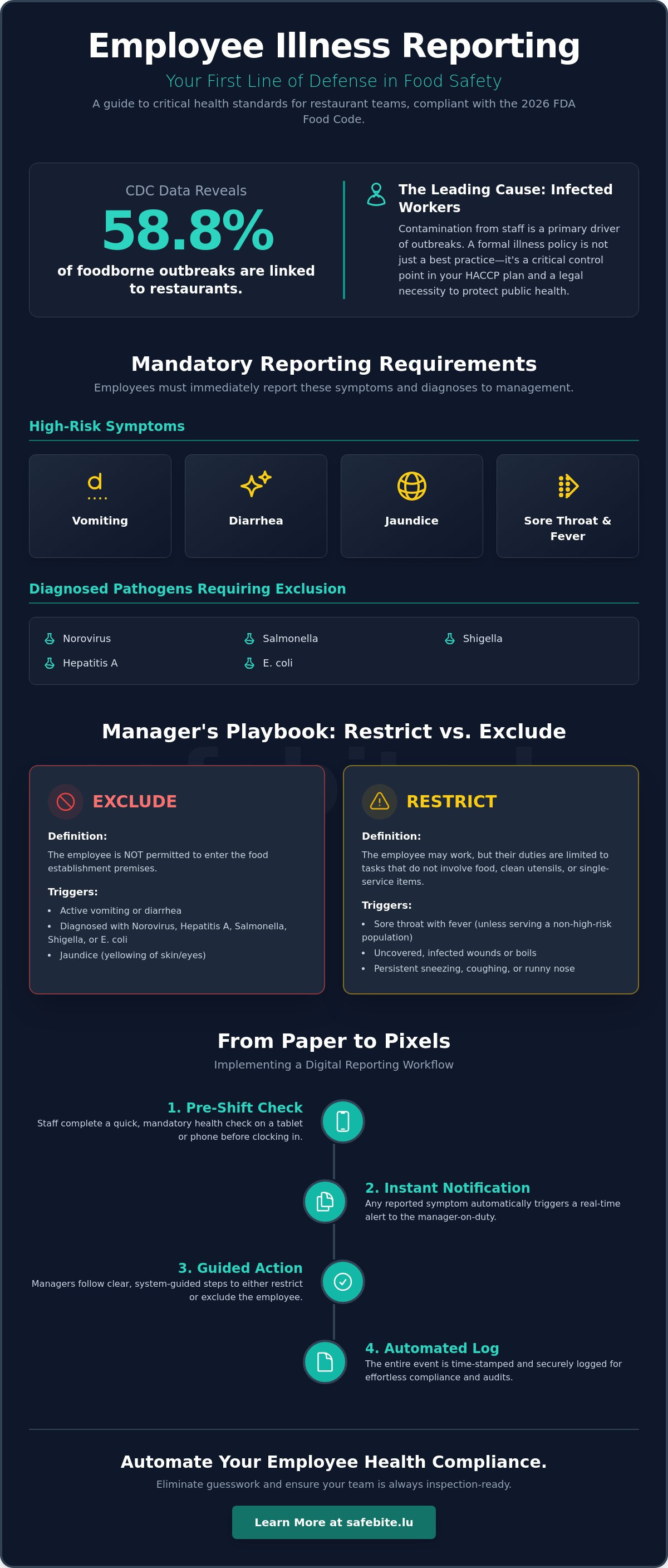
A professional employee illness reporting policy for restaurants functions as a technical blueprint for safety. It translates complex health regulations into actionable steps for your kitchen and front-of-house teams. To be effective, the template must clearly define what constitutes a reportable event. This includes a non-negotiable list of symptoms: vomiting, diarrhoea, jaundice, and a sore throat accompanied by fever. Beyond symptoms, the policy must list specific pathogens such as Norovirus, Salmonella, E. coli, Hepatitis A, and Shigella. Employees need to know that a diagnosis of any of these requires immediate exclusion from the premises to prevent a wider outbreak.
Precision matters here. Your policy should enforce a strict 24 to 48-hour symptom-free window before a staff member can return to duty. This timeframe is essential because many pathogens remain transmissible even after the person feels better. According to this guide from Penn State Extension on employee illnesses, clear communication between the employee and the person in charge is the only way to prevent a minor illness from becoming a public health crisis.
Identifying High-Risk Symptoms
Distinguishing between a standard cold and a foodborne illness is a common challenge for managers. While a runny nose might be manageable with strict hygiene, a sore throat combined with a fever is a critical reporting event that often requires restriction from food handling. You must also address physical injuries. Infected wounds, cuts, or lesions on the hands and arms must be properly covered with an impermeable bandage and a single-use glove. If the wound cannot be securely covered, the employee must be restricted from handling food, clean equipment, or single-service items until the injury is healed.
Defining the Reporting Timeline
Your employee illness reporting policy for restaurants should mandate immediate notification. Staff must contact management before their shift begins if they experience any reportable symptoms. This allows you to adjust the schedule and maintain safety without a last-minute scramble. For certain illnesses, a doctor's note may be required to verify that the individual is no longer shedding pathogens. Managing these records can be complex, especially when considering GDPR compliance in Luxembourg. Health data is sensitive. You must ensure that these records are stored securely and accessed only by authorized personnel. To simplify this level of oversight, many operators use Digital HACCP Checklists to log health declarations securely and maintain a clear audit trail for inspectors.
Restricting vs. Excluding: How to Manage Sick Staff
Effective management within an employee illness reporting policy for restaurants hinges on the critical distinction between restriction and exclusion. These two actions represent different levels of risk mitigation based on the severity of an employee's symptoms or their specific diagnosis. While both aim to prevent foodborne illness outbreaks, they require different operational responses from management. Understanding the nuance between these categories ensures that you don't overreact to a minor ailment while also preventing a contagious pathogen from entering your prep area.
Managing staff shortages during these periods is often the greatest challenge for operators. It's helpful to view these protocols as non-negotiable safety standards rather than scheduling inconveniences. A disciplined approach to these classifications protects your customers and your brand from the long-term damage of a public health incident. When exclusions occur, utilizing a Multi-site Management Dashboard can help you identify available staff from other locations to fill critical gaps without compromising safety protocols.
When to Exclude Staff Entirely
Exclusion is the most rigorous defensive measure. It involves the total removal of the employee from the food establishment. This action is mandatory when a staff member exhibits symptoms of vomiting or diarrhoea, or when they have a confirmed diagnosis of a "Big 6" pathogen. For cases involving Jaundice, the safety requirements are particularly strict. An employee must be excluded if the onset of jaundice occurred within the last seven days. During an exclusion period, the individual is prohibited from entering the facility for any reason. They cannot perform "clean" tasks such as office work or inventory counts. Their physical presence alone poses a risk of environmental contamination that your employee illness reporting policy for restaurants must strictly prohibit.
The Nuance of Restricted Duties
Restriction is a more targeted control measure. It allows the employee to remain at work but prohibits them from handling food, clean equipment, utensils, or unwrapped single-service items. This is often appropriate for staff with a sore throat and fever (in non-highly susceptible populations) or those with properly covered skin lesions. Tasks suitable for restricted staff include:
- Taking out the trash and recycling.
- Cleaning non-food contact surfaces such as floors or restrooms.
- Performing maintenance in areas away from food preparation.
- Organizing dry storage areas where all items are fully packaged.
Even while restricted, these employees must maintain rigorous hand hygiene. Managers must actively monitor restricted staff to ensure no accidental contact with food occurs. If symptoms worsen, the restricted status must be immediately upgraded to an exclusion. Transitioning a staff member back to full duty or from exclusion to restriction typically requires them to be symptom-free for at least 24 hours or to provide medical documentation verifying they are no longer a transmission risk.
Step-by-Step: Implementing a Digital Reporting Workflow
Implementing a modern employee illness reporting policy for restaurants requires a move away from static documents and toward integrated, live systems. A policy only works if it is used consistently. Digital workflows ensure that health checks become a non-negotiable part of the daily routine. By embedding these requirements into your existing operational tech, you transform a compliance burden into a streamlined safety habit. This proactive approach ensures that your facility is always prepared for an inspection, as the data is captured long before an auditor arrives on-site.
Moving Beyond Paper Logs
In 2026, manual record-keeping is a significant operational liability. Paper logs are easily falsified, often incomplete, and frequently lost during the chaos of a busy service. They lack the accountability required to manage a modern kitchen effectively. Digital entries provide an immutable, time-stamped record that demonstrates your commitment to transparency. Transitioning to digital food safety checklists allows you to capture health declarations in real-time. This ensures that no employee touches a prep surface without first confirming they are symptom-free. This level of data integrity is vital for defending your business against claims of negligence and provides a clear record for health inspectors.
Standard Operating Procedures (SOPs) for Managers
A manager's response to an illness report must be swift and methodical. The moment a symptom is flagged via an automated alert, the person in charge must immediately verify if the situation requires restriction or full exclusion. This decision should be documented within the system to maintain a clear chain of command. Communication with the wider team should focus on operational adjustments, such as shift coverage, rather than personal health details. This approach maintains professional standards and ensures GDPR compliance regarding sensitive health data. Managers should also use these digital records to identify long-term trends. For example, if multiple staff members report similar symptoms over a short period, it may indicate an environmental hygiene issue that requires deep cleaning. To ensure your management team is always one step ahead, you can implement Digital HACCP Checklists to automate these critical alerts and maintain a perfect audit trail. Storing "Return to Work" authorizations digitally also prevents the common issue of lost medical notes, ensuring that every staff member on the floor has been officially cleared for duty.
How SafeBite Automates Your Employee Health Compliance
Managing a high-stakes employee illness reporting policy for restaurants doesn't have to be a manual burden. SafeBite transforms these complex regulatory requirements into an automated, friction-free workflow that integrates directly with your kitchen's pulse. By moving away from static documents, you gain a dynamic system that actively protects your operation. Our Multi-site Management Dashboard provides a centralized view of health compliance across every location you manage. This oversight ensures that whether you operate one kitchen or twenty, the same rigorous safety standards are applied consistently across the board.
The platform eliminates the risk of human error through real-time notifications. When an employee flags a reportable symptom during their digital check-in, the system triggers an immediate alert to authorized managers. This allows for instant intervention before the staff member ever reaches a food preparation area. SafeBite also includes intelligent "Return to Work" prompts. These are programmed according to the mandatory 24 or 48-hour safety timelines, ensuring that no one returns to duty until they are officially cleared. Your records stay organized in inspection-ready digital folders, providing an immutable audit trail that proves your policy is active and effective.
Seamless Integration with Daily Operations
Success in modern food safety depends on how well your tools talk to each other. Linking health reporting to your kitchen operations management software ensures that safety is woven into the fabric of daily service. This level of integration significantly reduces the administrative load on busy chefs and owners. You can customize the reporting template to match the specific needs of your kitchen, ensuring that the questions asked are relevant to your unique operational environment. This precision helps maintain a disciplined, organized workspace where safety is never an afterthought.
Stay Inspection-Ready 24/7
Surprise visits from Luxembourgish health inspectors don't have to be stressful events. SafeBite provides the clear, digital proof of compliance required to satisfy even the most thorough auditors. By moving your records to a secure cloud-based system, you eliminate the common frustration of missing logbooks or illegible paper entries. Your data is always complete, time-stamped, and ready for review. This proactive stance instills confidence in inspectors and demonstrates your commitment to the highest food safety standards. Digitise your hygiene logs with SafeBite today to ensure your employee illness reporting policy for restaurants is supported by the industry's most reliable digital infrastructure.
Future-Proof Your Food Safety Standards
Establishing a rigorous employee illness reporting policy for restaurants is an essential step toward operational excellence and public safety. By clearly defining reportable symptoms and moving toward digital workflows, you remove the ambiguity that often leads to health code violations. This disciplined approach protects your customers and ensures your team remains focused on delivering quality service without the fear of a surprise inspection. Transitioning from paper logs to a digital-first system creates an immutable record that demonstrates your commitment to transparency and hygiene.
SafeBite provides the technological foundation to make these safety standards a reality. Our system is trusted by leading Luxembourgish hospitality groups to manage complex compliance requirements through real-time automated alerts and inspection-ready digital documentation. You can now replace manual guesswork with a proactive system that stays one step ahead of regulatory changes. Streamline your compliance with SafeBite's Digital HACCP Platform and gain the confidence that comes with a truly modern safety system. You have the tools to build a safer, more efficient kitchen today.
Frequently Asked Questions
What are the 'Big 6' pathogens that must be reported in a restaurant?
The 'Big 6' pathogens that require immediate reporting are Norovirus, Salmonella Typhi, Nontyphoidal Salmonella, Shiga toxin-producing E. coli (STEC), Hepatitis A, and Shigella. These organisms are highly contagious and can cause severe illness even in small doses. If a staff member is diagnosed with any of these, they must be excluded from the establishment immediately. Managers are often required to notify local health authorities when these specific pathogens are confirmed.
Can an employee work if they only have a minor sore throat?
An employee with a minor sore throat may often continue to work under restricted duties, provided they don't have a fever. However, if your restaurant serves highly susceptible populations, such as the elderly or immunocompromised, the employee must be excluded. In standard restaurant settings, restriction prevents them from handling food or clean equipment while allowing them to perform non-contact tasks like facility maintenance or trash removal.
How long must a staff member be symptom-free before returning to food prep?
Staff members must generally remain symptom-free for at least 24 to 48 hours before they're permitted to return to food preparation duties. This timeframe ensures that the individual is no longer shedding pathogens that could contaminate surfaces or ingredients. For specific high-risk illnesses like Jaundice or confirmed Hepatitis A, the return-to-work timeline is much stricter and often requires verified medical clearance from a qualified healthcare professional.
Do I need a doctor's note for every employee absence in Luxembourg?
You don't necessarily need a doctor's note for every brief absence, but Luxembourgish regulations often require medical certification for absences exceeding three days. Within the context of an employee illness reporting policy for restaurants, a medical release is essential if the employee was excluded due to a confirmed 'Big 6' pathogen. This documentation provides verified proof that the staff member is no longer a risk to public health.
What is the difference between foodborne illness and the common flu in a kitchen context?
The primary difference lies in the symptoms and the mode of transmission. The common flu is a respiratory illness characterized by coughs and body aches, while foodborne illnesses typically present as gastrointestinal distress like vomiting or diarrhoea. In a kitchen, gastrointestinal symptoms are higher priorities for exclusion. They pose a direct risk of contaminating food through the fecal-oral route or aerosolized particles during a vomiting event.
How should I store employee health records to comply with GDPR?
Employee health records must be stored in a secure, restricted-access environment to comply with GDPR mandates regarding sensitive personal data. You should only collect the minimum information necessary to ensure food safety and maintain these records for the duration required by local laws. Digital systems provide a significant advantage here. They offer encrypted storage and clear access logs that traditional paper files simply cannot match for security.
What happens if a health inspector finds a sick employee working in my kitchen?
If a health inspector identifies a symptomatic employee in your kitchen, your establishment faces immediate penalties, ranging from heavy fines to temporary closure. This is considered a critical violation. It represents a direct failure of your food safety management system. Beyond the legal consequences, such an event severely damages your reputation and demonstrates a lack of oversight in your daily health screening and reporting protocols.
Is a digital reporting system legally accepted by food safety authorities?
Digital reporting systems are widely accepted and often preferred by food safety authorities for their accuracy and reliability. These systems provide time-stamped, unalterable records that prove your employee illness reporting policy for restaurants is being followed consistently. Digital logs simplify the audit process for inspectors by presenting clear, organized data. This demonstrates a proactive, technologically savvy approach to preventing foodborne illness outbreaks within your facility.