What if the 20 minutes your staff spends scribbling on paper logs every shift isn't actually protecting your business from the Luxembourg Veterinary and Food Administration (ALVA)? With the Loi du 2 avril 2026 now in full effect, the margin for error has vanished. Managing HACCP for catering businesses Luxembourg through manual documentation is no longer just a time-consuming task; it's a liability that invites anxiety during unannounced inspections. You likely feel the pressure of tracking temperatures during off-site transport while trying to maintain a flawless record for the five-year traceability period required by law.
We're here to help you regain control. This guide outlines how to master the essentials of the new legal framework and transition from cumbersome paper logs to a streamlined digital food safety system. You'll learn how to navigate the shift toward immediate administrative sanctions, implement precise temperature monitoring for chilled and hot-held goods, and utilize digital checklists to ensure your team is always prepared for an ALVA auditor. We'll explore how moving beyond the clipboard allows you to reduce food waste and simplify your workflows through modern, proactive compliance.
Key Takeaways
- Understand the legal mandate under the Loi du 2 avril 2026 and how it enforces a more rigorous, digital-first approach to food safety.
- Learn the practical application of the seven HACCP principles to identify and manage critical control points specifically within complex catering workflows.
- Discover how implementing digital HACCP for catering businesses Luxembourg eliminates the operational risks of manual record-keeping, such as illegibility and retrospective filing.
- Follow a structured step-by-step framework to map your catering processes from initial delivery through to off-site transport and final service.
- Explore how automated temperature monitoring and centralized dashboards ensure your business remains 100% inspection-ready for ALVA audits.
Understanding HACCP Requirements for Luxembourg’s Catering Sector
Effective food safety management isn't about reacting to problems after they occur; it's about identifying risks before they reach the plate. This is the core philosophy of Hazard Analysis and Critical Control Points (HACCP), a systematic preventative approach designed to address biological, chemical, and physical hazards in food production. In the Grand Duchy, having a documented Food Safety Management System (FSMS) is a strict legal mandate. For professionals managing HACCP for catering businesses Luxembourg, the implementation of these principles is the foundation of operational integrity and public trust.
The Loi du 2 avril 2026 has refined these requirements, making digital transparency a cornerstone of modern compliance. While traditional restaurants manage food within a controlled environment, catering operations face unique logistical vulnerabilities. Every time a meal leaves your central kitchen for an off-site event, the complexity of your safety plan increases. Maintaining high standards across multiple locations requires a disciplined framework that leaves no room for guesswork.
The Role of ALVA and National Regulations
The Luxembourg Veterinary and Food Administration (ALVA) serves as the central authority for all food safety oversight. Established to unify enforcement, ALVA monitors compliance through rigorous on-site audits and the review of digital records. The 2026 regulatory updates have introduced a system of administrative sanctions, including on-the-spot fines for non-compliance. This shift means that being "mostly ready" is no longer an option. ALVA inspections evaluate the efficacy of documented procedures, staff hygiene practices, and the physical integrity of food storage environments. If your records are incomplete or illegible, the authorities now have the power to issue immediate penalties rather than waiting for lengthy court proceedings.
Catering vs. Restaurant HACCP: Key Differences
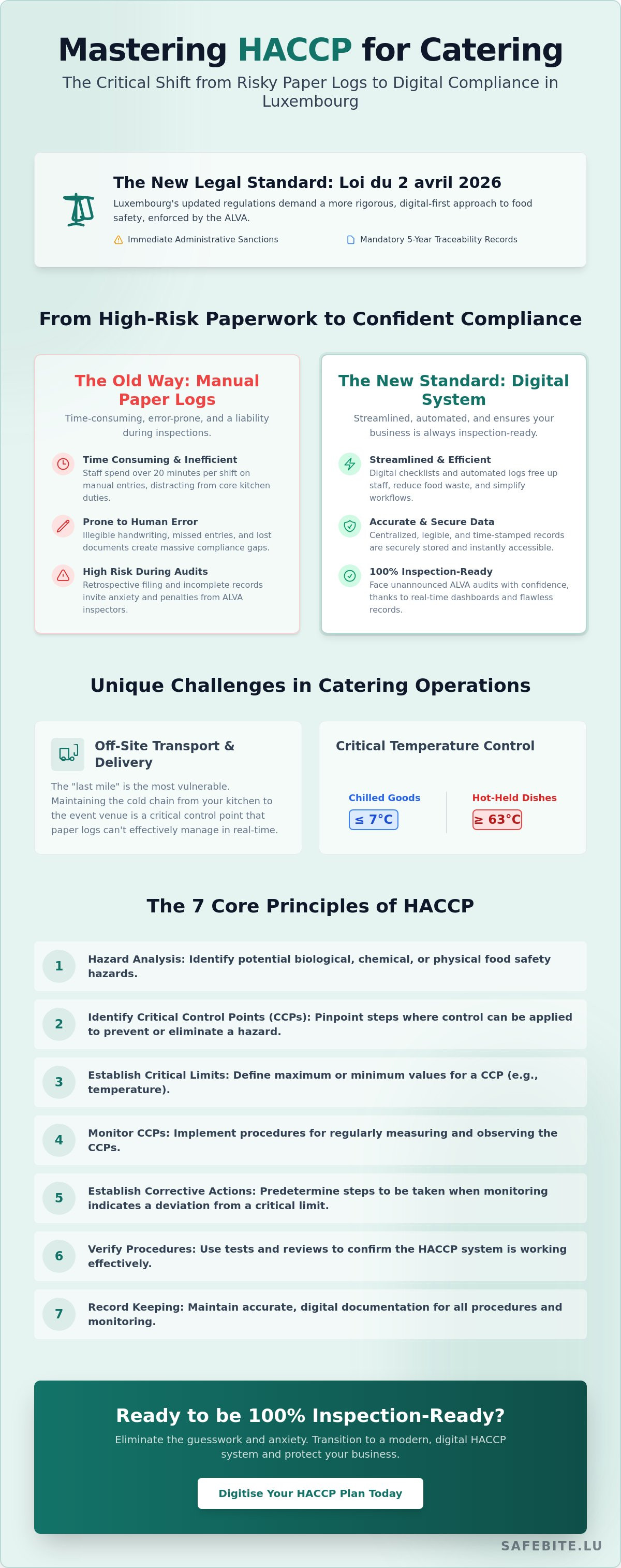
Catering operations demand a more robust plan than standard dining establishments because the supply chain is longer and more fragmented. When you're producing high-volume meals for hundreds of guests, a single error in hazard analysis can have widespread consequences. The most significant challenge is the "last mile" of food delivery. Maintaining the cold chain is critical; chilled goods must stay at or below 7°C, while hot dishes must remain at a minimum of +63°C throughout transport. General Horeca training provides your staff with basic hygiene awareness, but it isn't a substitute for a site-specific HACCP plan. A tailored strategy for HACCP for catering businesses Luxembourg must account for variable transport times, fluctuating external temperatures, and the specific equipment used for off-site service. Precision is mandatory. Efficiency follows order.
The 7 Principles of HACCP Applied to Catering Operations
Implementing a robust food safety framework requires moving beyond basic hygiene to a structured, scientific approach. The seven core principles of the HACCP Principles & Application Guidelines provide this structure, ensuring that every meal served is as safe as it is delicious. For professionals managing HACCP for catering businesses Luxembourg, these principles aren't just theoretical benchmarks; they're the operational gears that keep a high-volume kitchen running without incident. By systematically applying these steps, you transform a complex logistical operation into a controlled, predictable environment.
The process begins with Principle 1: Hazard Analysis and Principle 2: Identifying Critical Control Points (CCPs). In a catering context, a CCP is any stage where you can apply a control to prevent, eliminate, or reduce a food safety hazard to an acceptable level. This might include the reception of raw ingredients, the cooking process, or the loading of temperature-controlled transport vehicles. Identifying these points accurately is what separates a compliant business from one at risk during an ALVA audit.
Identifying Hazards in a Catering Environment
Catering operations face a unique set of biological, chemical, and physical risks. Biological hazards, such as Salmonella or Listeria, are particularly dangerous in large-batch cooking where internal temperatures can be uneven. Chemical hazards often stem from improper storage of cleaning agents, while physical hazards include foreign objects like glass or metal fragments. Understanding these risks is essential for staying aligned with Luxembourg food safety regulations, which demand rigorous oversight of cross-contamination during production and transport.
Once hazards are identified, you must establish Principle 3: Critical Limits. These are the boundaries that ensure safety. For example, the recognized standard for cooking high-risk foods is a core temperature of 75°C. For storage, chilled goods must remain at or below 7°C, while hot dishes must be held at a minimum of +63°C. If these limits aren't met, the safety of the food is compromised.
Establishing Monitoring and Corrective Actions
Monitoring (Principle 4) and Corrective Actions (Principle 5) are the heart of daily operations. You don't just set a limit; you must actively verify it's being met. If a refrigeration unit fails and temperatures rise to 9°C, your staff needs a clear, pre-defined corrective action, such as moving the stock to a backup unit or discarding it if the deviation lasted too long. This proactive vigilance ensures that errors are caught before they reach the consumer.
Finally, Principles 6 and 7 focus on verification and record-keeping. You must prove that your system works through regular reviews and maintain meticulous logs. Transitioning to digital HACCP logs makes this documentation seamless, ensuring you're always ready to demonstrate compliance. Under the 2026 laws, these records must be accurate, time-stamped, and easily accessible for inspection, providing a transparent history of your commitment to safety.
Overcoming the Challenges of Manual Food Safety Documentation
Relying on clipboards and binders creates a bottleneck in even the most efficient kitchens. Research indicates that staff in a typical kitchen spend 15 to 20 minutes per shift manually completing HACCP forms. For those managing HACCP for catering businesses Luxembourg, this adds up to hundreds of lost labor hours every year. Beyond the time lost, paper systems are inherently reactive. They tell you what happened hours ago, not what is happening right now in your cold storage or during off-site transport. This delay creates a window of risk that can compromise both food safety and regulatory standing. Efficiency is found through precision, not paperwork.
Why Paper Logs Fail During Inspections
The Luxembourg Veterinary and Food Administration (ALVA) has moved toward a more rigorous, digital-friendly inspection process since the implementation of the Loi du 2 avril 2026. Paper records are often difficult to store, prone to damage, and frequently suffer from legibility issues. Inspectors are particularly wary of "dry-labbing," the practice of retrospectively filling out logs to appear compliant. When an auditor sees identical handwriting and the same "perfect" temperatures recorded for an entire month, it triggers immediate suspicion. Manual recording is vulnerable to human error, often resulting in inaccurate temperature data that fails to reflect the true state of food safety. Under the current system of administrative sanctions, these inconsistencies lead directly to on-the-spot fines.
The Shift to Digital HACCP Management
Modernizing your approach involves transitioning to digital food safety checklists that ensure data integrity through time-stamping and mandatory fields. These systems eliminate the guesswork. If a refrigeration unit deviates from the required 7°C threshold, the system triggers a real-time alert, allowing for immediate corrective action before the stock is compromised. This proactive oversight is a key differentiator for HACCP for catering businesses Luxembourg that operate across multiple sites. It ensures that every team member, regardless of location, follows the exact same safety protocols.
Digital systems do more than just satisfy inspectors; they improve your bottom line. By using automated temperature monitoring, you can significantly reduce food waste, aligning your business with the EU targets to cut food waste by 30% per capita by 2030. Centralizing this data into a single dashboard gives owners total visibility without needing to be physically present at every event or kitchen. It's a transition from a state of constant anxiety to one of quiet, organized confidence. You don't just save time; you gain total control over your operational safety.
Implementing Your HACCP Plan: A Step-by-Step Guide
Constructing a compliant food safety system requires a methodical, phased approach. For those establishing HACCP for catering businesses Luxembourg, the plan must extend beyond the four walls of the kitchen to encompass every logistical touchpoint. A well-structured implementation ensures that your team isn't just following rules, but actively managing risks through a disciplined framework. This process transforms regulatory requirements into a streamlined operational routine.
- Step 1: Assemble your food safety team. Include representatives from production, logistics, and management to ensure the scope covers all catering activities.
- Step 2: Map your processes. Document the journey of food from supplier delivery and storage to preparation, transport, and final service at the event site.
- Step 3: Conduct hazard analysis and identify CCPs. Determine where safety risks are most likely to occur, such as during the cooling phase or while food is in transit.
- Step 4: Set up digital monitoring. Establish critical limits and configure automated alerts to notify managers immediately if a temperature threshold is breached.
- Step 5: Train your staff. Ensure every employee understands the new digital workflows and the specific Standard Operating Procedures (SOPs) for their role.
Managing CCPs During Food Transport
The "last mile" of delivery is often where catering safety is most vulnerable. Maintaining the integrity of the cold chain requires more than just insulated containers; it demands automated temperature monitoring that provides continuous data throughout the journey. You must validate that your thermal boxes and refrigerated vehicles are capable of keeping chilled goods at or below 7°C. Digital logs allow drivers to confirm delivery temperatures instantly, providing a transparent record that satisfies ALVA's traceability requirements. If you want to eliminate the stress of manual transport logs, explore how SafeBite automates your delivery checks.
Allergen Management and Matrix Accuracy
Luxembourg law mandates clear communication of the 14 major allergens to all consumers. In a catering environment, where menus change frequently for different events, maintaining an accurate allergen matrix is a critical safety step. Using digital tools to manage this information prevents cross-contact errors during high-pressure plating. It ensures that your staff has instant access to ingredient data, allowing them to answer guest inquiries with absolute confidence. Precision in allergen tracking isn't just a legal obligation; it's a fundamental part of your duty of care to your clients.
Digitising Your HACCP Plan with SafeBite for Inspection Readiness
Transitioning from a theoretical safety plan to daily operational excellence requires the right tools. SafeBite transforms the complexities of HACCP for catering businesses Luxembourg into a streamlined, digital workflow that works with your team, not against them. By automating daily hygiene tasks and temperature logs, the platform replaces the uncertainty of manual entry with the precision of real-time data. This shift doesn't just satisfy regulatory requirements; it instils a culture of proactive vigilance across your entire kitchen staff. When your records are digital, time-stamped, and tamper-proof, you're no longer just hoping to pass an inspection; you're proving your commitment to safety every single day.
The core advantage of this digital transition is the Multi-site Management Dashboard. For catering managers overseeing multiple event locations or central production units, having a single source of truth is invaluable. You can verify compliance across all sites without leaving your office. Because the mobile interface is designed for the fast-paced reality of a professional kitchen, staff training time is significantly reduced. Employees don't need to be compliance experts to follow the intuitive checklists; they simply need to follow the guided prompts on their devices. Efficiency becomes the standard, and errors become the exception.
Smart Reminders and Real-Time Oversight
One of the greatest risks in a busy catering environment is the forgotten check. SafeBite eliminates this vulnerability through automated push notifications that alert staff when a task is due. If a critical check is missed or a temperature limit is breached, managers receive immediate alerts, allowing for instant intervention. This remote monitoring capability is essential for managing off-site events where you can't be physically present. You can customise every checklist to match your specific catering SOPs, ensuring that whether your team is plating in a ballroom or a temporary marquee, they're adhering to the exact standards defined in your HACCP plan.
Securing Your Compliance Future
The regulatory landscape is constantly shifting, but your business doesn't have to struggle to keep up. Staying aligned with the latest Luxembourg food safety authority guidelines is effortless when your system updates automatically to reflect new requirements. The return on investment for a digital system is clear when you weigh the subscription cost against the hundreds of labor hours saved on manual documentation and the potential cost of ALVA fines. Your next step toward a friction-free operation is simple: consolidate your records into a digital compliance folder. This ensures that when an inspector arrives, you can provide comprehensive, professional proof of safety with a single click, securing the future of your catering business in Luxembourg's modern regulatory environment.
Secure Your Compliance Strategy for 2026
The transition to the Loi du 2 avril 2026 marks a new era of transparency and accountability for the Grand Duchy's food sector. Relying on outdated manual systems creates unnecessary vulnerabilities during ALVA audits and complicates the already demanding logistics of off-site service. By embracing a digital-first approach, you don't just meet the legal requirements; you build a more resilient and efficient operation. Mastering HACCP for catering businesses Luxembourg involves integrating precise monitoring into your daily routines, ensuring that food safety remains a silent, reliable partner in your success.
We've explored how identifying critical control points and automating your documentation can eliminate the stress of unannounced inspections. Now is the time to replace the clipboard with a solution that offers real-time oversight and long-term security. Explore SafeBite’s Digital HACCP Checklists today to implement inspection-ready digital logs and real-time temperature alerts designed specifically for Luxembourg hospitality standards. You have the expertise to deliver exceptional catering; let technology provide the peace of mind that your compliance is always 100% ready. Your journey toward a smarter, safer kitchen starts with a single digital step.
Frequently Asked Questions
Is HACCP mandatory for small catering businesses in Luxembourg?
Yes, implementing a documented food safety management system is a legal requirement for all food business operators under the Loi du 2 avril 2026. This mandate applies regardless of business size, including temporary event setups and market stalls. Every operator must register with the Luxembourg Veterinary and Food Administration (ALVA) and demonstrate that they are actively managing food safety risks through the seven HACCP principles.
What are the most common CCPs in a catering kitchen?
Critical Control Points (CCPs) typically include the reception of high-risk ingredients, core cooking temperatures, cooling phases, and the transport of finished dishes. For caterers, the loading and delivery phase is a vital CCP to ensure chilled goods remain at or below 7°C and hot foods stay above 63°C. Identifying these points accurately allows you to apply controls that prevent or eliminate biological and physical hazards.
How long must I keep HACCP records for the Luxembourg food safety authority?
Traceability records must be retained for five years to comply with ALVA requirements and national law. Daily HACCP logs, such as temperature checks and cleaning schedules, should be kept for at least the shelf-life of the product plus a reasonable buffer period. Storing these records in a digital format ensures they remain legible, organized, and instantly accessible during unannounced inspections by the food safety authorities.
Can I use a digital app instead of paper logs for my HACCP documentation?
Yes, you can and are encouraged to use digital systems for managing HACCP for catering businesses Luxembourg. ALVA inspectors favor digital records because they provide accurate, time-stamped, and transparent data that is difficult to falsify. Transitioning to a digital application eliminates the risks of "dry-labbing" and ensures your documentation is always inspection-ready, reflecting the digital-first approach emphasized in the 2026 regulatory framework.
How often should a catering business review its HACCP plan?
You should review your HACCP plan at least once a year or whenever your operational processes change. Significant triggers for a review include changing suppliers, introducing new high-risk menu items, or moving to a new production facility. Regular verification ensures that your safety protocols remain effective against evolving risks and that your staff stays aligned with the most current Luxembourg food safety standards.
What happens if a health inspector finds an error in my temperature logs?
Under the Loi du 2 avril 2026, ALVA has the authority to issue immediate administrative sanctions, including on-the-spot fines known as "avertissements taxés." If the inspector identifies systemic failures or a history of inaccurate logs, your business could face more severe penalties or temporary closure. Digital monitoring systems help mitigate this risk by triggering real-time alerts the moment a temperature deviation occurs, allowing for immediate correction.
Do I need specific training to use digital HACCP software?
While official HACCP training covers the methodology, most digital software is designed with intuitive interfaces that require very little technical instruction. Your staff can typically master digital checklists and temperature monitoring tools within a single shift. It remains the responsibility of the food business operator to ensure and document that all employees are competent in using the chosen system to maintain daily compliance.
How does digital allergen management work for seasonal menus?
Digital tools allow you to update your allergen matrix instantly as your menu evolves with the seasons. Instead of reprinting complex paper charts, you update a centralized database that synchronizes across all staff devices. This ensures that your team always has access to accurate information regarding the 14 mandatory allergens, allowing them to answer guest inquiries with absolute confidence and reducing the risk of cross-contact errors.