
The most successful kitchens don't prepare for health inspections; they operate in a state where the inspection is already won. It's understandable to feel a surge of anxiety when an official walks through the door unannounced, especially with the weight of inconsistent staff protocols and manual paperwork on your mind. Understanding exactly what inspectors look for in kitchen hygiene is the first step toward replacing that fear with professional confidence. By aligning your daily operations with the 2022 FDA Food Code, you can ensure that every temperature log and allergen label meets the highest regulatory standards.
This guide will help you master the specific criteria used by health inspectors to evaluate your facility, from critical poultry temperatures of 165°F to the essential presence of a knowledgeable Person-in-Charge. You'll learn how to maintain a permanent state of inspection-readiness through streamlined digital documentation and proactive oversight. We'll explore the shift toward data-driven enforcement in 2026, the inclusion of sesame as a major allergen, and the precise steps needed to secure a top rating for your HACCP systems.
Key Takeaways
- Shift your perspective by viewing health inspectors as proactive partners in public safety rather than just external auditors.
- Identify the core pillars of on-site evaluations, ranging from hygienic food handling protocols to the physical maintenance of your facility.
- Gain a precise understanding of what inspectors look for in kitchen hygiene by focusing on high-risk areas like cooling cycles and handwashing compliance.
- Avoid the common "documentation trap" by replacing unreliable manual logs with secure, digital audit trails that prove consistent adherence.
- Learn how to maintain a permanent state of inspection-readiness using automated checklists and real-time temperature monitoring systems.
Understanding the Framework: What is a Kitchen Hygiene Inspection?
An inspection is a vital snapshot of your operational integrity. While it's easy to view the official at your door as an adversary, they are actually a partner in public health. Their primary mission is to verify that your kitchen follows scientific food safety and hygiene principles to prevent foodborne illness. In the hospitality sector, these visits are almost always unannounced. This surprise element ensures that your hygiene standards remain consistent every hour of the day, not just when you're expecting visitors.
In Luxembourg, the governing body responsible for these checks is the Luxembourg Food Safety Authority (ALVA). They operate with a standardized framework designed to evaluate three core areas. First, they look at food hygiene, which covers how food is handled and stored. Second, they assess the physical structure of your premises, including cleanliness and pest control. Finally, they review your management and documentation systems. Knowing exactly what inspectors look for in kitchen hygiene helps you turn a potentially stressful event into a routine validation of your professional standards.
The Purpose of Regulatory Oversight
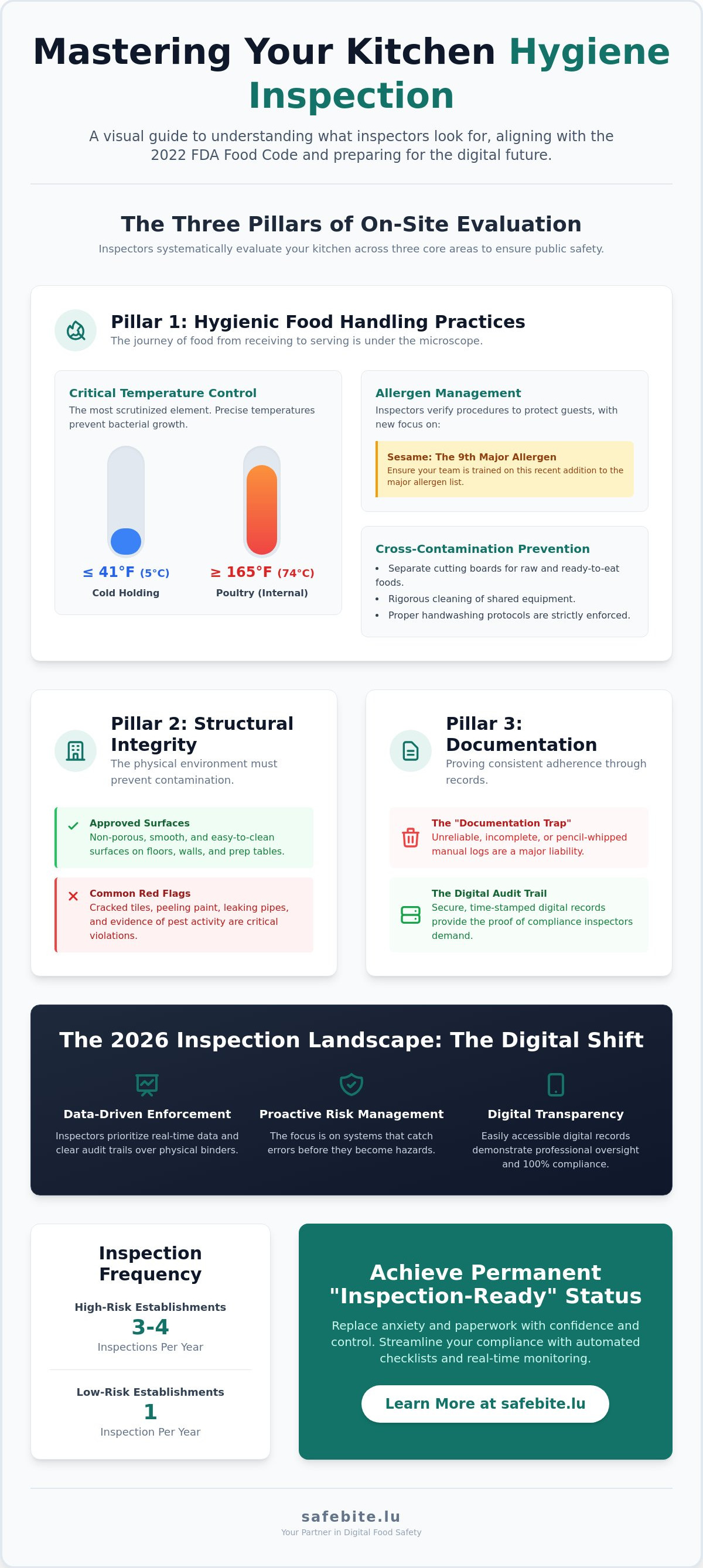
Inspections are the primary tool for protecting consumer trust. When a kitchen fails to meet the mark, it puts the public at risk and exposes the business to severe legal implications. In Luxembourg, serious non-compliance can result in administrative fines or the suspension of your operating license. ALVA uses a risk-based approach to decide how often they visit. High-risk establishments with complex preparation processes can expect to be inspected 3 to 4 times per year. If your business has a history of high standards and a low-risk profile, these visits may occur annually. This frequency ensures that safety never takes a backseat to operational speed.
The 2026 Inspection Landscape
Modern inspectors now prioritize digital transparency over the traditional clutter of physical binders and handwritten notes. The industry is moving away from reactive cleaning toward a culture of proactive risk management. The Luxembourg Food Safety Regulations establish the baseline for all audits conducted this year. Inspectors want to see that you have a system in place that catches errors before they become hazards. They value real-time data and clear audit trails that demonstrate 100% compliance across all shifts. When your records are digital and easily accessible, you provide the level of professional oversight that 2026 regulators expect.
The Three Pillars: What Inspectors Evaluate on Site
When an official enters your workspace, they are scanning for more than just visible dirt. They focus on the high-risk activities that directly impact consumer health. Understanding what inspectors look for in kitchen hygiene requires a deep dive into three specific operational pillars. Each pillar represents a layer of protection against contamination; a failure in any one can lead to a priority violation. Inspectors use these categories to determine if your kitchen is merely surviving or truly thriving under a robust safety culture.
Pillar 1: Hygienic Food Handling Practices
The core of any inspection is the handling of high-risk foods. Inspectors closely monitor the journey of ingredients from receiving to service, looking for any opportunity for cross-contamination. They pay particular attention to allergen management, especially since sesame was officially recognized as the ninth major food allergen. Your team must demonstrate clear separation between prep areas and rigorous cleaning of shared equipment. Temperature control is the most scrutinized element of this pillar. Officials check that cold holding remains at 41°F (5°C) or below and that poultry reaches a minimum internal temperature of 165°F (74°C), as specified in the FDA Food Code. Relying on manual checks is a risk; most modern kitchens now utilize automated temperature monitoring to ensure cold chain integrity 24/7. This technology provides the precise, unalterable data that inspectors value most.
Pillar 2: Structural Integrity and Cleanliness
The physical environment must support safe food production. Inspectors look for non-porous, smooth surfaces that are easy to sanitize. Cracked tiles, leaking pipes, or peeling paint are more than just aesthetic issues; they are potential breeding grounds for bacteria. Handwashing stations must be accessible, fully stocked with soap and paper towels, and used exclusively for hygiene. If an inspector sees a staff member rinsing a cloth in a hand sink, it's an immediate red flag. Ventilation and lighting must also be adequate to prevent grease buildup and ensure staff can see contaminants. Finally, your pest control monitoring must be active and documented. A clean kitchen with a hole in the wall is still a compromised kitchen. Maintaining these standards is easier when you use a Multi-site Management Dashboard to oversee facility maintenance across all your locations.
Pillar 3: Management and Training
A pristine kitchen means little if the staff don't understand why they are cleaning. Inspectors gauge your "food safety culture" through informal staff interviews. They might ask a line cook what the corrective action is for a failing refrigerator or how they handle a customer's nut allergy. If the answers are inconsistent, it suggests a management failure. You must maintain up-to-date training records for every employee to prove they've been briefed on current protocols. The implementation of digital food safety checklists is a powerful way to demonstrate consistent management. These tools ensure that daily tasks are never skipped and provide a transparent audit trail that builds immediate trust with the inspector. When your team is trained and your records are digital, you move from a reactive state to a position of proactive vigilance.
The Documentation Trap: Why Records Matter More Than Ever
In the eyes of a health official, your kitchen’s history is only as reliable as its documentation. A common mantra among regulators is that if it isn’t written down, it didn’t happen. While the physical state of your floors and prep tables is part of what inspectors look for in kitchen hygiene, your records provide the essential context for those observations. They show whether your standards are a daily habit or a last-minute scramble. Maintaining accurate logs serves as your primary due diligence defense, proving that you have taken all reasonable precautions to protect public health. If a foodborne illness is ever linked to your establishment, these records are the only evidence that can shield your business from severe legal liability.
Paper fails. It smudges, gets lost, or sits forgotten on a clipboard during a busy shift. These gaps are more than just clerical errors; they are red flags to an auditor. Digital timestamps offer a level of reliability that manual entries simply cannot match. When an entry is logged electronically, it creates an unalterable trail that confirms exactly when and by whom a check was performed. This shift from manual to digital oversight turns your paperwork from a potential liability into a strategic asset that demonstrates proactive management.
Mastering HACCP Record-Keeping
A robust HACCP plan requires a specific set of logs to be effective. These include:
- Daily temperature logs for all cold and hot holding units.
- Cleaning schedules for equipment and structural surfaces.
- Pest control monitoring reports and site maps.
- Staff illness reporting logs and training certificates.
Human error often compromises these records. Moving toward digital HACCP record keeping eliminates the risk of illegible handwriting or forgotten entries. It's equally important to document corrective actions. If a refrigerator exceeds 41°F, the inspector won't just look for the failure; they want to see exactly how you responded to fix it. A documented repair or stock disposal proves your safety system is functional and responsive.
The Risk of Fraudulent or Incomplete Logs
Experienced inspectors are trained to spot dry-labbing, the practice of filling out multiple days of logs in a single sitting. They look for identical ink colors, repetitive handwriting patterns, and suspiciously perfect numbers that don't reflect natural fluctuations. Missing or obviously fabricated documentation during a surprise visit can lead to immediate point deductions or a lower hygiene rating. A centralized Multi-site Management Dashboard provides instant, timestamped proof of compliance across your entire operation. This digital transparency builds immediate trust, showing exactly what inspectors look for in kitchen hygiene: accuracy, accountability, and a commitment to data-driven safety.
Common Red Flags and How to Pre-empt Them
Certain lapses act as immediate triggers for deeper scrutiny. When an official from ALVA enters, they often check high-visibility areas first to gauge the overall discipline of the team. Inadequate handwashing facilities, such as a sink blocked by a crate or lacking soap, suggest a fundamental breakdown in safety culture. Beyond the sink, poor temperature control during the cooling of high-risk foods remains a leading cause of priority violations. You must cool cooked foods from 135°F to 70°F within two hours to effectively prevent bacterial growth. If your team can't prove this timeline through precise logs, the inspector will likely assume the food is unsafe. Understanding exactly what inspectors look for in kitchen hygiene allows you to fix these red flags before the door even opens.
Personal Hygiene and Staff Behavior
Staff behavior is a living reflection of your management standards. Clean protective clothing and effective hair restraints aren't just suggestions; they're mandatory requirements for every person in the prep area. Inspectors also enforce strict rules against wearing jewelry, other than a plain wedding band, and prohibit smoking or eating near food. A clear, written employee illness reporting policy is essential for compliance. Every team member must know they're legally required to report symptoms like fever or jaundice to the Person-in-Charge before their shift begins. This proactive communication prevents outbreaks before they can start.
A robust safety culture extends beyond hygiene to include physical well-being and proper equipment handling; for professional guidance on team compliance, you can learn more about Guardian Safety and their comprehensive safety training modules.
Waste Management and Pest Control
Your back-of-house management directly impacts your final hygiene rating. Learning how to reduce food spoilage in restaurants is a key part of this process, as decaying organic waste attracts pests and creates cross-contamination risks. External waste bins must have tight-fitting lids and be emptied frequently to prevent overflow. ALVA maintains a zero-tolerance policy for active pest infestations. Even a single sighting can lead to an immediate closure order, which makes proactive monitoring a structural necessity for any professional kitchen. Regular inspections of delivery areas and storage seals are your best defense against unwanted visitors.
Allergen Management Accuracy
In 2026, the allergen matrix is scrutinized as closely as refrigeration logs. With sesame now a major allergen and others under review, your menu information must be 100% accurate. Every decanted ingredient, from bulk spices to oils, requires a clear label that identifies potential allergens. Cross-contact during peak service hours is a significant risk that inspectors watch for carefully. They want to see that your team uses dedicated utensils and cleaned surfaces for every specific allergen request. To ensure your team never misses a critical check, you can use an Allergen Management Tool to maintain perfect accuracy during every shift.
Achieving "Inspection-Ready" Status with SafeBite
Operating a professional kitchen in 2026 requires more than just a clean workspace; it demands a verifiable system of digital oversight. When you understand exactly what inspectors look for in kitchen hygiene, it becomes clear that paper logs and verbal promises are no longer sufficient. SafeBite replaces the uncertainty of manual record-keeping with a streamlined digital infrastructure. Our Digital HACCP Checklists ensure 100% completion of daily safety tasks by guiding staff through their requirements in real time. If a task is missed, management is notified immediately. This level of proactive vigilance transforms hygiene from a source of anxiety into a measurable, manageable part of your daily workflow.
One of the most powerful tools in your compliance arsenal is our Temperature Monitoring System. Instead of relying on staff to manually check refrigerators every few hours, sensors provide continuous data and real-time alerts for any excursions. This allows you to catch a failing unit before it enters the danger zone, preventing both food waste and priority violations. During an unannounced visit, you can provide instant access to all historical records with a few taps on a mobile device. This transparency builds immediate trust with officials, showing them that your kitchen operates with a level of precision that exceeds the baseline requirements of the law.
The SafeBite Advantage for Luxembourg Kitchens
SafeBite is specifically designed to align with the latest Luxembourg Food Safety Authority Guidelines. For restaurant groups, our Multi-site Management Dashboard provides a high-level view of compliance across every location, allowing you to identify and fix regional gaps before they result in a poor rating. The system also helps reduce food waste by automating FIFO (First-In, First-Out) protocols and providing better oversight of ingredient shelf lives. By simplifying staff training with an intuitive, mobile-first interface, you ensure that even new hires can execute safety protocols with the same accuracy as your veteran team.
Next Steps: From Anxiety to Authority
The transition to a digital-first kitchen begins with a simple self-audit. Use your current data to identify where gaps exist, whether in cooling logs, allergen labeling, or staff training records. Once you've identified these areas, you can set up automated reminders for every Critical Control Point (CCP) check. This ensures that your team never misses a beat, regardless of how busy the service becomes. Taking these steps moves your business from a reactive state of "hoping for the best" to a position of total authority over your operational standards. To see how these tools can protect your business, book a demo to digitize your kitchen hygiene management today.
Mastering Permanent Inspection Readiness
Mastering the specifics of what inspectors look for in kitchen hygiene is more than a regulatory hurdle; it's a fundamental commitment to operational excellence. We've explored how shifting from manual logs to digital systems eliminates human error and provides the unalterable proof that ALVA officials expect in 2026. By focusing on the three pillars of hygiene, structure, and management, you turn every shift into a successful audit. A well-prepared kitchen doesn't just pass inspections; it builds a foundation of consumer trust that protects your brand's reputation for the long term.
Maintaining this level of precision doesn't have to be overwhelming. You can digitize your HACCP logs and stay inspection-ready with SafeBite. Our platform offers automated temperature alerts and a real-time compliance dashboard specifically designed for Luxembourg hospitality standards. This proactive approach ensures your team is always prepared for a surprise visit, allowing you to focus on delivering exceptional service with complete peace of mind. Your journey toward total compliance starts with the right tools, and the transition is simpler than you think.
Frequently Asked Questions
What are the three main areas a food hygiene inspector will check?
Inspectors evaluate three primary areas: food hygiene, structural integrity, and management systems. They monitor how food is handled and stored, the cleanliness and maintenance of the physical premises, and the effectiveness of your HACCP-based procedures. This comprehensive approach ensures that every aspect of your operation supports public health and prevents the risk of foodborne illness outbreaks.
Can a health inspector shut down my kitchen immediately?
An inspector has the authority to suspend your operations immediately if they discover an imminent health hazard. This includes conditions like a lack of running water, sewage backup, or a significant pest infestation that compromises food safety. In these cases, the kitchen must remain closed until the specific issues are corrected and a follow-up inspection confirms the premises are safe.
How often do food hygiene inspections happen in Luxembourg?
In Luxembourg, the frequency of inspections is determined by the risk category assigned to your business by ALVA. High-risk establishments with complex menus or a history of non-compliance are typically inspected 3 to 4 times per year. Conversely, lower-risk businesses or those with a proven record of high standards may only see an inspector annually.
What is the most common reason for failing a kitchen hygiene inspection?
The most common reasons for failure are inadequate temperature control and poor documentation. When officials evaluate what inspectors look for in kitchen hygiene, they often find that cooling cycles for high-risk foods don't meet the required timeframes. These technical failures, combined with missing or incomplete manual logs, often lead to priority violations and a lower overall rating.
Is digital HACCP documentation legally accepted by inspectors?
Digital HACCP documentation is fully accepted and often preferred by inspectors for its accuracy and reliability. These systems eliminate common issues like "dry-labbing" or illegible handwriting by providing secure, timestamped entries. Utilizing digital records demonstrates a sophisticated approach to what inspectors look for in kitchen hygiene, proving that your safety protocols are active and consistently monitored.
What happens if an inspector visits while the manager is away?
The inspection will continue even if the manager is absent. Under current food safety regulations, a knowledgeable Person-in-Charge (PIC) must be present during all hours of operation. This individual must be able to demonstrate food safety knowledge and provide the inspector with immediate access to all necessary records, including temperature logs and staff training files.
Do I need a separate log for allergen cross-contamination checks?
While a separate log isn't strictly required, your HACCP system must clearly document how you manage allergen risks. This includes verifying ingredients upon delivery and ensuring staff follow specific cleaning protocols to prevent cross-contact. Using a digital allergen management tool can simplify this process by providing a clear, accessible record for inspectors to review during their visit.
How can I check my current food hygiene rating or status?
In Luxembourg, you can confirm your current status by reviewing the official reports provided by the Luxembourg Food Safety Authority (ALVA) after each visit. These documents outline your compliance level and any required improvements. Maintaining a digital history of these reports allows you to track your progress and ensure you are always ready for the next unannounced inspection.