
What if the 20 minutes your staff spends manually logging temperatures every shift is actually increasing your risk of an on-the-spot fine? Under the Loi du 2 avril 2026, meeting the specific food storage temperature requirements Luxembourg enforces is no longer a matter of pen and paper; it is a matter of digital proof. You likely recognize the stress of an unannounced ALVA inspection, where a single degree of deviation or a missing log entry can lead to immediate administrative sanctions.
We understand that maintaining a high-performance kitchen while ensuring total regulatory compliance is a constant challenge. You need a reliable way to protect your inventory from spoilage and your business from legal liability. This guide provides a clear roadmap to mastering Luxembourg's food safety standards and implementing a digital-first cold chain. We will detail the mandatory limits for chilled, frozen, and hot-held items, while showing you how to replace time-consuming manual tasks with automated, audit-ready HACCP documentation.
Key Takeaways
- Navigate the updated 2026 ALVA inspection framework and understand the shift toward immediate administrative sanctions under the latest Luxembourg legislation.
- Learn the mandatory food storage temperature requirements Luxembourg sets for chilled and frozen inventory to ensure your facility remains compliant with professional safety standards.
- Uncover the hidden labor costs and regulatory risks associated with manual pen-and-paper logging in a modern, high-pressure professional kitchen.
- Implement robust monitoring protocols for critical control points that safeguard your products from the moment of delivery through long-term storage.
- Explore how a digital temperature monitoring system can transform your HACCP workflow into a streamlined, automated process that eliminates human error.
Luxembourg Food Safety Framework and the Temperature Danger Zone
The Luxembourg Veterinary and Food Administration (ALVA) centralizes oversight for all food sector operators across the Grand Duchy. Since its establishment in 2022, ALVA has consolidated the functions of former veterinary services and the health directorate to create a unified inspection force. With the introduction of the Loi du 2 avril 2026, the regulatory landscape has shifted toward a regime of immediate administrative sanctions. Inspectors now have the authority to issue taxed warnings or on-the-spot fines for specific violations, making it vital to strictly adhere to the food storage temperature requirements Luxembourg enforces.
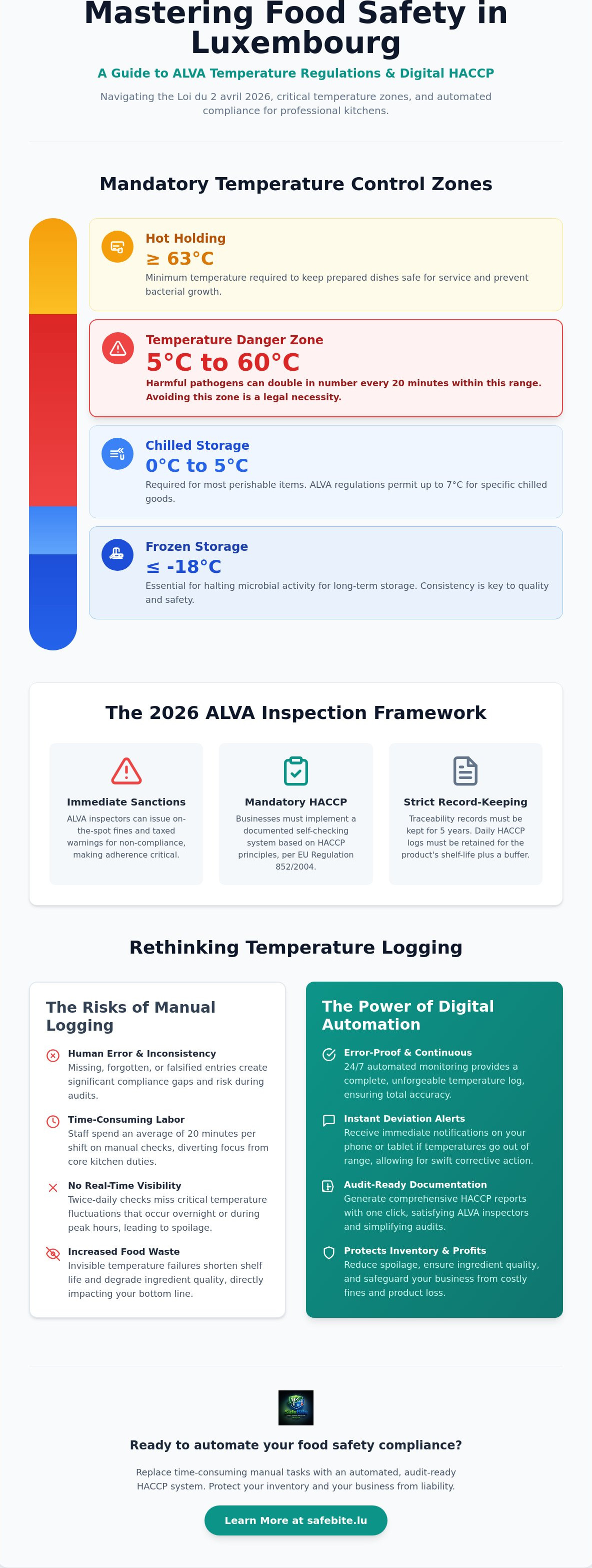
At the core of these inspections is the Temperature Danger Zone. In a professional kitchen environment, this critical range spans from 5°C to 60°C. Within these boundaries, harmful pathogens can double in number every 20 minutes. Maintaining temperatures outside this window isn't just a recommendation for quality; it's a legal necessity to prevent rapid microbial multiplication that leads to foodborne illness. Consistent monitoring is the only way to prove you've kept high-risk items out of this hazardous range.
National Regulatory Standards for 2026
Luxembourg operates under the strict umbrella of EU Regulation 852/2004, which mandates that every food business implement a documented self-checking system based on HACCP principles. The Commissariat au gouvernement à la qualité, à la fraude et à la sécurité alimentaire ensures these standards remain uniform. For professional operators, record-keeping is a heavy but necessary burden. Traceability records must be retained for five years. Daily HACCP logs, including temperature checks, should be kept for at least the shelf-life of the product plus a reasonable buffer period to satisfy ALVA auditors during unannounced visits.
Impact of Temperature Fluctuations on Food Quality
Proactive vigilance protects more than just your legal standing; it protects your bottom line. Micro-fluctuations often occur during peak service hours when refrigerator doors are opened frequently. These spikes might not lead to immediate spoilage, but they significantly shorten the shelf life of delicate ingredients. There's also a direct relationship between storage stability and the integrity of prepared dishes containing allergens. When food spoils prematurely due to poor climate control, your margins shrink. High food waste is frequently a symptom of invisible temperature failures that manual, twice-daily checks simply cannot detect in real-time.
Specific Temperature Requirements for High-Risk Food Groups
Precision is the foundation of food safety in a professional environment. While general guidelines offer a baseline, professional operators must adhere to category-specific thresholds to guarantee both safety and quality. The food storage temperature requirements Luxembourg mandates are non-negotiable. Chilled perishables generally require a range of 0°C to 5°C to maximize shelf life, though ALVA regulations permit up to 7°C for specific chilled goods. Frozen inventory must stay at -18°C or colder to halt microbial activity effectively. Hot holding requires a minimum of 63°C to ensure prepared dishes remain safe for service, while dry storage should be maintained in a cool, ventilated space to prevent the spoilage of shelf-stable goods.
Chilled and Frozen Storage Protocols
High-risk items like raw poultry, minced meat, and dairy demand the strictest oversight because they are highly susceptible to rapid bacterial growth. These products should be stored in the coldest part of your refrigeration units, typically the bottom shelves. Managing "thaw and use" items is another critical area where errors occur. Once a product begins the defrosting process, it must never be refrozen. The structural changes during thawing create an ideal environment for pathogens if the temperature isn't monitored. A robust FIFO implementation in a commercial kitchen supports these protocols by ensuring older stock is used first, reducing the time high-risk items spend in storage and improving overall airflow within the units.
Specialised Storage: Seafood and Prepared Goods
Fresh seafood requires a nuanced approach that standard refrigeration often can't provide alone. Storing fresh fish on a bed of crushed, draining ice keeps the product at an optimal 0°C to 2°C, which preserves texture better than air cooling. When it comes to prepared goods, the cooling phase is a major risk factor. You must move hot food through the danger zone quickly. Follow the 2-hour/4-hour rule: cool food from 60°C to 20°C within two hours, and down to 5°C within the next four. Vacuum-packed and sous-vide products present unique anaerobic risks, such as botulism, and require constant, precise chilled storage to remain compliant.
Maintaining these varied standards across multiple storage zones can be complex for a busy team. Implementing a digital Temperature Monitoring System provides the real-time oversight needed to manage these high-risk categories without the stress of manual checks.
The Risks of Manual Temperature Logging in Modern Kitchens
Traditional paper logs are a staple in many kitchens, yet they represent a significant vulnerability in your food safety strategy. Relying on staff to manually record the food storage temperature requirements Luxembourg mandates often leads to "dry-labbing." This practice, where logs are filled out retrospectively based on guesswork rather than actual readings, creates a false sense of security. It isn't just a lack of discipline; it's a systemic risk. When an ALVA inspector arrives, they look for consistency and authenticity. Inconsistent or obviously forged logs can trigger immediate administrative sanctions under the 2026 legal framework, potentially resulting in on-the-spot fines that impact your bottom line.
The hidden cost of manual checks is also measured in labor. Staff in a typical kitchen spend roughly 15 to 20 minutes per shift manually completing HACCP forms. Over a year, this adds up to hundreds of lost labor hours. These are hours your team could spend on culinary precision or guest experience. Beyond the time lost, manual logging suffers from the "gap problem." A paper log is merely a periodic snapshot. It tells you the temperature at 10 AM and 4 PM, but it offers no visibility into what happened at 3 AM when a compressor failed or a door was left ajar. You only discover the failure when it's too late, leading to high food waste and unnecessary spoilage costs.
Common Pitfalls in Manual Monitoring
Manual systems are only as accurate as the tools and the people using them. Inaccurate readings often occur due to poorly placed analog thermometers, such as those hung too close to a door where they catch warm air drafts. Furthermore, verifying how to calibrate a food thermometer on a paper-based system is notoriously difficult. Without a digital trail, you can't easily prove to auditors that your equipment was functioning correctly at the time of the reading. Shift changes and staff turnover also pose a threat; historical data is easily misplaced or poorly handed over, leaving gaps in your multi-year traceability records.
The Shift to Digital Accountability
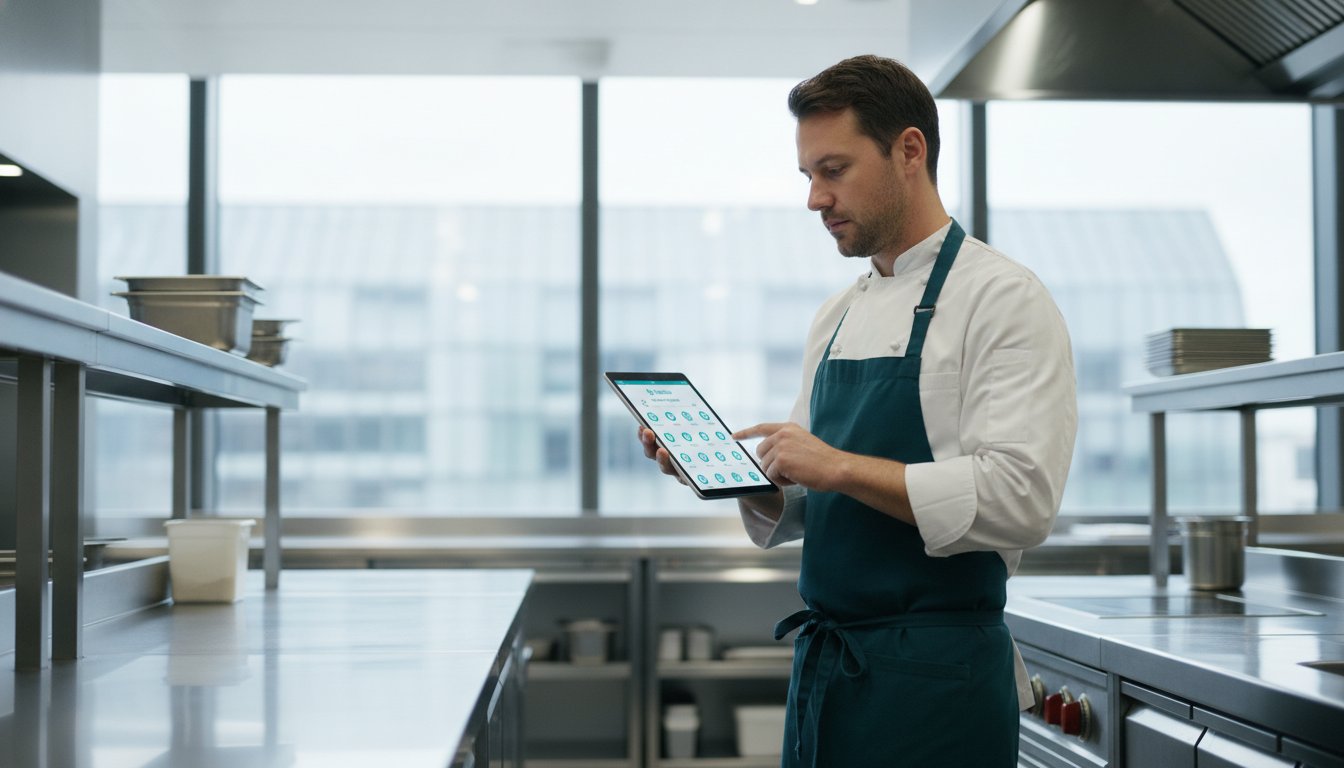
Modern health inspectors increasingly prefer digital records because they are time-stamped, unalterable, and easily accessible. Transitioning to a digital-first approach provides 24/7 visibility into your fridge performance, even when the kitchen is closed. Instead of reacting to a spoiled shipment in the morning, you receive proactive alerts on your mobile device the moment a unit drifts toward the danger zone. This shift from reactive to proactive food safety management doesn't just ensure compliance. It safeguards your reputation and ensures that every ingredient remains at peak quality for your customers.
Critical Control Points: Receiving and Monitoring Procedures
The safety of your inventory begins the moment a delivery vehicle arrives at your loading bay. This is the first critical control point where you have the power to stop potential hazards before they enter your kitchen. By establishing a rigorous receiving protocol, you ensure that every ingredient adheres to the food storage temperature requirements Luxembourg mandates. This proactive approach prevents the introduction of temperature-compromised goods into your storage units, where they could jeopardize the rest of your stock.
- Step 1: Vehicle Inspection. Before unloading, check the delivery vehicle's built-in temperature display. Chilled goods should arrive at or below 7°C, while frozen items must be at -18°C or lower.
- Step 2: Core Temperature Verification. Use a calibrated probe to check the internal temperature of high-risk items. Don't rely solely on the surface temperature of the packaging, as this can be misleading.
- Step 3: Swift Transfer. Move products immediately to their designated storage zones. Leaving perishables on a room-temperature loading dock, even for 15 minutes, can trigger unwanted microbial growth.
- Step 4: Digital Traceability. Log the receipt data, including the supplier name, batch number, and temperature reading, into your digital dashboard for permanent, unalterable record-keeping.
Corrective Actions for Temperature Breaches
A safety plan is only effective if your team knows how to respond when things go wrong. If a delivery arrives above the legal threshold, you must initiate the 'Reject' protocol. Refuse the shipment and document the reason clearly in your logs. ALVA inspectors value the presence of recorded corrective actions because it proves your self-checking system is functioning as intended. Similarly, if a refrigeration unit fails during service, your team needs an emergency plan to move stock to a backup unit or discard it if it has spent too long in the danger zone. Every deviation must be recorded with a corresponding action to maintain full compliance and protect your reputation.
Ensuring Equipment Accuracy
Don't trust built-in fridge displays blindly. These sensors are often positioned near the cooling coils and may not reflect the actual temperature of the food stored on the middle or bottom shelves. Verify these readings against independent, calibrated sensors to ensure accuracy. This level of precision should extend to all areas of your operation, including validating cooking temperatures and times to ensure total safety from receipt to service. Regular maintenance of door seals and condenser coils is equally vital to prevent energy loss and ensure your units can maintain the necessary environmental conditions.
Streamlining these complex checks is simpler with the right tools. You can automate your documentation and receive instant alerts by switching to a digital Temperature Monitoring System today.
Optimising Compliance with SafeBite Temperature Monitoring
Achieving total alignment with the food storage temperature requirements Luxembourg mandates shouldn't feel like a constant administrative burden. SafeBite transforms this complex regulatory necessity into a streamlined, automated workflow. By integrating a digital Temperature Monitoring System, you move beyond the limitations of manual snapshots and gain continuous oversight of your cold chain. This transition doesn't just satisfy ALVA auditors; it empowers your team to maintain the highest standards of culinary excellence without the friction of paper-based systems.
Imagine a scenario where a walk-in freezer door is left slightly ajar at midnight. Without digital intervention, you'd discover the failure at 8 AM, likely facing thousands of euros in lost stock and a significant gap in your traceability logs. SafeBite prevents this by sending automated alerts directly to your mobile device the moment a unit drifts toward the danger zone. This proactive vigilance allows for immediate intervention before spoilage occurs, effectively protecting your margins and your professional reputation. Whether you're managing a single kitchen or a sprawling estate, the Multi-site Management Dashboard centralises your data, ensuring that safety standards remain uniform across every location.
The Power of Automated Digital HACCP
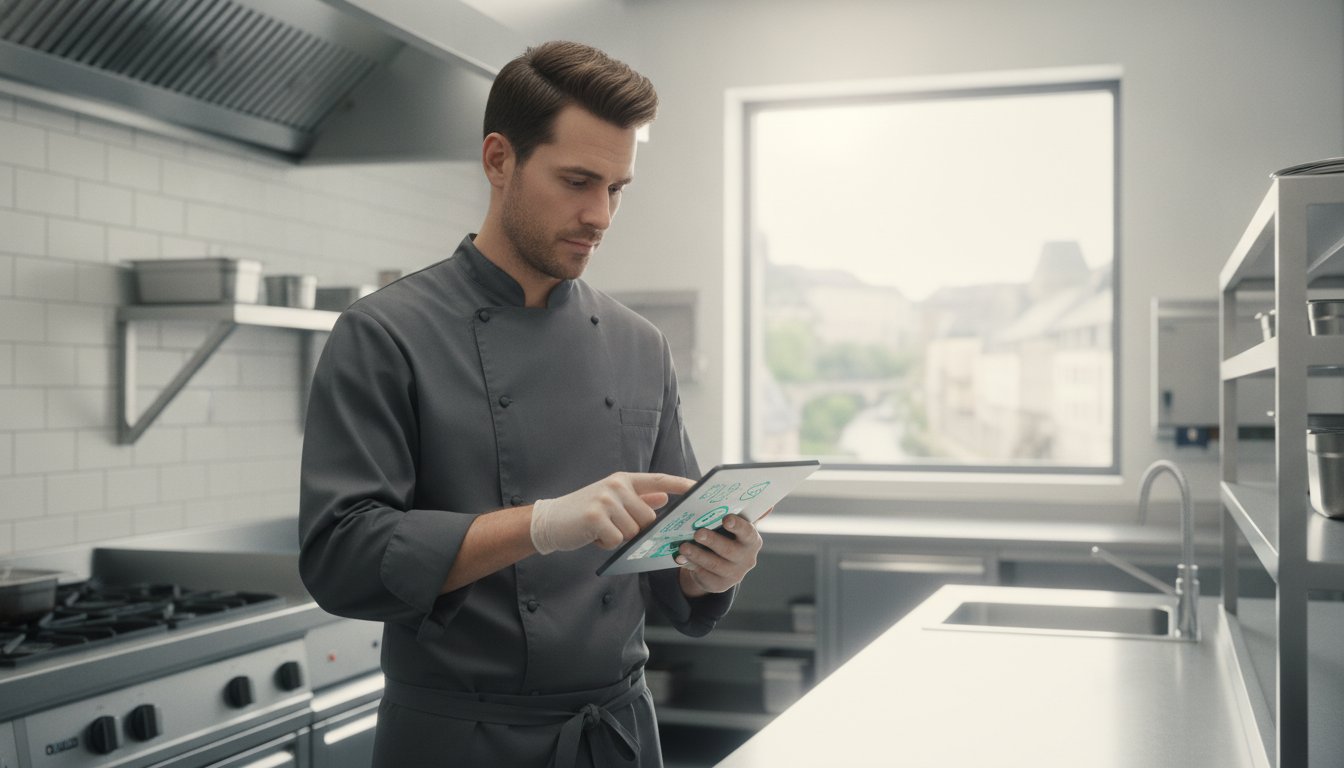
Replace the friction of paper logs with Digital HACCP Checklists that provide smart, timely reminders to your staff. These systems ensure 100% documentation accuracy for national regulatory audits by capturing data in real-time, making it impossible to "dry-lab" entries. You can easily customise temperature thresholds for specific equipment types, ensuring that a blast chiller and a dry-aging cabinet are each monitored against their unique safety parameters. This level of precision provides the calm authority needed during unannounced inspections, as you can generate instant compliance folders with a single click.
Reducing Waste and Protecting Margins
Early detection is the most effective way to eliminate food waste in a high-volume environment. When your team has access to transparent, real-time data, it fosters a safety-first culture where small deviations are corrected before they become expensive crises. This digital-first approach removes the guesswork from food safety, allowing you to focus on growth rather than damage control. The investment in technology pays for itself by preventing total stock loss and reducing the labor hours previously wasted on manual checks. Contact SafeBite to digitise your kitchen's temperature monitoring and secure your operational future today.
Securing Your Kitchen's Regulatory Future
Adhering to the food storage temperature requirements Luxembourg enforces is no longer a matter of periodic manual checks; it's a commitment to continuous, digital-first vigilance. We've discussed how the 2026 legal framework prioritises unalterable data and immediate accountability. By moving away from the risks of "dry-labbing" and manual logging, you eliminate the human error that often leads to costly administrative sanctions and unnecessary food waste. A proactive approach to receiving and storage ensures that your cold chain remains unbroken from the loading dock to the final plate.
Implementing a modern monitoring strategy allows you to focus on culinary excellence while technology handles the burden of documentation. Streamline your kitchen compliance with SafeBite's Digital HACCP Checklists to leverage an Automated Temperature Monitoring System and Real-time Alerts for Kitchen Staff. With Instant Inspection-Ready Reports, you'll always be prepared for unannounced ALVA audits. Embracing these innovations transforms food safety from a stressful obligation into a seamless, integrated part of your daily operations. You have the tools to protect your margins and your guests; now is the time to put them into action.
Frequently Asked Questions
What is the legal fridge temperature for restaurants in Luxembourg?
Professional food storage temperature requirements Luxembourg mandates that chilled products remain at or below 7°C. While consumer guidance often suggests 5°C, professional kitchens must strictly adhere to the limits defined in their specific HACCP plan. Maintaining a slightly lower internal set point, such as 4°C, provides a safety buffer against micro-fluctuations during peak service hours when doors are frequently opened.
How often must temperature checks be recorded in a professional kitchen?
Most manual HACCP plans require at least two temperature checks per day, typically at the start and end of service. However, relying on manual checks leaves significant data gaps during overnight hours or between shifts. Digital systems solve this by providing continuous, 24/7 monitoring, which ALVA inspectors increasingly prefer for its accuracy and ability to prove consistent climate control over long periods.
What should I do if my freezer temperature rises above -15°C?
You must immediately initiate your corrective action plan if a freezer exceeds the mandatory -18°C threshold. If the temperature reaches -15°C, check the duration of the breach and move the stock to a functioning unit if possible. If the food has begun to thaw or has been above -18°C for more than two hours, it may need to be discarded to ensure microbiological safety.
Are digital temperature logs legally accepted by Luxembourg inspectors?
Yes, digital logs are fully accepted and often preferred by ALVA inspectors for their reliability. Under the Loi du 2 avril 2026, the shift toward digital record-keeping is encouraged because digital logs are time-stamped and unalterable. This provides a transparent audit trail that confirms your facility consistently meets food storage temperature requirements Luxembourg standards, which is much harder to prove with traditional paper-based logs.
How long can high-risk food be left at room temperature during preparation?
High-risk food should not be left in the temperature danger zone for more than two hours during preparation. Following the 2-hour/4-hour rule, food that has been out for more than two hours must be used immediately or chilled back down. If it exceeds four hours at room temperature, it must be discarded to prevent the risk of foodborne illness and ensure guest safety.
What is the correct temperature for hot holding food in a buffet?
Hot dishes must be held at a minimum temperature of +63°C throughout the entire service period. This ensures that the food remains outside the danger zone where bacteria multiply most rapidly. It's vital to check the core temperature of the food itself using a calibrated probe rather than relying on the buffet unit's thermostat display, which only measures the surrounding air or water.
Do I need to check the temperature of food deliveries upon arrival?
Yes, checking delivery temperatures is a mandatory critical control point in any professional HACCP system. You should verify that chilled goods arrive at 7°C or below and frozen goods at -18°C or lower. Refusing a delivery that doesn't meet these standards is a necessary step to protect your inventory and ensure your business remains compliant with national food safety regulations.
How do I calibrate a digital food thermometer for HACCP compliance?
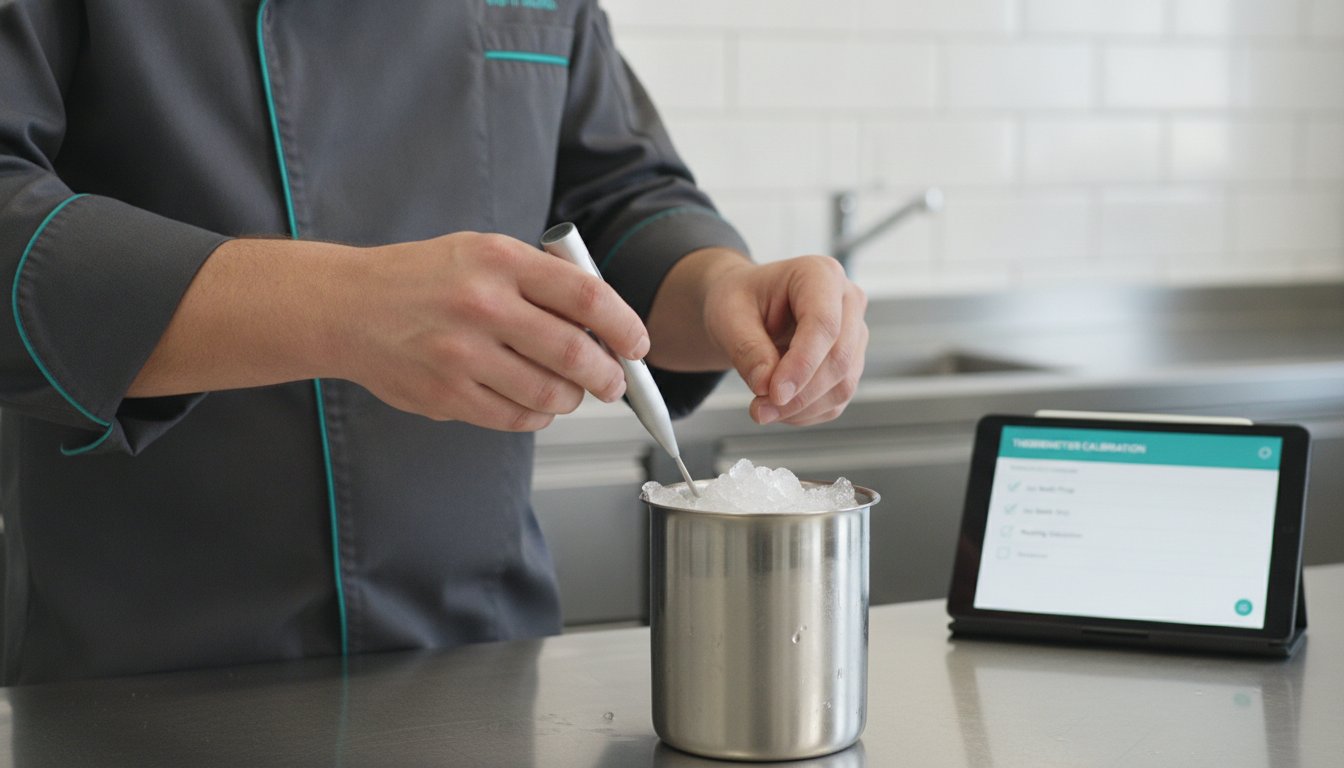
You should calibrate your thermometer regularly using the ice point method to ensure total accuracy. Fill a container with crushed ice and a small amount of water, then insert the probe until the reading stabilises at 0°C. If the device deviates, adjust it according to the manufacturer's instructions and record the calibration in your digital logs to provide proof of equipment accuracy for health inspectors.