Did you know that 37% of restaurants failed their health inspections due to inadequate temperature documentation? In a regulatory environment where the FDA issued $127 million in penalties during 2025, the margin for error in your kitchen has effectively vanished. While most operators focus on daily checks, many overlook the fundamental necessity of validating cooking temperatures and times to prove their methods actually work. It's no longer sufficient to merely record a number on a clipboard. You must demonstrate that your specific process is scientifically capable of eliminating foodborne pathogens before the first plate reaches a customer.
It's natural to feel frustrated by the confusion between verification and validation, especially when manual paper logs are slow and prone to human error. You deserve the confidence that comes with a foolproof system rather than the anxiety of a surprise audit. This guide provides the scientific and practical steps you need to ensure your cooking processes consistently meet 2026 compliance standards. We'll preview the latest 2022 FDA Food Code requirements, the impact of FSMA Rule 204, and how digital oversight can replace tedious paperwork with precise, automated accuracy.
Key Takeaways
- Distinguish between validation and verification to confirm your kitchen is implementing the correct safety protocols rather than just following a routine.
- Master the scientific concept of thermal lethality and why a 6.5-log or 7-log reduction is necessary to eliminate pathogens like Salmonella.
- Follow a structured five-step internal process for validating cooking temperatures and times, specifically designed to account for "worst-case" kitchen variables.
- Learn how to replace inefficient paper documentation with digital HACCP checklists to maintain a centralized, audit-ready dashboard of your safety compliance.
What is Validating Cooking Temperatures and Times?
Validating cooking temperatures and times is the scientific process of proving that a specific thermal application consistently achieves the required lethality to destroy harmful pathogens. While many kitchens rely on "safe" practices based on tradition or visual cues, validation requires objective evidence. It transforms a subjective kitchen habit into a verifiable safety protocol. This distinction is vital for professional kitchens because validation serves as a core requirement of the 7 HACCP principles. Without it, your safety plan lacks a scientific foundation.
For operators in regions like Luxembourg, where national health inspections are rigorous, having validated processes provides a shield of professional readiness. It shifts the conversation with auditors from "we think this is safe" to "we have proven this is safe." This proactive stance prevents the costly penalties and reputational damage that follow a failed inspection. By moving beyond anecdotal proof, you ensure your business is protected by data rather than luck.
The Role of Validation in Your HACCP Plan
Validation acts as the essential foundation that must exist before daily monitoring begins. It specifically supports HACCP Principle 3, which involves establishing critical limits. You can't monitor a limit if you haven't first proved that the limit actually keeps the food safe. Validation is the scientific evidence that your critical limits are effective. By establishing this proof early, you ensure that every subsequent check performed by your team is grounded in reality rather than guesswork.
Why 'Following the Chart' Isn't Always Enough
Relying solely on generic industry charts can lead to dangerous oversights. Every kitchen environment introduces unique variables that affect how heat penetrates food. These factors include:
- Equipment performance: An aging oven may have inconsistent heat distribution compared to a new combi-steamer.
- Food density: A four-inch thick meatloaf requires a vastly different thermal profile than a thin poultry breast.
- Initial temperatures: Ingredients starting at 2°C will reach safety thresholds slower than those starting at room temperature, potentially lingering too long in the danger zone.
Large-batch cooking often hides "cold spots" where temperatures fail to reach the required lethality, even if the surface appears done. This is why custom recipes and high-volume processes require individual steps for validating cooking temperatures and times to account for these specific operational realities. Precision here is the difference between a compliant kitchen and a liability risk.
The Science of Thermal Lethality: Time vs. Temperature
Pathogen destruction depends on a concept known as "log reduction." In professional food safety, we typically aim for a 6.5-log or 7-log reduction in Salmonella. This means that for every ten million bacteria present, only one survives. Achieving this level of safety requires understanding the inverse relationship between heat and duration. While high-heat cooking might kill pathogens in seconds, lower temperatures can achieve the same result if maintained for a specific "dwell time." This is the scientific heart of validating cooking temperatures and times.
If you're using a slow-cook or sous-vide method, an "instant-read" of the internal temperature isn't enough to prove safety. You must document that the food remained at that temperature long enough to reach the required lethality. The USDA's Compliance Guideline for Validating Cooking Instructions provides a detailed framework for these calculations. It emphasizes that safety is a curve, not a single point on a thermometer. Your validation process must target specific pathogens, including:
- Salmonella: The primary target for poultry and eggs.
- E. coli: A critical concern for ground beef and non-intact meats.
- Listeria: Resilient and dangerous, especially in ready-to-eat environments.
Target Internal Temperatures for High-Risk Foods
According to the 2022 FDA Food Code, different proteins require specific thresholds to be considered safe. Poultry, stuffed meats, and casseroles must reach 165°F (74°C) for at least 15 seconds. Ground meats and injected products require 155°F (68°C) for 17 seconds. Reheating leftovers follows the poultry standard; they must reach 165°F within two hours to ensure any pathogens that grew during cooling are eliminated. Establishments serving vulnerable populations, such as childcare centers or nursing homes, must be even more vigilant. In these settings, there's often no room for "medium-rare" options for high-risk items. Every process must be strictly validated to ensure maximum lethality standards are met every time.
The 'Hold Time' Factor
When cooking at lower temperatures to preserve texture, documenting the hold time becomes your primary safety record. You can't guess these windows. Precision is mandatory. This is why knowing how to calibrate a food thermometer is non-negotiable. If your equipment is off by even two degrees, your dwell time calculations will be invalid, potentially leaving pathogens active. Maintaining this level of accuracy across a busy kitchen is challenging. Implementing a Temperature Monitoring System can simplify this oversight by providing real-time data and alerts. It ensures that every batch meets the scientific requirements for safety without the need for constant manual intervention.
Validation vs. Verification: Clearing the Confusion
In the high-pressure environment of a professional kitchen, terms like validation and verification are often used interchangeably. However, conflating these two concepts creates significant gaps in your food safety strategy. Validation asks the fundamental question: "Are we doing the right thing?" It focuses on the science behind your rules. Verification asks: "Are we doing what we said we would do?" It focuses on the daily execution of those rules. Understanding this distinction is the first step toward a robust compliance culture.
You must validate your processes before you begin daily operations. Validating cooking temperatures and times ensures that your specific equipment and recipes are capable of reaching the required lethality levels. Once that proof is established, you move into the verification phase. Verification is the recurring check that happens every single day to confirm your team is following the validated protocol. You validate once to set the standard, but you verify every shift to maintain it.
The data produced by these two activities looks very different. Validation data often consists of scientific studies, thermal mapping reports, or manufacturer specifications that prove a process works. Verification data consists of the daily logs, temperature readings, and checklists that prove the process was followed. Without validation, your daily logs are merely recording a process that may not even be safe. Without verification, your validated plan is just a document gathering dust on a shelf.
Examples in a Professional Kitchen
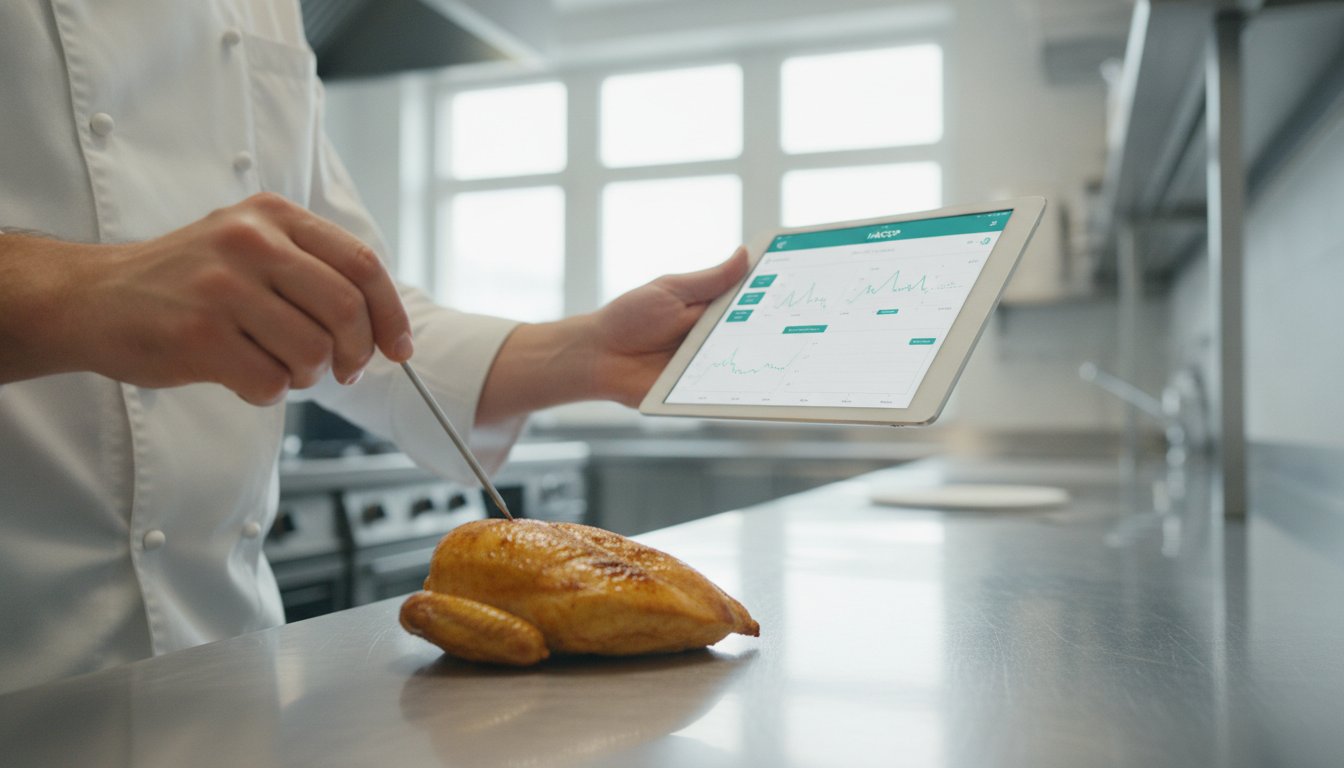
Consider a scenario involving roasted chicken. A validation study might involve testing your specific combi-oven to prove that a setting of 180°C for 25 minutes consistently results in a core temperature of 75°C for a standard 1.5kg bird. This is the scientific proof of concept. The verification step occurs when a chef uses a probe to record an actual reading of 76°C for a specific batch on their shift. To streamline this daily requirement, digital food safety checklists serve as the primary tool for verification. They allow for instant data entry and ensure that no critical check is missed during a busy service.
When to Re-Validate Your Processes
Validation isn't a one-time event that lasts forever. Certain triggers require you to revisit your scientific proof to ensure it remains accurate. Equipment changes are the most common reason for re-validation; a new oven model may have different airflow patterns than your previous unit. Menu updates also play a role. If you switch from using fresh chicken breasts to frozen ones, the initial temperature and density changes will alter the thermal curve. Finally, you must stay alert to regulatory shifts. Keeping up with updated Luxembourg food safety authority guidelines ensures your internal standards align with the latest 2026 legal requirements. Any shift in these external rules should prompt an immediate review of your internal validation data.
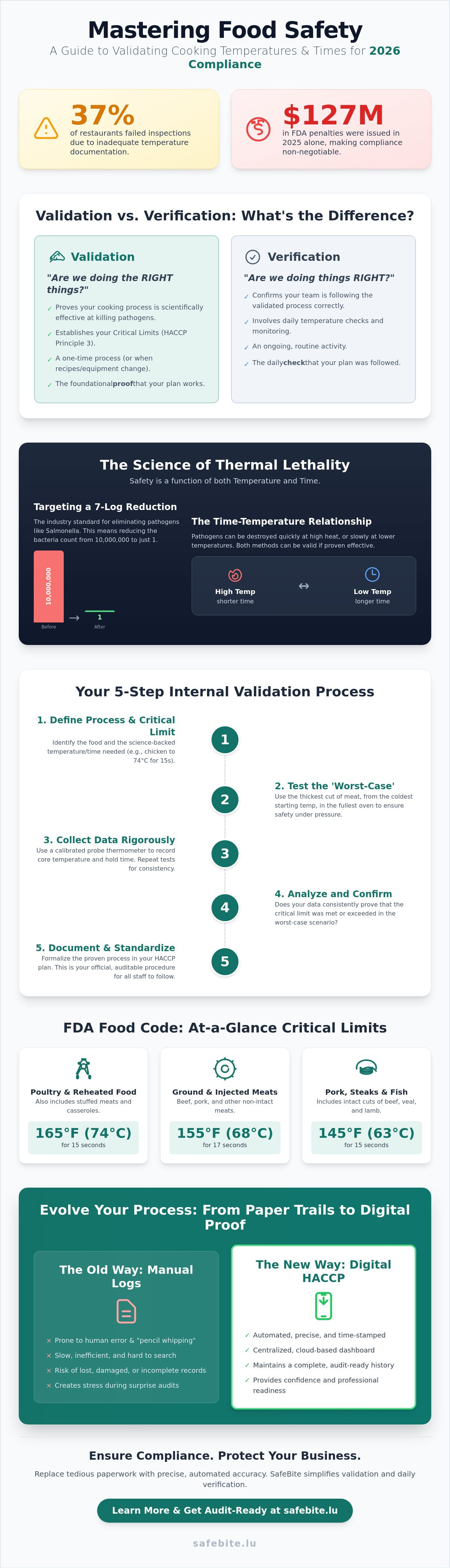
5 Steps to Validate a New Cooking Process Internally
Moving from theoretical safety to practical execution requires a structured approach. Validating cooking temperatures and times isn't an abstract laboratory exercise; it's a vital kitchen management process that ensures your specific recipes are safe before they ever reach a customer's plate. By following a disciplined internal protocol, you can create a culture of precision that stands up to the most rigorous health inspections.
- Step 1: Identify the Hazard. Determine which pathogen poses the highest risk for your specific dish. For poultry, this is typically Salmonella; for ground beef, you'll focus on E. coli.
- Step 2: Define the 'Worst Case Scenario'. Your validation must account for the most challenging conditions. This means testing the largest portion size, the highest density, and the coldest possible starting temperature from the refrigerator.
- Step 3: Conduct Multiple Test Runs. Perform at least three separate trials using precise, calibrated probes. Consistency is the hallmark of validating cooking temperatures and times; a single successful run doesn't constitute scientific proof.
- Step 4: Analyze the Data. Review your results against the lethality curves discussed earlier. Ensure that the core of the product reached the required temperature and remained there for the necessary dwell time.
- Step 5: Document the Results. Create a formal validation report. This document should live in your HACCP folder as permanent proof that your process is scientifically sound.
To ensure these steps are followed accurately across every shift, implementing Digital HACCP Checklists provides the oversight needed to maintain these high standards without constant manual supervision.
Mapping Heat Distribution
Precision requires more than a single probe. You must use multi-point probing to identify how heat moves through your equipment and the product itself. Document specific equipment settings such as fan speed, humidity levels, and rack positions, as these variables significantly impact thermal penetration. The 'cold spot' is usually the geometric center of the thickest part of the food. Identifying this point is essential because if the cold spot reaches safety thresholds, the rest of the product is guaranteed to be safe.
Creating Standard Operating Procedures (SOPs)
Validation data is only useful if your staff can execute it. Translate your scientific findings into clear, jargon-free instructions for your kitchen team. These SOPs should integrate seamlessly with other core safety tasks, such as your FIFO implementation, to ensure that only properly stored and prepared ingredients enter the cooking process. This level of detail ensures consistency across multiple sites and prevents errors during high-volume shifts when the kitchen is under pressure.
Simplifying Validation and Compliance with SafeBite
Managing a busy kitchen is demanding enough without the added stress of tracking down stray temperature logs in a grease-stained binder. Transitioning from messy paper folders to a centralized digital dashboard replaces chaotic paperwork with streamlined oversight. This shift is particularly crucial when validating cooking temperatures and times, as the volume of data required to prove compliance can quickly become overwhelming for manual systems. By digitizing these records, you transform a tedious administrative chore into a strategic advantage.
SafeBite’s Digital HACCP Checklists automate the proof of verification by guiding staff through required checks at the exact moment they need to occur. If a reading falls outside your validated limits, the system triggers real-time alerts. This immediate feedback allows your team to take corrective action before a safety breach occurs. Having this data available at a single click significantly reduces "inspection anxiety." When an auditor arrives, you don't need to scramble through cabinets; you simply present a professional, organized record of your kitchen's vigilance.
Digital Logs as Scientific Evidence
Digital logs provide a level of security that paper simply cannot match. Every entry includes digital timestamps and unique user IDs, creating a tamper-proof audit trail that satisfies even the most rigorous regulatory standards. This transparency is vital when you need to aggregate data over long periods to prove process stability to national inspectors. For operators overseeing multiple locations, the Multi-site Management Dashboard provides a birds-eye view of compliance across the entire group. It ensures that the high standards you've validated in one kitchen are being met in every other unit, regardless of geographical distance.
Future-Proofing Your Food Safety Culture
Moving to a digital system does more than just tick a compliance box; it helps future-proof your entire food safety culture. You can use the collected data as a powerful training tool, showing staff exactly why specific times and temperatures matter for pathogen lethality. This clarity often leads to a more engaged team that understands the "why" behind their daily tasks. Additionally, precise temperature control helps in reducing food waste. By avoiding the common habit of overcooking "just to be safe," you maintain better product quality and higher yields while still operating within your validated safety parameters.
The transition to a modern kitchen shouldn't be a burden. It's an investment in your brand's reputation and your customers' health. By combining scientific validation with digital precision, you create a kitchen that is both efficient and unshakeably safe. Start your digital HACCP journey with SafeBite today and experience the confidence of total compliance.
Securing Your Kitchen's Future with Scientific Precision
Mastering the distinction between validation and verification is the first step toward a resilient food safety culture. By rigorously validating cooking temperatures and times, you move beyond guesswork and establish a scientific foundation that protects both your customers and your business reputation. This proactive approach ensures that every dish served meets required lethality standards, regardless of kitchen volume or staff turnover.
Leading hospitality groups are already moving away from the unreliability of manual records in favor of automated HACCP compliance. SafeBite provides a streamlined solution that ensures national Luxembourg regulatory alignment through a centralized, digital dashboard. This transition replaces paper-based clutter with a tamper-proof audit trail that is always ready for inspection. Book a demo of SafeBite's digital food safety platform to see how we can simplify your compliance journey. You have the tools and the knowledge to lead a safer, more efficient kitchen; we're here to help you make that vision a reality.
Frequently Asked Questions
What is the difference between food safety validation and verification?
Validation is the scientific proof that a specific cooking process effectively eliminates pathogens, essentially asking if you're doing the right thing. Verification is the ongoing check to confirm that your team is following those validated steps daily. While you validate a process once to set the safety standard, you verify it every shift to ensure execution. This distinction is critical for maintaining an audit-ready kitchen and professional compliance.
How often should I validate my cooking temperatures?
You should perform a validation check whenever you introduce a new recipe, change a supplier, or install new kitchen equipment. Even if your menu remains static, a periodic review is recommended to account for equipment wear or updated regulatory standards. Any shift in "worst-case scenario" variables, such as a change in portion size, requires re-validating cooking temperatures and times to ensure continued safety.
Do I need a laboratory to validate my restaurant's recipes?
You don't necessarily need a third-party laboratory to validate most standard restaurant recipes. Internal validation can be achieved by conducting multiple test runs with calibrated thermometers and documenting that the core of the product consistently reaches the required lethality. However, for highly complex or non-traditional processes like extended sous-vide, consulting a food safety expert may provide additional legal security and scientific peace of mind.
What are the core temperature requirements for poultry in Luxembourg?
In Luxembourg, the standard requirement for poultry is reaching a core temperature of 75°C to ensure the destruction of Salmonella and other heat-resistant pathogens. While some international standards allow for lower temperatures with longer hold times, 75°C remains the safest benchmark for general compliance. Always ensure this temperature is measured at the thickest part of the bird to account for the slowest-heating point in the oven.
Can I use a microwave for validated cooking processes?
Microwaves can be used, but they are significantly harder to validate due to inconsistent heating patterns and "cold spots." If you include microwave cooking in your HACCP plan, your validation must involve multi-point probing and a post-cook standing time to allow temperatures to equilibrate. Most professional operators prefer more predictable thermal equipment for high-risk proteins because it's easier to maintain a standardized, safe result every time.
What happens if my cooking process fails a validation test?
If a process fails validation, you must immediately adjust your cooking parameters, such as increasing the oven temperature or extending the duration. You cannot serve the product under those specific conditions until a new set of test runs proves that the adjusted limits consistently achieve safety. Documenting these failures and the subsequent corrective actions is a vital part of your HACCP records, showing inspectors that you are proactive.
How does digital HACCP software help with validation?
Digital HACCP software simplifies the process by centralizing your validation data and automating the verification logs. It allows you to store your scientific proof alongside daily temperature readings, creating a clear link between your safety theory and kitchen practice. When validating cooking temperatures and times, the software provides a tamper-proof audit trail that is easily accessible during surprise health inspections or internal audits.
Is validating cooking times mandatory for small cafes?
Yes, the requirement to validate critical control points applies to all food businesses, regardless of their size or seating capacity. While a small cafe may have fewer processes to validate than a large hotel, you must still prove that your cooking methods are effective. Failure to provide this evidence during a national inspection can lead to penalties or closure orders, as safety standards are non-negotiable across the industry.