What if your next surprise ALVA inspection wasn't a source of anxiety, but an opportunity to showcase your kitchen's digital precision? Balancing culinary excellence with the rigorous demands of the Law of April 2, 2026, is a heavy lift for any restaurateur in the Grand Duchy. You're likely tired of the hours wasted on manual temperature logs and the persistent fear that a single missed entry could lead to regulatory scrutiny. It's frustrating when high staff turnover makes consistent safety training feel nearly impossible.
This guide will help you master these complexities by focusing on a modern digital HACCP implementation Luxembourg strategy. You'll learn how to build a robust, audit-ready system that replaces unreliable paperwork with automated oversight. We'll walk through the essential steps to streamline your operations, ensure full compliance with the latest Luxembourgish regulations, and maintain a 24/7 audit-ready kitchen that protects both your guests and your business reputation.
Key Takeaways
- Master the legal requirements of Luxembourg’s Law of April 2, 2026, to ensure your food safety protocols align with current ALVA standards.
- Transition from vulnerable paper logs to a secure system that prevents manual logging errors and keeps data accurate during surprise inspections.
- Execute a digital HACCP implementation Luxembourg strategy that uses real-time alerts and automated temperature monitoring to safeguard your inventory.
- Streamline your staff’s daily routines by digitizing critical control points and allergen management, making compliance a seamless part of the kitchen workflow.
- Shift your focus from reactive paperwork to proactive prevention, which reduces the risk of foodborne illness and potential administrative fines.
Understanding the HACCP Plan Framework in Luxembourg
The foundation of modern food safety in the Grand Duchy rests on a disciplined approach to risk management. Known globally as Hazard Analysis and Critical Control Points (HACCP), this system shifts the focus from reactive testing to proactive prevention. In Luxembourg, maintaining a robust plan isn't a suggestion; it's a strict legal mandate under the Law of April 2, 2026 (A177). This legislation aligns national standards with EU Regulation 2017/625, placing the responsibility of food integrity squarely on the operator's shoulders. The Luxembourg Veterinary and Food Administration (ALVA) now oversees these controls with a focus on high-resolution data. A digital HACCP implementation Luxembourg strategy ensures that your records aren't just present, but are accurate, time-stamped, and tamper-proof. Moving beyond the era of physical binders, today's standards demand a level of transparency that only digital systems can provide.
The Legal Landscape for National HoReCa Businesses
Luxembourgish food safety enforcement has evolved significantly since the establishment of ALVA in 2022. Every HoReCa business is familiar with the "Plaquette de contrôle," the visible sign of an establishment's hygiene status. However, achieving a favorable rating now requires more than a clean kitchen. Inspectors increasingly scrutinize the reliability of your documentation. Manual logs, often prone to retrospective filling or physical damage from kitchen grease and water, no longer meet the threshold for high-level compliance. The 2026 regulations introduce a three-tier penalty system, where administrative measures can be triggered by inconsistent record-keeping. Precise, real-time data is your best defense against these sanctions.
Who Needs a Formal HACCP Plan?
Whether you operate a boutique café in Ville Haute or a multi-site restaurant group across the country, a formal plan is mandatory. Small establishments might follow simplified guides, but they must still document critical control points with precision. For larger or multi-site operations, the complexity scales. These businesses require venue-specific plans that account for unique supply chains and diverse menus. A generic hygiene guide won't suffice during a rigorous audit. By prioritizing a digital HACCP implementation Luxembourg approach, multi-site managers can oversee compliance across all locations from a single dashboard, ensuring that every venue maintains the same high standard of safety.
A successful plan requires more than just identifying risks; it requires a commitment to constant oversight. To stay ahead of regulatory changes, businesses must move away from static documents toward dynamic systems that alert staff to issues before they become hazards. This transition protects your customers and ensures your business remains a trusted name in the Luxembourgish culinary scene.
The 7 Principles of HACCP: A Modern Kitchen Application
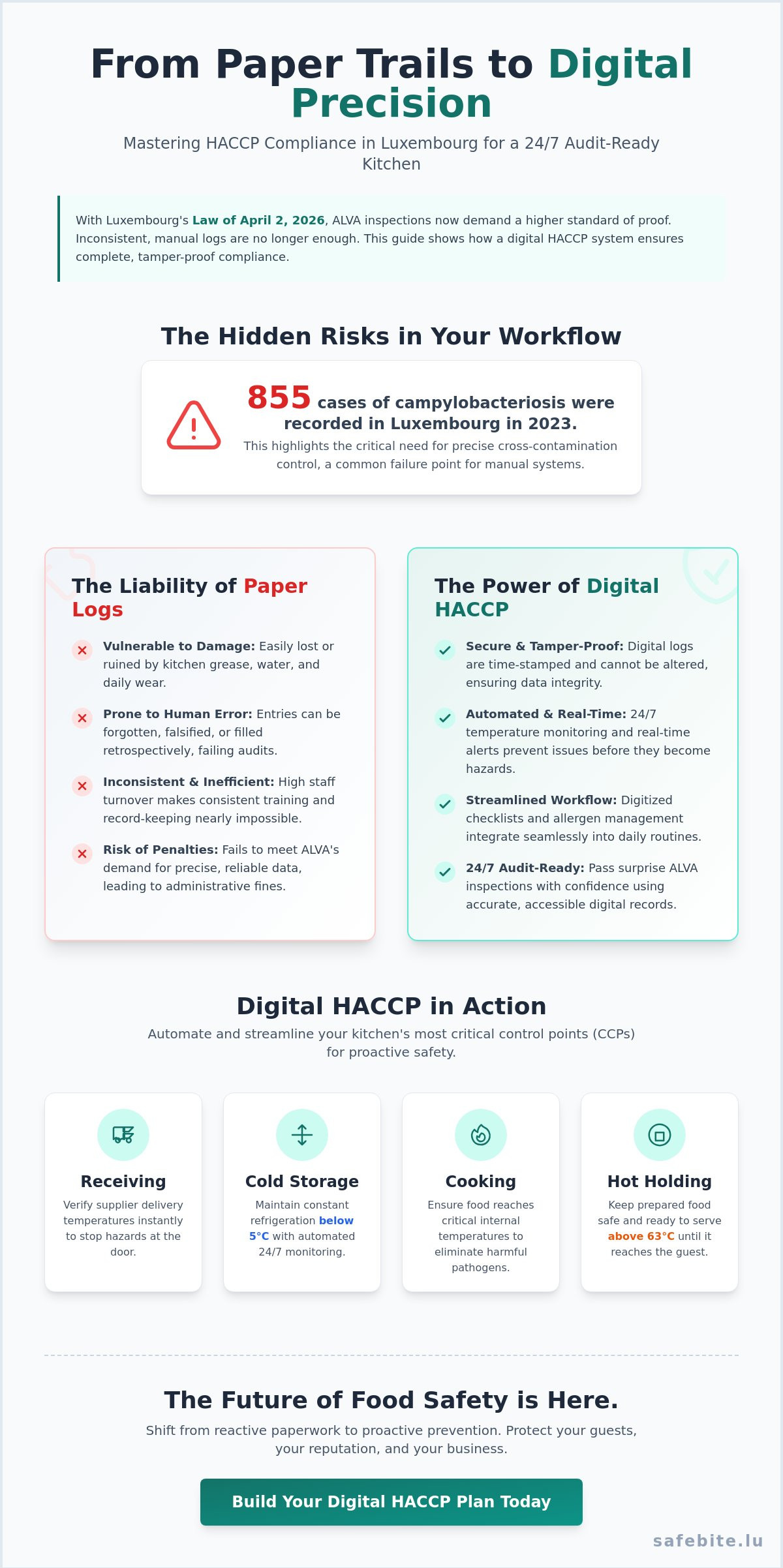
The seven principles of HACCP provide the structural integrity for any food safety system. While the core theory remains constant, the practical application has shifted toward high-tech oversight. Implementing these principles according to official HACCP guidelines ensures that every dish served in your establishment meets the highest safety standards. In a modern kitchen, this process begins with a rigorous Hazard Analysis. You must identify exactly where biological, chemical, or physical risks might enter your workflow. For instance, with 855 cases of campylobacteriosis recorded in Luxembourg in 2023, controlling poultry cross-contamination is a high priority. A digital HACCP implementation Luxembourg approach allows you to track these risks with surgical precision, moving away from guesswork toward data-backed assurance.
Identifying CCPs in Your Restaurant Workflow
Identifying Critical Control Points (CCPs) is the next logical step in your safety journey. These are specific stages where a hazard can be prevented, eliminated, or reduced to acceptable levels. Mapping your kitchen layout to your hazard analysis helps identify these points without creating operational bottlenecks. Common CCPs include:
- Receiving: Verifying the temperature of incoming high-risk chilled goods.
- Cold Storage: Maintaining constant refrigeration, typically below 5°C.
- Cooking: Ensuring food reaches internal temperatures sufficient to kill pathogens.
- Hot Holding: Keeping prepared food above 63°C until it reaches the guest.
Differentiating between a general hygiene task, such as sanitizing a countertop, and a CCP, such as the final cook temperature, is vital for a focused and effective safety plan.
Setting and Verifying Critical Limits
Critical Limits are the absolute barrier between safety and contamination. These are measurable values, such as specific temperatures or time durations, that must be strictly maintained at each CCP. In a professional environment, timestamped verification is no longer optional. Modern auditors look for a continuous, uninterrupted record of these limits. Using a digital monitoring system ensures that if a limit is approached, your team receives an immediate alert. This allows for a proactive response, such as adjusting a thermostat or moving stock, before food waste occurs or safety is compromised.
The final principles involve verification and documentation. It isn't enough to have a plan; you must prove that the system is functioning as intended. Digital HACCP implementation Luxembourg transforms this requirement from a daily chore into an automated asset. Every log, corrective action, and temperature check is stored in a secure, cloud-based dashboard. This creates a permanent, tamper-proof audit trail. This level of documentation provides the confidence needed when ALVA inspectors arrive, as your history of compliance is both complete and instantly accessible.
The Liability of Paper: Why Manual HACCP Plans Fail
The traditional overstuffed binder sitting on a kitchen shelf is more than just an eyesore; it's a significant operational liability. In the high-pressure environment of a professional kitchen, paper logs are frequently subjected to grease, water, and heat, leading to illegible records or complete data loss. Beyond physical damage, manual systems suffer from the "Friday Afternoon Effect," where staff, overwhelmed by service demands, attempt to fill in an entire week's worth of temperature checks from memory. This retrospective logging is a dangerous gamble that compromises food safety and leaves your business vulnerable during an inspection. Transitioning to a digital HACCP implementation Luxembourg strategy replaces these unreliable habits with a system of proactive vigilance.
Manual binders also obscure the bigger picture. Identifying a slow-failing refrigerator or a recurring hygiene lapse is nearly impossible when the data is buried in hundreds of handwritten pages. Without real-time visibility, you're forced to react to crises rather than preventing them. This creates a heavy psychological burden on your team, who often view safety documentation as a tedious administrative hurdle rather than a vital part of their craft. When record-keeping feels like a chore, accuracy inevitably declines.
Hidden Costs of Manual Compliance
The financial drain of paper-based systems is often underestimated by restaurant owners. Consider the cumulative labor hours your chefs spend manually recording temperatures and checking off cleaning tasks; these are hours diverted from culinary innovation and guest service. Furthermore, inaccurate manual logs contribute to unnecessary food waste. If a cooling unit fails and it isn't caught immediately due to a missed manual check, the entire inventory must be discarded. Understanding Why Your Kitchen Needs Digital Food Safety Checklists in 2026 is essential for reclaiming these lost resources and protecting your margins.
Audit Risks and Falsification
Modern ALVA auditors in Luxembourg approach perfect, ink-on-paper logs with increasing skepticism. Uniform handwriting and identical temperature readings across several days are red flags that suggest falsification rather than diligent monitoring. Under the Law of April 2, 2026 (A177), inconsistent or missing safety records can trigger administrative measures or criminal sanctions. Adopting a digital HACCP implementation Luxembourg framework eliminates this risk by using automated digital timestamps and mandatory fields. This ensures that every entry is recorded at the exact moment the task is performed, providing an authentic and transparent history of your kitchen's safety standards. By removing human error and the temptation to "pencil whip" logs, you build a foundation of trust with national authorities.
Step-by-Step: Implementing a Digital HACCP Plan
Implementing a modern safety system requires a deliberate shift from static documentation to active monitoring. While the principles of hazard analysis are well established, the execution in 2026 relies on precision and speed. A successful digital HACCP implementation Luxembourg strategy follows a logical progression that integrates with your existing kitchen culture rather than disrupting it. By following a structured roadmap, you can transition from vulnerable paper logs to a resilient digital ecosystem.
Step 1 involves a digital-first hazard analysis. Instead of flipping through folders, you audit your menu and suppliers within a digital interface, allowing for instant updates as ingredients or vendors change. Step 2 requires defining your kitchen-specific CCPs and digitizing the monitoring flow. By embedding these into a software environment, you ensure that every critical limit is strictly enforced through mandatory data fields. Step 3 is the deployment of automated temperature sensors. These devices eliminate the need for staff to manually log fridge and freezer temperatures every few hours, providing constant, 24/7 surveillance. Step 4 focuses on training. You provide staff with interactive, app-based checklists for daily hygiene tasks, making compliance a natural part of their workflow. Finally, Step 5 establishes a real-time management dashboard. This central hub offers total operational oversight, allowing you to monitor multiple sites or specific kitchen stations from any device.
Transitioning Your Team to Digital Workflows
Staff resistance often stems from the fear of added complexity during a busy shift. To overcome this, the digital interface must be simpler and faster than picking up a pen. Providing smart reminders ensures that essential checks are never missed during the chaos of peak dinner service. When the system prompts a chef at the exact moment a task is due, the cognitive load is reduced. You can explore our comprehensive guide on how to transition from paper to digital HACCP logs to ensure a smooth adoption process across your entire team.
Configuring Automated Alerts
One of the most significant advantages of a digital system is the ability to respond to issues before they escalate into a crisis. You can configure SMS or push notifications for temperature excursions in real-time. This is particularly vital for after-hours protection. For instance, if a walk-in fridge fails at 2 AM, an escalation protocol ensures the right person is notified immediately, potentially saving thousands of Euros in inventory. Over time, this data allows you to predict equipment maintenance needs by identifying subtle temperature fluctuations before a total mechanical breakdown occurs. To start building your own automated safety network, view our temperature monitoring systems.
SafeBite: The Future of Food Safety in Luxembourg
SafeBite represents the final step in your transition toward a modern, high-precision kitchen. By centralizing every aspect of the Law of April 2, 2026, into a single interface, the platform ensures that your digital HACCP implementation Luxembourg strategy is both comprehensive and effortless. You no longer need to worry about the gaps in your documentation or the physical state of your binders. Instead, you gain access to automated checklists, sophisticated allergen management tools, and real-time alerts that keep you ahead of potential hazards. This shift allows Head Chefs and General Managers to focus on their primary mission: delivering exceptional culinary experiences without the constant weight of administrative oversight.
The platform is designed to provide total operational oversight. With our multi-site management dashboard, owners can monitor compliance across several locations from one central hub. This level of transparency ensures that high standards are maintained consistently, regardless of which venue you are physically visiting. By digitizing the entire national HACCP requirement, SafeBite makes being audit-ready a permanent state rather than a stressful preparation. You gain the ability to generate comprehensive reports at the touch of a button, providing instant proof of your kitchen's safety and integrity.
Built for the Luxembourgish Hospitality Sector
Our platform is specifically engineered to meet the nuances of Luxembourg food safety regulations. We understand the local inspection landscape and the high standards expected by ALVA. By centralizing allergen management through our specialized tool, SafeBite protects your guests and your brand reputation from the risks of cross-contamination or mislabeling. This localized approach ensures that your venue isn't just following general EU rules, but is fully compliant with the specific requirements of the Grand Duchy. Local support and a deep understanding of national standards mean you have a partner that is as invested in your compliance as you are.
Operational Excellence Through Automation
True compliance shouldn't be a weekly scramble. SafeBite eliminates the "Friday Afternoon Effect" mentioned earlier by requiring real-time digital logging throughout the day. This creates a culture of proactive vigilance where tasks are completed as they happen, not when an inspection is looming. Our temperature monitoring system works 24/7, removing the burden of manual checks and providing immediate notifications if a unit begins to fail. Automated reporting simplifies the health inspection process, allowing you to present a complete, timestamped history of your kitchen's safety. When an inspector asks for your records, you can provide an accurate, digital audit trail that demonstrates your commitment to excellence. To see how these tools can transform your operations, book a demo to see SafeBite in action.
Securing Your Kitchen’s Future with Digital Precision
Transitioning to a digital system is no longer a luxury for Luxembourgish restaurateurs; it is a strategic necessity. By replacing vulnerable paper binders with automated oversight, you eliminate the risks of retrospective logging and ensure your documentation meets the rigorous standards of the Law of April 2, 2026. A successful digital HACCP implementation Luxembourg strategy protects your inventory through constant temperature monitoring. It empowers your team with streamlined, interactive checklists. This shift isn't just about compliance. It’s about gaining total control over your operational environment.
You can now move beyond the stress of surprise inspections by maintaining a 24/7 audit-ready environment. SafeBite provides the infrastructure needed to scale your operations while keeping food safety at the forefront. With inspection-ready dashboards and automated temperature alerts, our platform is already trusted by leading Luxembourg hospitality groups to maintain excellence. Digitize your HACCP plan today with SafeBite and reclaim the time you need to focus on your culinary craft. Your path to a safer, more efficient kitchen starts here.
Frequently Asked Questions
Is a digital HACCP plan legally accepted in Luxembourg?
Yes, digital HACCP records are fully recognized by the Luxembourg Veterinary and Food Administration (ALVA). Under the Law of April 2, 2026, the priority is the accuracy and accessibility of safety data rather than the medium used. A digital HACCP implementation Luxembourg strategy ensures your records are time-stamped and tamper-proof, which meets the highest standards of national regulatory scrutiny and ensures your business remains audit-ready.
How long do I need to keep HACCP records for my restaurant?
You should generally retain your records for at least six months beyond the shelf life of the food products, though many Luxembourgish businesses maintain archives for several years to ensure total traceability. Digital systems simplify this by providing unlimited cloud storage. This eliminates the need for physical filing cabinets while ensuring that historical data is instantly retrievable during a multi-year audit or a specific legal inquiry.
What are the most common CCPs for a standard restaurant kitchen?
Critical Control Points typically include the stages of receiving chilled goods, cold storage, thermal processing (cooking), and hot holding. These are the specific moments where a hazard must be controlled to prevent contamination. While every menu requires a unique hazard analysis, these four areas form the backbone of most professional kitchen safety protocols in the Grand Duchy, ensuring that high-risk ingredients stay within safe boundaries.
Can SafeBite help me manage allergen compliance as well?
Yes, SafeBite includes a specialized Allergen Management Tool designed to centralize and track ingredients across your entire menu. This feature allows your team to provide accurate information to guests with dietary restrictions, reducing the risk of accidental exposure. By integrating allergen tracking into your daily digital workflow, you protect both your customers and your restaurant's reputation while meeting national transparency requirements.
What happens if I lose internet connection in the kitchen?
Modern digital systems are designed to function offline by caching data locally on your device until a connection is restored. Once your kitchen is back online, all recorded temperature checks and completed checklists sync automatically with the cloud. This ensures that your safety logs remain continuous and that no critical data is lost during temporary network interruptions, maintaining the integrity of your digital HACCP implementation Luxembourg.
Does my staff need special training to use a digital HACCP system?
No extensive technical training is required because digital interfaces are designed to be more intuitive than complex manual binders. Most staff members can master the app-based checklists within a single shift. The system guides users through each task with clear prompts, which actually reduces the training burden for new hires and helps maintain consistency during periods of high staff turnover.
How does automated temperature monitoring reduce food waste?
Automated sensors provide 24/7 oversight and trigger immediate alerts if a cooling unit deviates from its critical limits. This proactive approach allows you to intervene long before food reaches a dangerous temperature. By catching equipment failures early, you can move stock to a functioning unit and avoid the significant financial loss associated with discarding spoiled inventory due to a missed manual check.
Is SafeBite suitable for small cafes or just large restaurant chains?
SafeBite is fully scalable and designed to support establishments of all sizes, from boutique cafes to national hospitality groups. While large chains benefit from the multi-site management dashboard, small businesses gain significant value from the reduction in manual labor and the peace of mind that comes with being audit-ready. The system adapts to the specific volume and complexity of your unique kitchen operations without unnecessary friction.