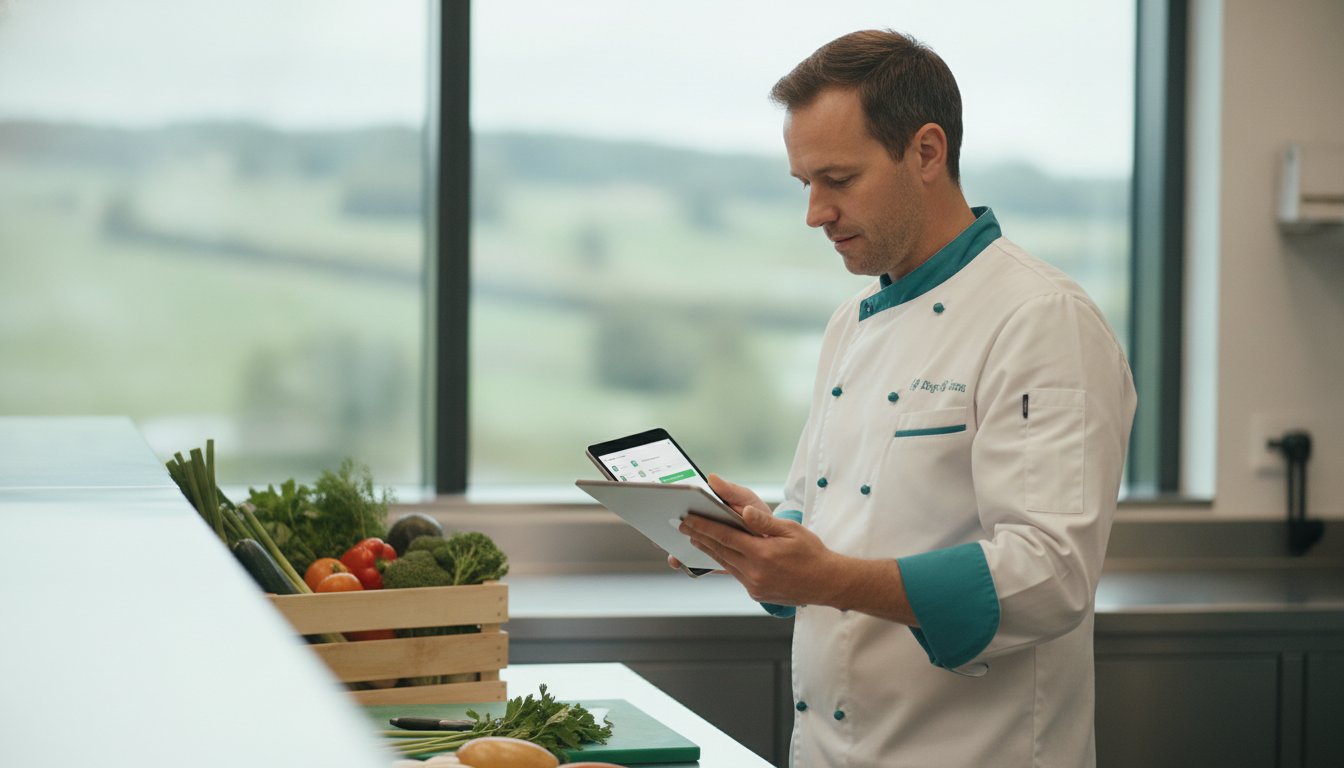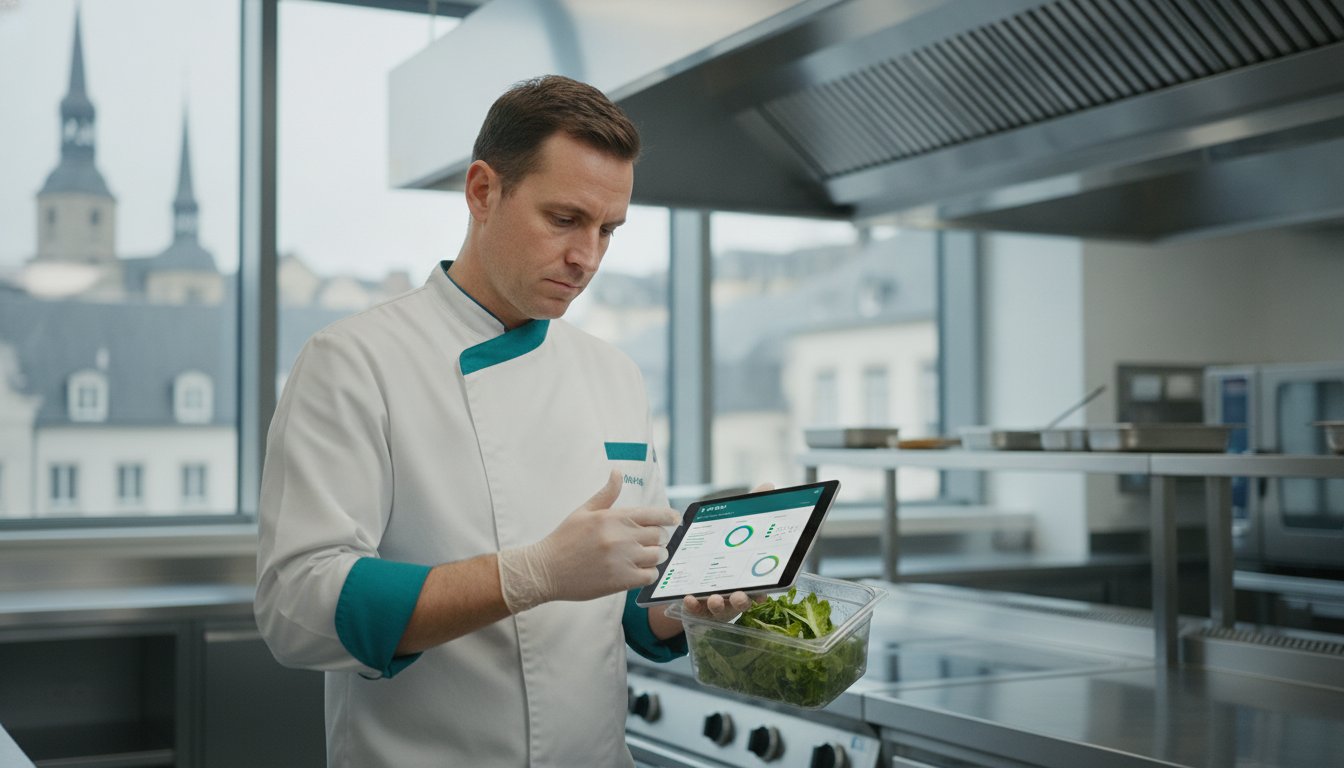

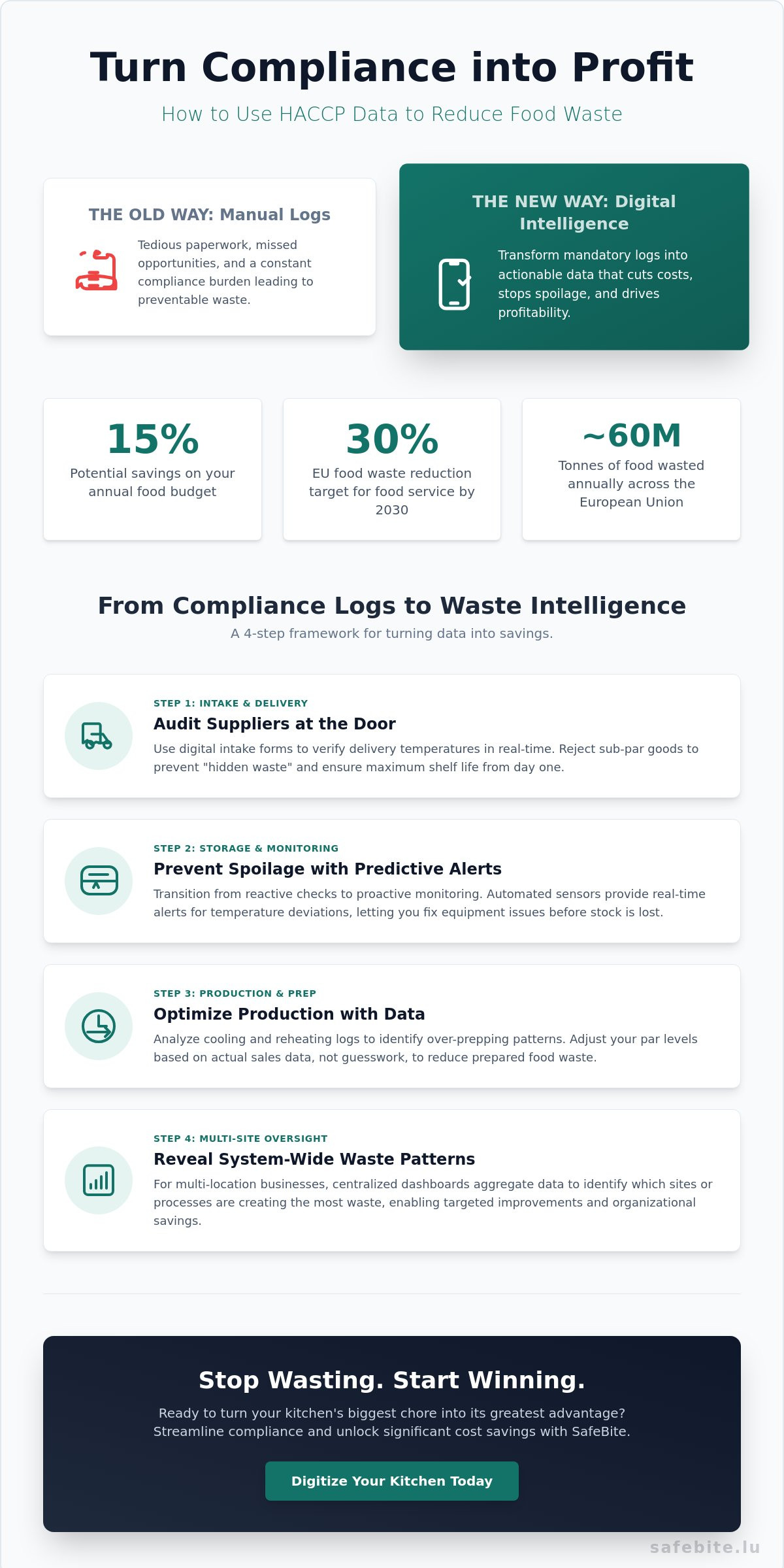
What if the most tedious part of your kitchen's daily routine was actually the key to reclaiming 15% of your food budget? It's a common frustration for operators across Luxembourg. You spend hours on manual logs just to stay compliant with strict national standards and evolving EU food waste reduction targets. You've likely felt the sting of throwing away high-value inventory because a cooler fluctuated overnight or a prep list was miscalculated. While many see these logs as a burden, using HACCP data to reduce food waste is the most effective way to turn a compliance requirement into a profit driver.
We understand that food safety often feels like a defensive play rather than a growth strategy. However, your safety logs are a goldmine of untapped business intelligence. This article explores how modern digital checklists and automated temperature monitoring systems provide the visibility you need to protect your margins. We will outline a clear roadmap to help you streamline compliance and make data-backed decisions that stop spoilage at the source.
Key Takeaways
- Understand why 2026 industry standards require an integrated approach that merges mandatory food safety with operational sustainability.
- Learn the specific methods for using HACCP data to reduce food waste by analyzing delivery and cooling logs to uncover supplier issues and production inefficiencies.
- Transition from reactive waste tracking to predictive monitoring that uses real-time alerts to stop inventory loss before it occurs.
- Discover a practical implementation plan for digitizing kitchen workflows and empowering staff to treat digital checklists as essential business tools.
- See how multi-site management dashboards can reveal waste patterns across different locations to improve total organizational profitability.
The Intersection of Food Safety and Sustainability
In 2026, the boundary between food safety and sustainability has dissolved for professional kitchens in Luxembourg. HACCP is no longer a separate compliance task; it's the foundation of a lean operation. Across the European Union, nearly 60 million tonnes of food are wasted every year, a figure that exceeds total imports. These losses represent a massive environmental failure and a direct hit to your profit margins. By using HACCP data to reduce food waste, chefs are shifting from reactive hazard management to proactive resource preservation.
New EU targets adopted in March 2026 demand a 30% reduction in food waste per capita in the food service sector by 2030. You can't manage what you don't measure. Traditional safety checks based on Hazard Analysis and Critical Control Points (HACCP) often focus on immediate hazards, but the data they generate tells a story about the future of your stock. When you track a cooling curve or a delivery temperature, you're recording the lifespan of your capital. Moving toward an integrated approach means your safety logs become your most reliable inventory forecasts.
HACCP Data as a Business Intelligence Asset
Every temperature entry serves as a diagnostic tool. If a walk-in fridge consistently hovers near the safety limit, it's not just a compliance risk. It's a spoilage catalyst that shortens the shelf life of every ingredient inside. Digital records outperform paper by aggregating these micro-trends over weeks and months. You'll stop asking if you passed the inspection and start asking how much inventory you saved. This transition turns a mandatory chore into a competitive advantage. It's about optimizing operations rather than just passing audits.
Aligning with Luxembourg Food Safety Standards
Compliance isn't just about avoiding fines. Following Luxembourg food safety regulations provides a structured framework for high-level inventory control. These standards encourage meticulous stock rotation and digital transparency. When your kitchen remains audit-ready through digital logging, you naturally implement better stock management practices. This readiness ensures that ingredients are used at their peak quality rather than being discarded due to oversight. Digital transparency provides the clarity needed to satisfy both national inspectors and internal waste reduction goals. Using HACCP data to reduce food waste is the logical evolution of these regulatory requirements.
Turning Compliance Logs into Waste Intelligence
Compliance logs are often viewed as a static archive. They sit in binders, gathering dust until an auditor arrives. However, this mindset ignores the wealth of operational data hidden in those temperature checks and cleaning schedules. By using HACCP data to reduce food waste, you turn a legal necessity into a strategic advantage. Recent studies on global trends in HACCP confirm that when safety systems are used to monitor resource efficiency, kitchens experience lower costs and improved product quality. It's a shift from merely surviving an inspection to mastering your inventory.
Delivery and Intake Data
Waste often begins before an ingredient ever hits the prep table. Delivery logs are your first line of defense. When you use digital intake forms, you aren't just checking a box. You're auditing your suppliers in real time. Rejecting sub-par goods at the door prevents "hidden waste" where ingredients spoil prematurely because they were mishandled during transit. This immediate temperature verification preserves the maximum possible shelf life for your inventory. Over time, this data identifies which vendors consistently deliver at the edge of the safety zone, allowing you to make better purchasing decisions.
Production and Expiry Tracking
Cooling and reheating logs offer a direct look into your production efficiency. If logs consistently show that specific items are being reheated but not sold, or cooled in quantities that suggest over-prep, you have the evidence needed to adjust your par levels. This data-driven approach replaces guesswork with precision. To simplify this level of oversight, integrating digital HACCP checklists can help your team capture this data without adding to their workload. It ensures that every record is accurate and actionable.
Identifying "danger zones" where temperatures frequently deviate also allows you to address equipment issues before they lead to a total loss of stock. Automated reminders and digital labeling ensure that First-In, First-Out (FIFO) practices are followed strictly. This prevents the "forgotten box" syndrome in walk-in freezers, where expensive proteins are lost to freezer burn or passed expiry dates. By digitizing these records, you gain a transparent view of your kitchen's health that paper logs simply cannot provide.
Finally, consider the impact of mistake-driven waste. Incorrectly handled allergen requests lead to remade plates and discarded ingredients. Digital allergen management tools provide a centralized source of truth for the entire team. By ensuring the right information is available at every step, you eliminate the need for costly remakes and improve overall kitchen throughput. Every data point you collect serves a dual purpose: keeping your guests safe and your margins secure.
Predictive Monitoring: Stopping Waste Before the Bin
Traditional waste management often relies on scales and bins to measure what has already been lost. While tracking what you throw away provides some insight, it's essentially an autopsy of your profit. Predictive monitoring represents a fundamental shift in kitchen management. By using HACCP data to reduce food waste, you identify risks before they result in a loss. This proactive alignment of safety and efficiency is a core pillar of the Federal Interagency Strategy to reduce food waste, which emphasizes how clear safety data helps achieve national sustainability goals.
Real-Time Alerts vs. Manual Logging
Manual temperature checks are prone to human error and only capture a single moment in time. A walk-in fridge can fail at 10:00 PM on a Saturday, and without a 24/7 watch, you won't know until Sunday morning. By then, thousands of dollars in high-value proteins and produce are unsalvageable. An automated temperature monitoring system acts as a persistent insurance policy. It provides real-time alerts the moment a threshold is crossed. This allows your team to intervene, move stock, or call a technician before the food enters the danger zone. It's the difference between a minor inconvenience and a total financial loss.
Analyzing Trend Data for Equipment Maintenance
Beyond immediate alerts, the long-term data gathered through digital HACCP logs reveals the underlying health of your hardware. A compressor that's struggling or a door seal that's leaking won't always cause a catastrophic failure immediately. Instead, it causes subtle, recurring temperature fluctuations. By using HACCP data to reduce food waste, you can spot these patterns early. Spotting a consistent 2-degree upward shift over a three-day period allows for preventative maintenance. Fixing a seal today is significantly cheaper than replacing an entire inventory of spoiled goods tomorrow. Stable temperatures lead to predictable spoilage rates, which is essential for maintaining tight inventory margins.
Consider a scenario where a digital checklist flags a repeated "corrective action" for a specific prep cooler. On paper, these might look like isolated incidents. In a digital dashboard, they appear as a clear trend of equipment fatigue. When you catch a 2-degree shift early, you aren't just saving the equipment; you're preserving the integrity and shelf life of every ingredient stored within. This transition from reactive repairs to data-backed preventative maintenance is what separates high-performance kitchens from those struggling with rising food costs.
Implementing a Data-Driven Waste Strategy
Transitioning from paper logs to a digital ecosystem is the first step in reclaiming your margins. Data is only as valuable as your ability to act on it. While theoretical frameworks provide a starting point, a busy kitchen needs a practical "Monday morning" roadmap. By using HACCP data to reduce food waste, you move beyond the "if" of food safety and into the "how" of operational excellence. This strategy requires a systematic approach to digitizing workflows and reviewing the resulting insights with surgical precision.
The implementation begins with digitizing your existing HACCP workflows to ensure clean, reliable data collection. When information is trapped on paper, it's invisible. Once it's digital, it becomes a trend. From there, you must train your team to treat digital checklists as operational tools rather than administrative chores. When a chef understands that an accurate temperature log prevents a $2,000 inventory loss, the task gains purpose. This shift in perspective is essential for long-term success.
Staff Engagement and Training
The success of any data-driven strategy depends on the people entering the data. You must connect safety tasks to the survival and profitability of the business. Reducing the friction of data entry is critical. Intuitive digital interfaces allow staff to complete logs in seconds, not minutes. This efficiency fosters a culture of proactive vigilance rather than punitive compliance. Instead of hunting for missing signatures, you're discussing real-time kitchen health. When staff see that their precision leads to a more organized, less wasteful environment, buy-in happens naturally.
Reviewing the Dashboard
A weekly management review of "Critical Control Point" (CCP) deviations is where the actual savings are found. You should look for recurring patterns rather than isolated incidents. If your logs show a specific protein consistently failing its cooling curve, you have a prep or equipment issue to solve. Use your data to identify your "top 5" wasted items and trace them back to their safety logs. Did they spoil because of a temperature fluctuation, or were they over-prepped? Setting realistic reduction targets based on your baseline HACCP data allows you to track progress with certainty.
Finally, use these insights to adjust your procurement and prep levels. If the data shows you're consistently discarding prep at the end of a shift, your par levels are too high. Rewarding staff for hitting waste reduction milestones identified in the data reinforces the value of their precision. Ready to transform your kitchen's data into a profit engine? Explore how SafeBite’s digital HACCP checklists and monitoring tools can automate your waste reduction strategy today.
The SafeBite Advantage: From Checklists to Cost Savings
Operational challenges require streamlined resolutions. While the strategies discussed in previous sections provide a roadmap, successful execution depends on having the right tools in place. SafeBite’s digital HACCP checklists serve as a dual-purpose solution, safeguarding your guests while simultaneously protecting your inventory. By using HACCP data to reduce food waste, you move from a defensive posture to a proactive management style that prioritizes both safety and margins. Modernizing your kitchen with these tools is the highest ROI move an operator can make in 2026.
The transition to a digital environment eliminates the friction of manual oversight. SafeBite’s Temperature Monitoring System provides a layer of protection that manual checks simply cannot match. If a cooling unit fails at midnight, you receive an immediate alert. This prevents the catastrophic loss of thousands of dollars in stock. For operators managing several locations, the Multi-site Management Dashboard offers a centralized view of performance. It allows you to identify which sites are excelling and which ones require intervention to curb waste trends before they impact your annual budget.
Simplified Compliance, Maximum Insight
SafeBite replaces cumbersome paper logs with smart, automated workflows that guide your team through their daily requirements. These digital records are organized into an audit-ready dashboard, providing General Managers with immediate visibility into kitchen operations. You'll no longer spend hours digging through binders to find a specific cooling curve or delivery log. SafeBite is the bridge between regulatory compliance and operational efficiency. It ensures that every data point collected contributes to a leaner, more profitable business model through constant, automated oversight.
Ready for the Future of Food Service?
Data-driven kitchens hold a significant competitive advantage. As food costs continue to fluctuate and regulations tighten, the ability to make decisions based on accurate, real-time data is invaluable. Getting started with this digital transition doesn't require a service disruption. SafeBite is designed to integrate seamlessly into your existing routines, providing immediate clarity without the learning curve of hardware-heavy alternatives. It's time to take control of your kitchen's future and stop letting profits slip through the cracks.
Success in 2026 is defined by precision. By using HACCP data to reduce food waste, you're investing in a system that pays for itself through reclaimed margins and reduced labor hours. Gain the confidence that comes with total operational transparency. Let SafeBite help you turn your compliance requirements into your greatest business asset. Reach out today to see how our suite of digital tools, from our Allergen Management Tool to our comprehensive monitoring systems, can transform your kitchen's profitability.
Securing Your Kitchen's Operational Future
The transition from manual logging to a digital ecosystem is no longer a luxury; it's a strategic necessity in 2026. By using HACCP data to reduce food waste, you transform mandatory safety checks into a high-resolution map of your inventory's health. Digital monitoring stops losses before they reach the bin while digitized workflows empower your staff to focus on quality rather than paperwork. This shift doesn't just satisfy inspectors; it strengthens your bottom line and ensures long-term sustainability.
Implementing these changes requires the right partner. SafeBite provides automated real-time alerts and a centralized multi-site dashboard designed specifically for the hospitality industry. These tools provide the precision you need to manage complex operations with ease. Start reducing your kitchen waste with SafeBite’s digital HACCP platform today. You'll gain the control and confidence needed to thrive in an increasingly data-driven industry. We're ready to help you turn your compliance data into your greatest operational asset.
Frequently Asked Questions
How exactly can HACCP data help reduce food waste?
HACCP data identifies the specific points where temperature fluctuations or production errors occur. By using HACCP data to reduce food waste, operators see which ingredients are consistently entering the danger zone or being over-prepared. This visibility allows for targeted operational adjustments that prevent spoilage before it happens. It turns a static safety log into a dynamic tool for inventory preservation.
Is digital HACCP software expensive to implement for a single restaurant?
The investment for digital HACCP software depends on the scale of your operation and the specific tools you select, such as automated sensors or multi-site dashboards. Many single-location restaurants find that the reduction in manual labor hours and the prevention of a single inventory loss event often balances the initial setup. You should evaluate the potential ROI based on your current waste levels and labor costs.
Can HACCP data help with inventory management and ordering?
Yes, HACCP logs provide a historical record of production and consumption patterns that inform smarter purchasing. By reviewing cooling and reheating logs, chefs can identify which batch sizes are consistently too large for actual demand. This data allows for more precise ordering and procurement. You'll stop buying excess stock that ultimately ends up in the bin due to over-prep.
What are the most common causes of food waste that HACCP data identifies?
HACCP data frequently pinpoints equipment malfunctions, poor supplier quality at intake, and inadequate cooling procedures. It also highlights mistake-driven waste, such as allergen errors or mislabeled expiry dates. Identifying these recurring issues allows management to implement corrective actions before ingredients are lost. It moves the kitchen from guessing why waste happens to knowing exactly where it occurs.
Do I need special equipment to start using HACCP data for waste reduction?
You primarily need a digital platform to record data and integrated sensors for continuous monitoring. While basic digital checklists can be completed on standard tablets or smartphones, a dedicated Temperature Monitoring System provides the continuous data stream necessary for predictive maintenance. This setup ensures you have the high-resolution data required to spot subtle trends that manual checks often miss.
How does real-time temperature monitoring prevent food loss?
Real-time monitoring provides an immediate notification the moment a storage unit deviates from its safe range. This allows your team to move stock or repair equipment immediately, rather than discovering a failure hours later during a manual check. It acts as a 24/7 safeguard against catastrophic stock loss. You're no longer vulnerable to refrigerator failures that happen overnight or during off-hours.
Is digital record-keeping legally accepted by Luxembourg food safety inspectors?
Digital food safety records are fully accepted and often preferred by Luxembourg inspectors due to their accuracy and transparency. Systems that provide unalterable, time-stamped logs demonstrate a high level of due diligence. This digital transparency makes the audit process more efficient for both the operator and the inspector. It shows you're proactive about safety and have total control over your processes.
How long does it take to see a reduction in food waste after switching to digital logs?
Most kitchens begin to see measurable improvements within the first 30 days of using HACCP data to reduce food waste. The initial gains usually come from catching equipment issues early and tightening intake procedures at the delivery door. Long-term savings from optimized prep levels and improved supplier reliability typically stabilize after one full quarter of consistent data collection and review.