
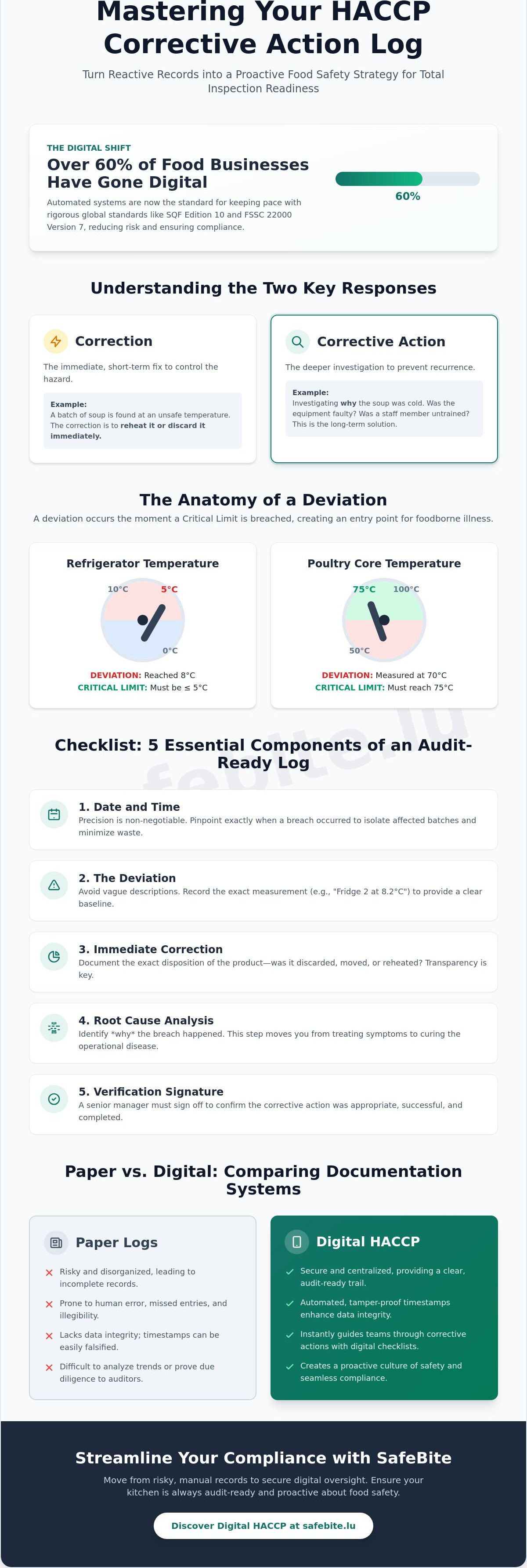
What if your corrective action log wasn't just a record of failure, but a strategic roadmap for proactive kitchen management and total inspection readiness? Most food safety managers naturally feel a sense of unease when an auditor asks to see deviation records, fearing that a mountain of disorganized paper folders or an incomplete HACCP corrective action log template will lead to a non-compliance report. It's a valid concern in an era where over 60% of food businesses have already transitioned to automated systems to keep pace with rigorous standards like SQF Edition 10 and FSSC 22000 Version 7.
This guide will help you master the essential components of a modern documentation framework while showing you how to move from risky, manual records to secure digital oversight. You'll learn how to establish a clear, audit-ready system that reduces the risk of foodborne illness and ensures your staff remains compliant without the friction of paper-based logs. We'll explore the specific data points required for 2026 compliance and provide a clear path toward a more efficient, technology-driven food safety culture.
Key Takeaways
- Understand why documenting deviations serves as a vital safety net for your food safety plan rather than just a record of operational errors.
- Identify the essential data points required in a professional HACCP corrective action log template to ensure every entry is precise and audit-ready.
- Evaluate the hidden risks of paper-based logs and how digital records enhance data integrity through automated, tamper-proof timestamps.
- Learn a structured approach to implementing corrective processes, from defining critical limits to assigning clear staff responsibilities.
- Explore how modern digital checklists can instantly guide your team through the necessary steps when a limit is breached, maintaining seamless compliance.
What is a HACCP Corrective Action Log?
A HACCP corrective action log is a formal, documented record of every instance where a Critical Control Point (CCP) limit was breached. It's the physical manifestation of Principle 5 within the Hazard Analysis Critical Control Point (HACCP) framework. This log acts as your safety net. It ensures that when things go wrong, you have a pre-planned, systematic response ready to execute. Without this documentation, a kitchen operates in a state of reactive uncertainty, which is a significant risk in a professional food environment.
It's vital to distinguish between a correction and a corrective action. A correction is the immediate, short-term fix. If a batch of soup is found at an unsafe temperature, you might reheat it or discard it. A corrective action is the deeper investigation into why the soup was cold in the first place. Did the equipment fail? Was the staff member untrained? Your HACCP corrective action log template must capture both the immediate fix and the long-term solution to satisfy modern auditors and protect your customers.
Regulatory authorities in 2026 have shifted their focus toward total data integrity. While the FDA's FSMA 204 compliance date is now July 20, 2028, global standards like FSSC 22000 Version 7 already demand robust, verifiable documentation of every deviation. You can't just fix a problem; you must prove you've analyzed the root cause. This level of oversight is no longer optional. It's a fundamental requirement for staying in business.
The Anatomy of a Deviation
A deviation occurs the moment a Critical Limit is exceeded. Consider a refrigerator hitting 8°C when its limit is 5°C, or poultry failing to reach a core temperature of 75°C. These aren't just minor hiccups; they're potential entry points for foodborne illness. If these moments aren't logged immediately, they become invisible risks. Undocumented deviations are often the primary reason for failed inspections, as they suggest a lack of control over the kitchen's most dangerous hazards.
Why a Template is Just the Beginning
Having a HACCP corrective action log template is a great start, but the real value lies in how your team uses it. Consistent logging transforms a reactive "firefighting" environment into a proactive culture of safety. It signals to your staff that precision matters. For those operating within specific European jurisdictions, aligning these logs with the latest Luxembourg Food Safety Authority Guidelines: A 2026 Compliance Manual is essential for maintaining local certification and operational excellence. True safety isn't found in the template itself, but in the disciplined habits it creates across your entire organization.
Checklist: Essential Components of a Professional Log Template
A robust HACCP corrective action log template is much more than a simple grid; it is a legal document that must stand up to the intense scrutiny of a health inspector. To be effective, every log entry must provide a granular level of detail that allows for full traceability. When a deviation occurs, the data you record becomes the primary evidence of your due diligence and your commitment to the HACCP Principles & Application Guidelines. Precision is your best defense against liability.
Every professional log should include these five essential pillars:
- Date and Time: Precision is non-negotiable. Knowing exactly when a breach occurred helps you isolate affected batches and minimize unnecessary food waste.
- The Deviation: Avoid vague descriptions. Record the exact measurement, such as "Fridge 2 at 8.2°C," to provide a clear baseline for the investigation.
- Immediate Correction: Document exactly what happened to the product. Whether it was discarded, moved to another unit, or reheated, the disposition of the food must be transparent.
- Root Cause Analysis: This field identifies why the breach happened. Without this, you are simply treating symptoms rather than curing the operational disease.
- Verification Signature: A senior manager or designated supervisor must sign off to confirm that the corrective action was both appropriate and successful.
If you find that managing these details on paper is becoming a burden, consider how digital HACCP tools can automate the entry process and ensure no field is left blank.
Documenting the "Why": Root Cause Identification
Identifying the root cause is what prevents a one-time error from becoming a chronic failure. You must distinguish between equipment failure, such as a compressor breakdown, and human error, like a door left ajar. Many managers find that "staff retrained" is the most frequent and vital entry in their log. Using "The 5 Whys" method helps you dig deeper. If a fridge was too warm, why? Because the door was open. Why? Because the seal was broken. Why? Because the maintenance check was skipped. This level of detail turns a log into a management tool.
Verification vs. Validation in Your Log
Verification is the process of confirming that the corrective action actually took place. This is where the supervisor's role is critical. They aren't just signing a paper; they're auditing the response. Timestamps are essential here to prove real-time compliance rather than "back-filling" logs at the end of a shift. Ensuring your log meets the latest Luxembourg food safety regulations requires a disciplined approach to these signatures. Proper verification proves that your safety system is not just a plan on a shelf, but a living process in your kitchen.
Paper vs. Digital: Comparing Your Documentation Options
Choosing the right format for your HACCP corrective action log template is a decision that impacts your kitchen's daily efficiency and your long-term legal security. While traditional paper binders have been the industry standard for decades, the shift toward digital oversight is accelerating. In fact, over 60% of food-related businesses have already transitioned from manual logbooks to automated systems as of May 2026. This transition is driven by the need for higher data integrity and the reality that paper records often fail to meet the rigorous demands of modern audits. When choosing your documentation method, you must consider whether your current system provides a true safety net or simply a false sense of security.
Effective documentation requires more than just a place to write; it requires a system that ensures accuracy at every step. The FAO guidance on corrective actions emphasizes that records must be permanent and legible to be considered valid. Paper logs frequently struggle to meet these basic criteria. Smudged ink, illegible handwriting, and physical damage from kitchen environments can render your most critical records useless during a surprise inspection. Digital solutions solve these issues by providing a standardized, clean, and indestructible record of every action your team takes.
The Risk of Manual Record Keeping
Manual record keeping introduces a significant level of operational risk. One of the most common issues is "retroactive filling," where staff attempt to complete logs from memory just before a shift ends or an inspector arrives. This practice, often called "dry-labbing," is easily detected by experienced auditors and can lead to immediate failure. Furthermore, if a log is stored on a clipboard in a back office, a deviation occurring on the line might go unnoticed for hours. For a deeper look at these challenges, you can read our guide on Mastering Documentation and Record-Keeping in HACCP, which explores the specific vulnerabilities of physical folders.
The Benefits of Digital Transformation
Digital logs offer a level of proactive vigilance that paper simply cannot match. Automated timestamps eliminate the possibility of falsifying records, as every entry is logged in real time. Smart alerts can notify a manager's mobile device the moment a CCP limit is breached, allowing for an immediate response rather than a delayed discovery. This real-time oversight is particularly valuable for those managing multiple sites, as it allows you to monitor compliance across several locations from a single dashboard. With the FDA's FSMA 204 compliance date set for July 20, 2028, establishing a digital foundation now ensures you are prepared for the complex traceability requirements ahead. You can pull up twelve months of logs in seconds, transforming a stressful audit into a routine demonstration of your kitchen's professional standards.
How to Implement Your Corrective Action Process
A well-structured HACCP corrective action log template provides the framework, but successful implementation relies on a disciplined five-step approach. Moving from a static document to a living safety process requires a blend of clear definitions and staff accountability. When your team knows exactly what to do the moment a limit is breached, you eliminate the hesitation that leads to food safety incidents. Precision starts with preparation.
- Step 1: Define clear Critical Limits. You cannot log a deviation if your team doesn't know where the safety line is drawn. Every CCP in your kitchen must have a specific, measurable threshold.
- Step 2: Assign monitoring duties. Specific staff members should be responsible for monitoring and logging deviations. Clear ownership prevents the "someone else will do it" mentality.
- Step 3: Pre-approve actions. Establish a set of standard responses for common issues. This allows chefs to act instantly during a crisis without waiting for a manager's permission.
- Step 4: Conduct weekly reviews. Set aside time each week to analyze the log. This habit helps you spot recurring trends that might indicate equipment fatigue or training gaps.
- Step 5: Digitise your monitoring. Transition to a digital log for pest control monitoring and temperature checks to ensure data integrity and instant accessibility.
To simplify this transition and ensure your team never misses a critical step, you can implement digital HACCP checklists that automate these workflows and provide real-time oversight.
Training Your Staff for Proactive Vigilance
Staff training is the most critical component of a functional HACCP plan. You must empower your chefs to take immediate action when a deviation occurs. It's vital to foster an environment where honesty is valued above perfection. A recorded deviation is a sign of a healthy, transparent system; a hidden one is a liability. Use your completed logs as practical training tools during monthly safety briefings. Showing the team how a previous breach was successfully handled builds confidence and reinforces the importance of the HACCP corrective action log template as a management tool rather than just a compliance chore.
Reviewing Logs for Continuous Improvement
Reviewing your records is about more than just satisfying an auditor. It's a strategic way to identify equipment that needs maintenance before a total failure occurs. For instance, if a walk-in fridge consistently triggers a corrective action once a month, it's time to call a technician. This proactive approach also helps in reducing food waste by identifying patterns in spoilage that might otherwise go unnoticed. For a deeper look at managing these costs, read our guide on How to Reduce Food Spoilage in Restaurants. Consistent review turns your data into a roadmap for a more efficient, profitable kitchen.
Streamlining Compliance with SafeBite Digital HACCP
Modern food safety management requires a shift from reactive documentation to proactive oversight. While a physical HACCP corrective action log template provides a basic structure, it often fails under the pressure of a fast-paced kitchen environment. SafeBite replaces these static paper folders with intuitive digital checklists designed to capture data with surgical precision. This transition ensures that every deviation is not only recorded but addressed through a verified workflow that satisfies the most demanding auditors. By digitising your logs, you move away from the risks of illegible handwriting and lost pages toward a system of total accountability.
One of the most powerful features of a digital system is the use of automated corrective action prompts. When a staff member records a measurement that exceeds a critical limit, the app immediately guides them through the necessary corrective steps. This eliminates guesswork and ensures that the response is consistent with your pre-approved safety protocols. Instead of a manager discovering a fridge failure hours too late, our temperature monitoring system provides real-time alerts. This allows for an immediate intervention that saves stock and protects your business from the risk of foodborne illness.
The transition to digital also simplifies the audit process. Rather than spending hours searching through physical folders, you can generate comprehensive, audit-ready reports with a single click. These reports provide a clear, chronological history of every deviation and the corresponding action taken, proving to inspectors that your kitchen operates with a high level of discipline and oversight.
Digital Log for Pest Control and Beyond
Standardisation is the cornerstone of professional food safety, especially for those managing multiple locations. SafeBite integrates your pest control, temperature, and cleaning logs into a single, unified application. By using our multi-site management dashboard, you can ensure that every location follows the same rigorous standards without needing to be physically present at every site. This level of centralised control makes your business inspection-ready 24/7. It ensures that every HACCP corrective action log template across your entire organization is complete, accurate, and instantly accessible from any device.
Ready to Ditch the Paperwork?
The industry-wide move toward digitisation is no longer a future trend; it is the 2026 standard. Moving your food safety management to the cloud reduces the administrative burden on your chefs and provides a level of data security that paper cannot match. Setup is straightforward. SafeBite is built to mirror your existing kitchen workflows, making the transition frictionless for your team. If you're ready to eliminate the mountain of paper folders and secure your documentation for the next audit, it's time to discover how SafeBite simplifies HACCP compliance. Secure your records, empower your staff, and focus on culinary excellence with the confidence that your compliance is always one step ahead.
Secure Your Kitchen’s Future with Smarter Documentation
Mastering your corrective action process transforms a reactive compliance requirement into a proactive management strategy. By focusing on root cause analysis and precise data entry, you ensure your kitchen is prepared for the rigorous standards of 2026. While a traditional HACCP corrective action log template provides the necessary structure, the transition to digital records is what truly eliminates the risk of human error and lost data. This shift allows your team to spend less time on administrative tasks and more time on maintaining high culinary standards.
It's time to move beyond the limitations of physical folders and illegible handwriting. You can digitise your HACCP logs today with SafeBite to access automated CCP alerts and a real-time compliance dashboard that simplifies oversight. Our system replaces all manual kitchen paperwork, ensuring that every deviation is recorded with an unchangeable timestamp for maximum audit security. Taking this step today ensures your business remains resilient, compliant, and ready for whatever the next inspection brings. Your path to a safer, more efficient kitchen starts with a single digital update.
Frequently Asked Questions
What is the most common mistake in a HACCP corrective action log?
The most common mistake is failing to document the root cause or the specific preventative measure taken. Simply stating that food was discarded is a correction, but a corrective action requires identifying why the deviation occurred, such as a faulty gasket on a fridge, and fixing that underlying issue. This prevents the problem from recurring during the next shift and proves to auditors that your safety system is proactive.
How long must I keep my HACCP corrective action records?
In most jurisdictions, including Luxembourg, it's recommended to keep HACCP records for at least one year beyond the shelf life of the product. You should always verify specific national authority guidelines for your region. Digital storage is highly recommended because it prevents the physical degradation of logs and makes your HACCP corrective action log template entries instantly searchable during multi-year audits or surprise inspections.
Can I use a spreadsheet as a digital HACCP log?
While a spreadsheet is a step up from paper, it lacks the security and automation found in dedicated food safety software. Spreadsheets can be easily edited or deleted, which often raises red flags for inspectors concerned about data integrity. Professional software like SafeBite provides unchangeable timestamps and automated alerts that a static spreadsheet cannot offer, ensuring your records remain tamper-proof and fully compliant.
Is a corrective action log required for every kitchen?
Yes, if your business operates under a HACCP plan, Principle 5 requires you to establish and document corrective actions for every deviation. This mandate applies to restaurants, school canteens, and retail food production facilities alike. Failure to maintain these records is one of the most common reasons for a reduced hygiene rating during inspections, as it indicates a lack of control over critical safety limits.
What happens if we miss a log entry?
A missed entry is considered a gap in monitoring, which constitutes a compliance failure. If you discover a gap, you must document it immediately, explaining why it happened and what specific steps were taken to ensure the food remained safe during that period. Implementing digital reminders can virtually eliminate this risk by alerting staff when a scheduled check hasn't been completed on time.
Who is responsible for signing off on corrective actions?
While any trained staff member can perform an immediate correction, a HACCP-trained supervisor or manager should sign off on the final corrective action and its verification. This ensures that the root cause was properly addressed and that the business is taking food safety seriously at a leadership level. Having a senior team member verify the HACCP corrective action log template entries demonstrates a robust food safety culture.