Approximately 48 million people in the U.S. suffer from foodborne illnesses annually; this statistic underscores why a rigorous safety strategy is non-negotiable for your business. You likely feel the mounting pressure of an impending health inspection or find yourself buried under stacks of manual logs. It's common to feel uncertain about which risks truly qualify as critical when you're managing a fast-paced environment. Learning how to conduct a hazard analysis for a kitchen shouldn't feel like a bureaucratic burden.
We'll help you master this first and most vital principle of HACCP, transforming your safety protocols from a source of stress into a streamlined, professional workflow. This guide provides a methodical framework to identify biological, chemical, and physical risks while preparing your team for the 2026 regulatory environment. You'll gain the clarity needed to build a compliant plan that ensures both guest safety and operational efficiency. From assessing ingredient flow to establishing robust digital oversight, here is your roadmap to a safer, more resilient kitchen.
Key Takeaways
- Create a detailed process flow diagram to visualize every stage of your kitchen's operation and define the scope of your safety protocols.
- Master how to conduct a hazard analysis for a kitchen by systematically categorizing biological, chemical, and physical risks.
- Utilize the HACCP Decision Tree to objectively identify Critical Control Points where hazards can be eliminated or reduced to safe levels.
- Understand the legal requirements for documented hazard analysis and how digital checklists ensure constant readiness for health inspections.
- Learn how a centralized dashboard provides real-time oversight and consistent safety standards across multiple kitchen locations.
What is a Hazard Analysis and Why is it the Foundation of Your Kitchen?
Hazard analysis is the systematic process of identifying biological, chemical, and physical risks within the food production cycle. It serves as the bedrock of any professional food safety management system. Understanding how to conduct a hazard analysis for a kitchen is about more than just checking boxes; it is about mapping every potential point of failure from the moment raw ingredients arrive at your loading dock to the second a finished plate reaches the guest. While a general workplace safety assessment focuses on slips, trips, and falls, a food-specific hazard analysis zooms in on microscopic threats like pathogen growth or allergen cross-contact.
For businesses operating in Luxembourg, this isn't just a best practice; it's a legal mandate. Local food safety authorities require a documented analysis for every food business to ensure public health is protected. Beyond compliance, a thorough analysis significantly reduces food waste by identifying spoilage risks early. It also safeguards your brand reputation. In 2026, a single foodborne illness outbreak can go viral in minutes, making your hazard analysis your most effective insurance policy against catastrophic PR damage.
The Seven Principles of HACCP: Where Analysis Fits
The global standard for food safety is built upon Hazard Analysis and Critical Control Points (HACCP). Principle 1 is the conduct of the hazard analysis itself. You simply cannot establish effective control points or monitoring procedures without first identifying what you are trying to control. This analysis informs your entire safety plan, dictating where you need to implement our Temperature Monitoring System or use specific digital checklists. Think of the hazard analysis as the diagnostic phase of food safety management. It provides the data necessary to build a proactive defense rather than a reactive one.
Common Misconceptions About Kitchen Hazards
Many operators fall into the trap of believing that "we've never had an issue" is a valid substitute for a formal analysis. Past luck doesn't guarantee future safety. Relying on "common sense" is equally dangerous; kitchen staff often develop habits that overlook subtle risks like chemical leaching from improper storage or cumulative temperature abuse. Another common pitfall is "compliance blindness" caused by paper-based systems. When teams are forced to fill out physical logs manually, they often treat the process as a chore to be completed after the fact. This leads to falsified data and ignored risks. Transitioning to Digital HACCP Checklists eliminates this friction, ensuring that hazards are identified and addressed in real time rather than buried in a dusty binder.
Categorizing Kitchen Hazards: The Four Pillars of Risk
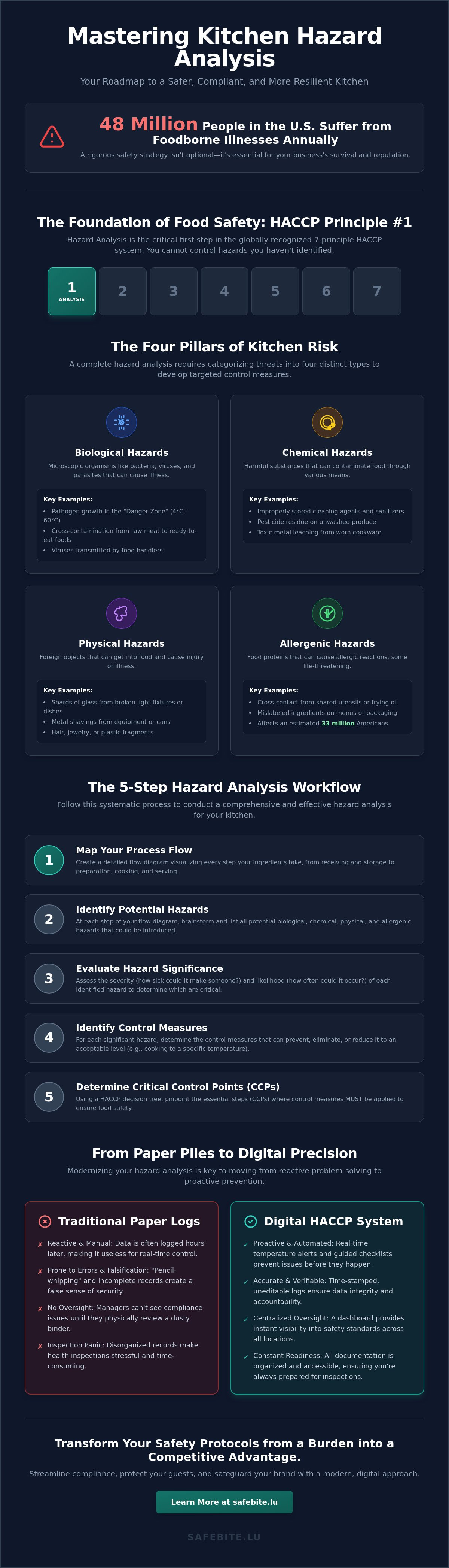
Professional kitchens are high-velocity environments where safety risks evolve every hour. To master how to conduct a hazard analysis for a kitchen, you must first categorize threats into four distinct pillars: biological, chemical, physical, and allergenic. While many operators focus solely on temperature, a comprehensive analysis requires a broader perspective. Biological hazards involve pathogens like bacteria and viruses that thrive in high-heat, high-moisture areas. Chemical hazards often stem from cleaning agents or toxic metal leaching, while physical hazards include foreign objects like glass or metal shards entering the production line. Finally, allergenic hazards represent the fourth vital pillar, requiring precise cross-contact prevention to protect the estimated 33 million Americans with food allergies.
Following the FDA's HACCP Principles & Application Guidelines ensures that your categorization remains scientifically sound and regulatorily compliant. By compartmentalizing these risks, you can develop targeted control measures for each, rather than relying on a one-size-fits-all approach that might miss subtle but dangerous contamination points.
Biological and Chemical Threats in Professional Kitchens
Pathogen Growth Zones are specific areas in your layout where food potentially remains in the danger zone for too long. Identifying these is a critical part of knowing how to conduct a hazard analysis for a kitchen. You should also develop a list of Potentially Hazardous Foods (PHFs) specific to your menu, such as leafy greens, sprouts, or precooked meats. Safe chemical storage is equally important; keep sanitation supplies entirely separate from food prep areas to prevent accidental contamination. Implementing a Temperature Monitoring System provides the real-time data needed to keep biological threats under control.
Allergen Management: The Fourth Vital Pillar
Modern hospitality demands that allergens be treated with the same rigor as biological pathogens. Mapping the flow of the 14 major allergens through your storage and prep areas is essential because cross-contact can occur through shared utensils, fryers, or even airborne particles. Integrating an creating an accurate allergen matrix into your workflow provides the necessary structure to manage these risks effectively. Using a dedicated Allergen Management Tool can automate this mapping, reducing the risk of human error during peak service hours. By documenting every touchpoint, you create a safety net that protects both your guests and your business from the repercussions of undeclared allergens.
The 5-Step Workflow for Conducting a Comprehensive Hazard Analysis
Executing a successful hazard analysis requires a disciplined, sequential approach. It's not a task for a single individual; you should assemble a multidisciplinary team that includes kitchen leadership, floor staff, and maintenance personnel. This collective expertise ensures no detail is overlooked. Once your team is ready, you must define the scope of your analysis, covering every menu item and operational process. Understanding how to conduct a hazard analysis for a kitchen involves moving beyond guesswork and adopting a data-driven strategy that mirrors the precision of your culinary output.
Creating Your Kitchen's Process Flow Diagram
The second step involves mapping the entire journey of your food. You must trace every ingredient from receiving and storage through prep, cooking, cooling, reheating, and final service. A one-size-fits-all diagram usually fails to capture the unique bottlenecks or high-traffic intersections where cross-contamination is most likely to occur. Every arrow on your flow diagram represents a potential point of failure. By visualizing these transitions, you can pinpoint exactly where a biological or physical threat might enter the stream. For instance, OSHA's Kitchen Equipment Hazard Guide highlights how specific machinery can introduce physical risks if not maintained according to a strict schedule.
Evaluating Risk: The Likelihood vs. Severity Matrix
After identifying potential hazards at every stage, you must evaluate their significance. We recommend using a simple 3x3 matrix to plot the likelihood of an occurrence against the severity of the potential harm. This objective method allows you to prioritize high-risk areas that require immediate preventative measures. Hazards that cross the threshold of being both likely and severe are classified as "Significant Hazards." These are the primary candidates for transition into Critical Control Points (CCPs). It's vital to record your findings meticulously; detailed notes on why certain hazards were excluded are just as important as the reasons for their inclusion. This documentation provides a clear audit trail for health inspectors and internal reviews.
Finally, determine the necessary preventative measures for each identified risk. This might involve implementing a Temperature Monitoring System for high-risk storage areas or utilizing Digital HACCP Checklists to ensure staff follow sanitation protocols. By following this 5-step workflow, you transform a complex regulatory requirement into a manageable, transparent system that protects your operation and your guests.
Bridging the Gap: Identifying Critical Control Points (CCPs)
Identifying your Critical Control Points (CCPs) is the bridge between theory and practice. A CCP is a specific step where control can be applied to prevent, eliminate, or reduce a food safety hazard to safe levels. While the earlier stages of how to conduct a hazard analysis for a kitchen identified the "what," CCPs define the "where." This distinction is vital for operational efficiency. Not every hazard requires a CCP; some are managed through Operational Prerequisite Programs (OPRPs), which maintain general hygiene and environmental standards. However, for significant risks, a CCP is your mandatory line of defense.
Using a structured HACCP Decision Tree allows your team to identify these points objectively rather than relying on gut feeling. This logical progression ensures your safety plan is both lean and effective. It prevents you from over-complicating your operations with unnecessary "critical" designations while ensuring that high-risk stages, like the final cook temperature of poultry, receive the oversight they require. Your previous work on how to conduct a hazard analysis for a kitchen provides the raw data for this decision-making process, ensuring that your CCPs are rooted in the actual flow of your ingredients.
Applying the Decision Tree to Your Kitchen Workflow
To determine if a step is a CCP, your team should ask three targeted questions. First, does a control measure exist at this step? If not, and the step is necessary for safety, the process must be redesigned. Second, is this step specifically designed to eliminate or reduce the hazard to a safe level? A final cooking or pasteurization stage is often a CCP for this reason. Finally, could contamination occur at unacceptable levels at this step? If the answer is yes, and a subsequent step won't fix it, you've found a CCP. This methodical approach removes the ambiguity that often leads to inconsistent safety standards.
Setting the Stage for Monitoring and Corrective Actions
Once your CCPs are established, the next stages of food safety management become intuitive. Your hazard analysis informs the specific "Critical Limits" you must set, often derived from the 2022 FDA Food Code. For example, you might set a limit of 74°C (165°F) for 15 seconds for specific proteins. To ensure these limits are never breached, many modern kitchens are moving toward automated temperature monitoring. This technology provides a primary tool for CCP oversight, alerting you the moment a deviation occurs. Before fully implementing these measures, you must validate them to prove they actually control the hazard. You can manage this entire transition from analysis to action across all your locations with a Multi-site Management Dashboard, ensuring a unified standard of safety.
From Paper to Digital: Streamlining Your Hazard Analysis with SafeBite
Manual hazard analyses often suffer from fragmented data and poor version control. When you rely on paper, it's difficult to verify if a preventative measure was actually performed at the correct time or if the person performing it understood the risk. SafeBite eliminates this uncertainty by centralizing your safety data and providing smart reminders that keep your team on track. Learning how to conduct a hazard analysis for a kitchen is the first step, but maintaining that analysis requires a system that scales with your business. For operators managing multiple locations, our Multi-site Management Dashboard provides a single source of truth. This oversight ensures that safety standards remain consistent across every kitchen in your portfolio, regardless of who is on shift.
The Efficiency Gain of Digital Checklists
Replacing messy clipboards with Digital HACCP Checklists transforms how your team interacts with safety protocols on a daily basis. Automated logs reduce the "human error" factor by requiring real-time entries and providing instant feedback when a critical limit is breached. This level of oversight is essential for meeting Luxembourg food safety regulations, which demand high levels of transparency and accuracy. When an inspector arrives for a surprise audit, you don't need to scramble through dusty binders or search for missing pages. You can pull up your entire history of CCP logs and hazard analysis documentation instantly on a tablet or smartphone. This readiness demonstrates a culture of proactive vigilance that builds immediate trust with regulatory authorities.
Next Steps: Implementing Your Findings
A hazard analysis isn't a static document you file away after the initial setup. It's a living roadmap of your kitchen's risks that your team should review at least quarterly or whenever you change your menu, suppliers, or equipment. This ensures your protocols reflect the current reality of your operation. Knowing how to conduct a hazard analysis for a kitchen means recognizing that risks evolve as your business grows. It's equally important to train your staff on the "why" behind the digital logs they complete. When a chef understands that a digital check prevents a specific biological hazard identified in your analysis, compliance becomes a shared mission rather than a clerical task. Precision in documentation leads to precision in safety. Start your journey toward a paperless, compliant kitchen with SafeBite today.
Securing Your Kitchen's Future Through Digital Vigilance
Mastering the intricacies of how to conduct a hazard analysis for a kitchen is the most significant step you can take toward operational excellence. By mapping your food's journey and identifying critical control points with precision, you move beyond simple compliance and into a state of proactive readiness. You've learned that safety isn't a static document; it's a dynamic system that requires constant oversight and clear communication across your entire team. Transitioning from fragmented paper logs to a centralized digital framework ensures that no risk is overlooked and every preventative measure is verified in real time.
Precision and accuracy are the hallmarks of a professional kitchen. We invite you to digitize your kitchen's hazard management with SafeBite to maintain total control over your safety protocols. Our platform offers automated HACCP documentation, real-time temperature alerts, and a multi-site dashboard for total oversight. These tools empower you to lead with confidence, knowing your business is protected and your guests are safe. You're ready to build a more resilient and efficient operation today.
Frequently Asked Questions
What is the first step in conducting a hazard analysis for a kitchen?
The first step is assembling a multidisciplinary team to define the scope of your analysis, covering all menu items and operational processes. This group should include individuals with specific knowledge of your kitchen's daily workflow and equipment maintenance. By establishing this foundation, you ensure that the subsequent process flow mapping is accurate and representative of the actual risks present in your facility.
How often should a kitchen's hazard analysis be updated?
You should review and update your hazard analysis at least annually or whenever significant changes occur in your operation. These changes include introducing new menu items, switching suppliers, or installing new kitchen equipment. Regular reviews ensure your safety plan remains a living document that reflects the current reality of your environment, preventing your protocols from becoming obsolete or ineffective over time.
Can I use a generic HACCP template for my hazard analysis?
While generic templates provide a helpful starting point, your hazard analysis must be customized to your specific kitchen layout and processes. Every facility has unique bottlenecks and traffic patterns that a standard template cannot account for. Tailoring the analysis ensures you identify actual risks rather than theoretical ones, which is a critical component of learning how to conduct a hazard analysis for a kitchen effectively.
What is the difference between a hazard and a risk in food safety?
A hazard is a biological, chemical, or physical agent that has the potential to cause harm, such as Salmonella or glass shards. In contrast, risk is the measure of the likelihood that the hazard will occur and the severity of the resulting harm. Understanding this distinction allows you to prioritize your resources by focusing on high-risk areas identified during your systematic evaluation of potential threats.
Do small cafes need to conduct a full hazard analysis under Luxembourg law?
Yes, Luxembourg law requires all food businesses, regardless of size, to implement a food safety management system based on HACCP principles. While the complexity of the analysis may vary depending on the scale of the operation, a documented hazard analysis is mandatory. Small cafes must still identify their specific risks and establish control measures to ensure guest safety and maintain regulatory compliance during inspections.
What are the most common biological hazards found in commercial kitchens?
The most common biological hazards include pathogenic bacteria such as Salmonella, E. coli, and Listeria monocytogenes, alongside viruses like Norovirus. These pathogens often thrive in high-moisture environments or are introduced through improper handwashing and cross-contamination. Identifying these threats is a core part of how to conduct a hazard analysis for a kitchen, as it dictates the critical limits for cooking and cooling temperatures.
How do I document a hazard analysis for a health inspector?
Documentation should include your process flow diagrams, risk evaluation matrices, and a list of identified CCPs with their corresponding critical limits. Using digital tools allows you to present organized, timestamped logs instantly during an audit. Clear records demonstrate to the inspector that your kitchen maintains proactive vigilance and follows a structured, scientific approach to food safety management, significantly reducing the fear of failing inspections.
What happens if I miss a hazard during my initial analysis?
If you discover a missed hazard, you must update your documentation immediately and implement appropriate control measures. Food safety is an iterative process; discovering new risks during daily operations is an opportunity to strengthen your plan. Documenting the new hazard and your corrective actions shows inspectors that you're committed to continuous improvement and are actively monitoring your kitchen for evolving safety threats.