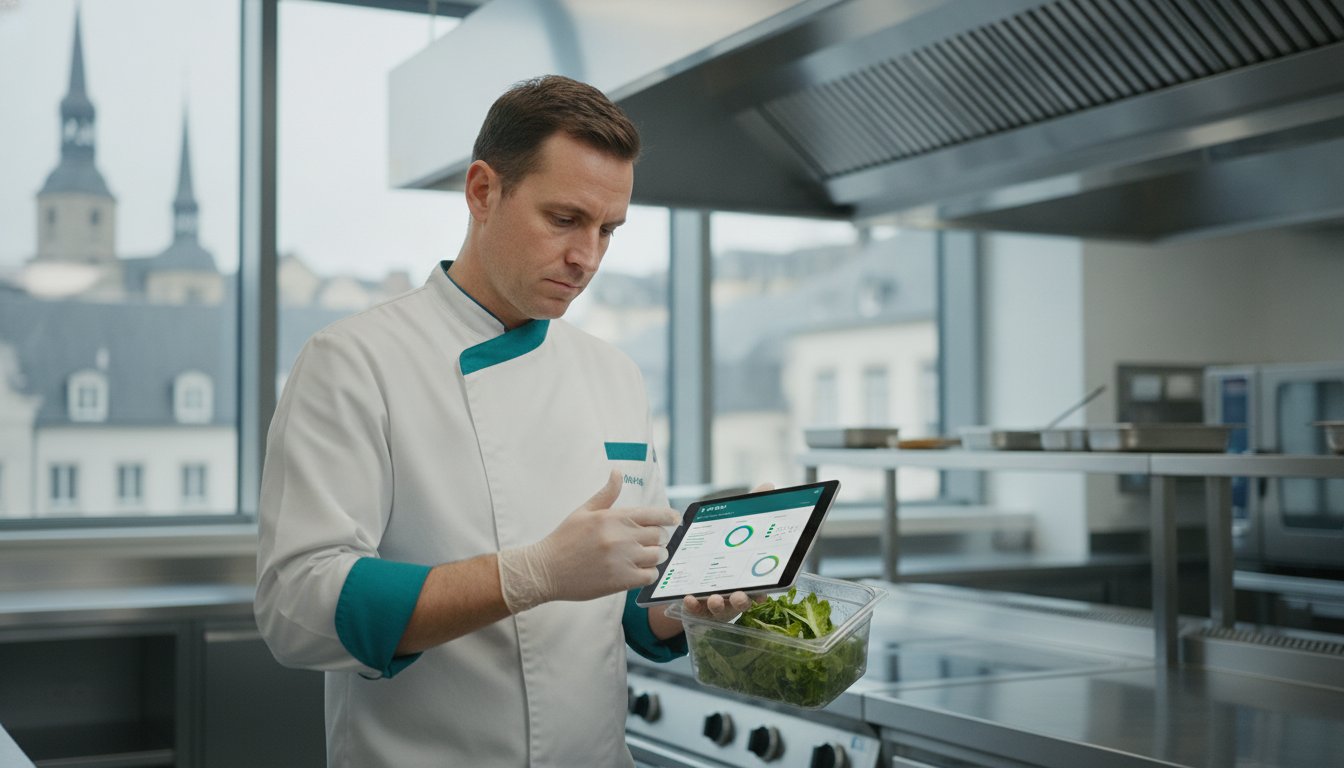

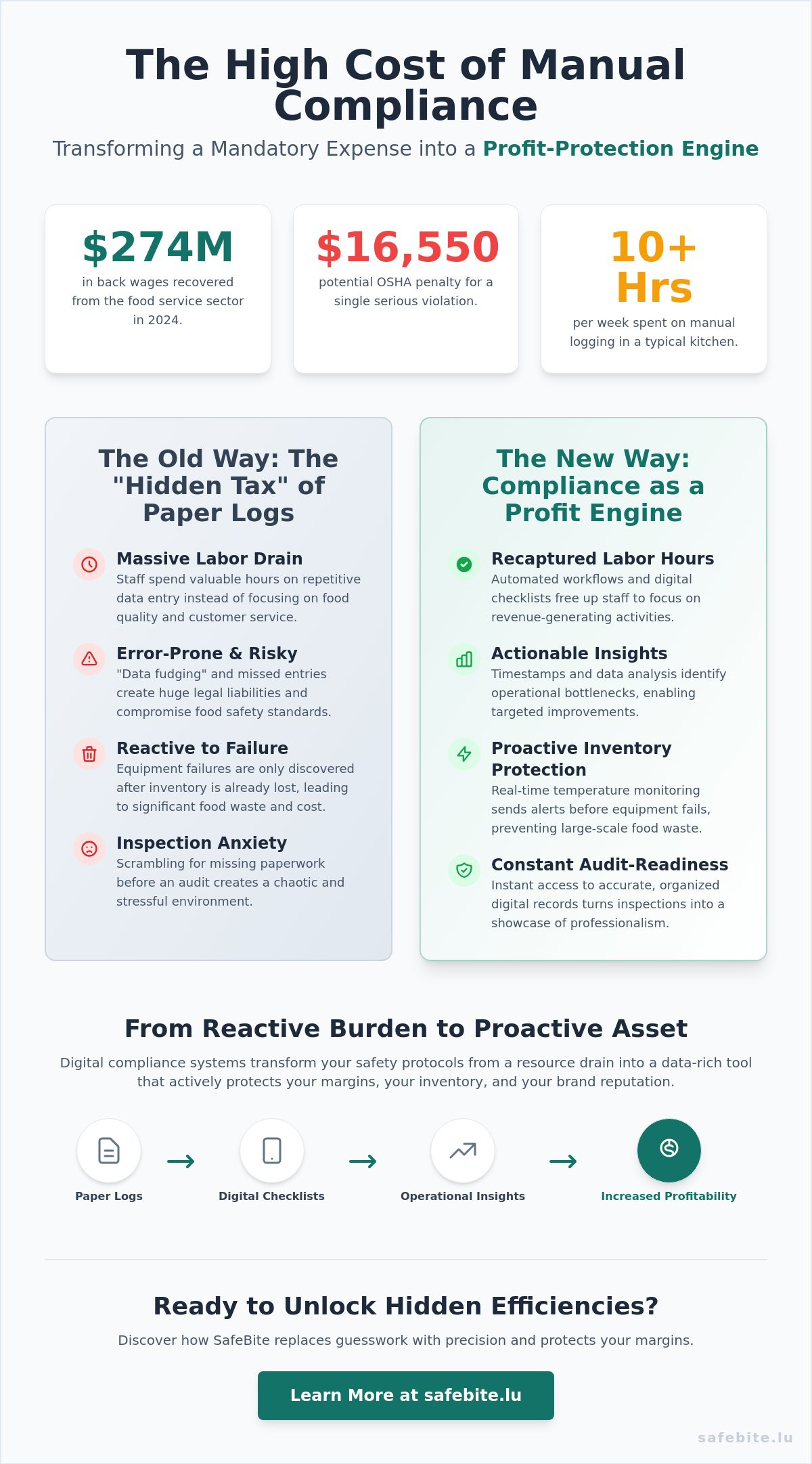
In 2024, the Department of Labor recovered over $274 million in back wages from the food service sector, confirming it as the most investigated industry in the United States. It's a sobering figure that highlights the high financial risks inherent in manual oversight. You likely feel the mounting pressure of rising labor costs and the heavy administrative burden of manual HACCP logging every day. It's natural to view regulatory requirements as a drain on your resources. However, improving restaurant profitability with compliance software is about more than just avoiding OSHA's $16,550 serious violation penalties.
We'll show you how shifting from paper logs to digital systems protects your margins, reduces food waste, and unlocks hidden operational efficiencies. You'll discover how tools like digital HACCP checklists and automated temperature monitoring systems replace guesswork with precision. This strategic guide explores how modern technology transforms compliance from a mandatory expense into a proactive profit-protection engine that ensures total confidence during health inspections.
Key Takeaways
- Traditional paper-based safety logs represent a hidden operational tax that drains staff time and creates unnecessary storage burdens.
- Discover how improving restaurant profitability with compliance software starts by replacing manual logging with automated workflows that recapture lost labor hours.
- Real-time temperature monitoring systems protect your inventory from equipment failure, paying for themselves by preventing even a single instance of large-scale food waste.
- Digital records streamline the audit process, providing authorities with instant access to accurate data and replacing inspection anxiety with organized confidence.
- Centralized dashboards offer multi-site operators the visibility needed to maintain consistent safety standards and protect margins across every location.
The Compliance Paradox: Why Traditional Safety Management Erodes Restaurant Margins
Many operators view safety protocols as a necessary evil that exists only to satisfy inspectors. This mindset creates a "compliance paradox" where the systems meant to protect your business actually drain its resources through inefficient manual processes. In 2026, compliance software has evolved beyond simple digital forms. It's now a proactive ecosystem that automates the Hazard Analysis and Critical Control Points (HACCP) framework, allowing managers to focus on growth rather than paperwork. Improving restaurant profitability with compliance software starts with recognizing that manual logs are a hidden tax on your margins.
Traditional management is often reactive. You fix a fridge after it fails or scramble to find missing paperwork five minutes before an auditor arrives. This chaos is expensive. By shifting to a digital-first approach, you move toward a model of "Compliance-Driven ROI." This means your safety protocols actively contribute to your bottom line by preventing loss before it happens and optimizing how your team spends their time.
The Hidden Costs of Paper-Based HACCP
Manual record-keeping is notoriously labor-intensive. In a typical mid-sized kitchen, staff can spend upwards of 10 hours every week manually recording temperatures and completing cleaning logs. When you multiply those hours by your average hourly wage, the cost of paper becomes clear. There's also the significant risk of "data fudging," where employees fill in logs retroactively to avoid trouble. This practice doesn't just compromise food safety; it creates a massive legal liability. If an incident occurs, "guessed" data won't hold up in court. These administrative burdens are intensified by Luxembourg food safety regulations, which demand high levels of accuracy and traceability.
Shifting the Mindset: Compliance as a Profit Asset
Transitioning to digital tools allows you to treat compliance as a data goldmine rather than a chore. Instead of filing papers away to be forgotten, you gain real-time insights into your operational health. Digital prompts guide your team through their shifts, which reduces the mental load on your chefs and floor staff. They don't have to remember every single task; the system reminds them. This creates a calmer, more efficient kitchen environment. Beyond the kitchen, maintaining a permanent "inspection-ready" status can lead to tangible financial gains. Many insurance providers offer more favorable rates to businesses that can prove they use automated monitoring to mitigate risk. By reducing liability and labor costs simultaneously, you transform a regulatory requirement into a strategic profit-protection engine.
Recapturing Labor Hours: How Automation Drives Kitchen Efficiency
While many operators focus on AI scheduling to trim payroll, they often overlook the significant labor drain caused by administrative friction. Improving restaurant profitability with compliance software involves identifying and eliminating these invisible hours spent on manual paperwork. When your team is tethered to clipboards, they aren't focusing on food quality or guest experience. By transitioning to digital food safety checklists, you replace slow, manual entries with a streamlined system that works at the speed of a modern kitchen.
Digital logs do more than just store data; they act as a diagnostic tool for your operations. By reviewing completion timestamps, managers can identify specific bottlenecks in daily kitchen prep that lead to service delays. This level of granularity is impossible with paper. If a certain station consistently falls behind on its safety checks, you have the data to address the root cause, whether it's a training gap or an inefficient station layout. This proactive approach ensures that your labor spend is always directed toward productive, revenue-generating activities.
Eliminating Manual Logging Fatigue
Manual logging is a repetitive task that invites human error and "logging fatigue." In high-volume environments, staff often prioritize service over safety documentation, leading to gaps that require management to spend hours chasing down signatures. Automated prompts and "one-tap" logging change this dynamic by making compliance a seamless part of the workflow rather than an interruption. By automating these repetitive data entry tasks, your restaurant can save over 15 staff hours every month. This reduction in administrative drag allows your senior chefs to spend more time mentoring junior staff, which directly improves team retention and service standards. To see how these workflows look in practice, you can explore our digital checklist features.
Real-Time Oversight for Multi-Site Managers
For those managing multiple locations, the logistical challenge of maintaining standards is immense. Traditional oversight requires physical site visits to verify that logs are being maintained correctly according to the standards outlined in the U.S. Food Safety System. Digital compliance tools allow for "management by exception." Instead of reviewing every log from every site, you only intervene when the software flags a deviation or a missed check. This remote auditing capability significantly reduces travel time and allows you to standardize procedures across a national brand from a single dashboard. Improving restaurant profitability with compliance software means your regional managers can oversee more sites with greater precision, reducing the need for additional middle-management hires as you scale.
Protecting Your Inventory: Reducing Food Waste Through Real-Time Monitoring
Inventory represents a restaurant's most volatile asset. While loss prevention strategies often focus on theft or "sweethearting," environmental failures are frequently more damaging to the bottom line. Improving restaurant profitability with compliance software involves securing your cold chain against these invisible "micro-failures." A single refrigerator malfunction overnight can result in thousands of euros of lost stock, a scenario that often goes unnoticed until the morning shift begins and it's already too late to save the product.
Research into the financial impact of restaurant compliance shows that businesses with rigorous safety oversight perform better financially because they avoid the dual costs of waste and regulatory fines. Digital tools move your team from reactive cleaning to proactive preservation. By tracking historical temperature data, you can identify a compressor that's struggling before it finally breaks. This allows for scheduled maintenance rather than emergency repairs, which are always more expensive and disruptive to service.
Beyond POS: The Role of Automated Temperature Logs
Your POS system tracks what you sell, but it's blind to the health of the ingredients sitting in your walk-in. Automated temperature monitoring systems provide 24/7 oversight, protecting stock during power outages or "door-left-open" events that happen after hours. Consistent storage temperatures also extend the shelf-life of delicate produce and proteins, directly improving your portion yield. When ingredients stay at optimal temperatures, you get more plates out of every delivery. This precision ensures that you aren't throwing away profit due to avoidable spoilage.
Managing Allergens and Recalls Without Revenue Loss
Manual inventory searches during a product recall are slow and prone to human error. Digital allergen management tools allow for instant cross-referencing of batches, ensuring that problematic items are removed from service immediately. This speed prevents guest illness and the significant legal costs that follow such incidents. Beyond safety, being able to provide precise, instant allergen information builds deep guest trust. This transparency is a powerful driver for repeat visits and higher check averages. Improving restaurant profitability with compliance software means you're creating a safer dining environment that guests are happy to return to, knowing their health is a top priority.
Audit-Readiness as a National Risk Management Strategy
For many operators, the arrival of a health inspector triggers a wave of "pre-audit panic." This reactive scramble disrupts normal kitchen flow and pulls focus away from the guest experience. Improving restaurant profitability with compliance software means replacing this anxiety with a state of permanent audit-readiness. When your safety data is organized in digital archives, you don't just survive an inspection; you use it as a benchmark for operational excellence. In Luxembourg, where authorities demand rigorous traceability, having instant access to historical logs simplifies the process for both the manager and the auditor.
There is a direct, documented correlation between high hygiene scores and revenue growth. Modern consumers frequently check national databases for safety ratings before booking a table. A "Green" status or a high star rating acts as a powerful driver for new customer acquisition, essentially serving as a free marketing tool provided by the government. By maintaining these standards through digital oversight, you protect your brand's reputation and ensure that a single complaint doesn't escalate into a business-ending event. Digital logs provide the "due diligence" evidence required to prove your kitchen followed every protocol, shielding you from unfounded liability claims.
The Financial Impact of Inspection Failures
The cost of a violation far outweighs the investment in preventative technology. As of 2026, the maximum OSHA penalty for a serious violation has reached $16,550, while willful or repeated violations can soar to $165,514 per instance. When you compare these figures to the predictable monthly cost of a restaurant food safety software subscription, the financial choice becomes clear. Beyond the immediate fines, public hygiene warnings cause long-term brand damage that can take years to repair. High-performing restaurants treat compliance as a non-negotiable insurance policy that preserves their hard-earned margins.
Building a Culture of Proactive Vigilance
Transitioning to a digital system helps build a culture where safety is everyone's responsibility, not just the manager's. Junior staff members often feel more engaged when using intuitive, digital checklists that provide clear instructions and instant feedback. This sense of ownership leads to higher morale and better retention rates, as employees feel supported by the tools they use. A paperless environment also appeals to the 2026 workforce, who expect modern, tech-forward solutions in their professional lives. When your kitchen is clean and your records are flawless, your team operates with a level of confidence that translates directly into better service. To see how you can empower your team with better tools, view our digital compliance dashboard.
Scaling for Success: Leveraging SafeBite for Long-Term Profitability
Scaling a restaurant brand from a single site to a regional group often introduces a "standardization tax." As you grow, the distance between leadership and the kitchen floor increases, making it harder to maintain the precision required for high margins. SafeBite bridges this gap by integrating safety data directly into your broader kitchen operations management ecosystem. It's not just about recording temperatures; it's about creating a unified operational language across your entire portfolio. Improving restaurant profitability with compliance software becomes a reality when you can manage your entire group with the same level of detail as a single unit.
Future-proofing your business against the evolving 2026 safety standards requires a system that scales with you. Whether you're navigating the updated FDA Food Codes or specific Luxembourgish requirements, digital tools provide the flexibility to push updates across all sites instantly. This agility ensures you're always ahead of regulatory changes, protecting your long-term profitability from unexpected compliance shocks. Transitioning from paper to profit-driven digital compliance is the final step in securing your restaurant's future in an increasingly regulated market.
Centralised Control for Growing Hospitality Groups
Managing multiple locations shouldn't mean hiring extra layers of middle management just to check paper logs. SafeBite's multi-site management dashboard provides a bird's-eye view of your entire operation, allowing you to compare performance across locations. You can easily identify top-performing teams and use their workflows as a template for sites that may be struggling with consistency. This data-driven oversight allows you to standardize the "SafeBite Way," ensuring that a guest in your third location receives the same high safety standard as a guest in your first. Unlike video surveillance, which only shows what happened after a failure, our dashboard identifies the "why" by highlighting missed checks or equipment deviations before they become crises.
Seamless Integration into Modern Kitchen Workflows
The success of any technology depends entirely on staff adoption. If a tool is difficult to use, it becomes another hurdle for your chefs rather than a solution. SafeBite prioritizes user experience (UX) through a mobile-first design that fits naturally into the fast-paced kitchen environment. This intuitive approach ensures 100% staff adoption, as team members find it easier to tap a screen than to hunt for a pen and a clipboard. By removing the friction from daily tasks, you ensure that your investment actually delivers the promised ROI. It's time to stop viewing safety as a chore and start seeing it as your most reliable profit-protection engine. Schedule a demo today to see how SafeBite protects your margins and streamlines your path to growth.
Turning Compliance into a Competitive Advantage
The transition from manual logs to digital oversight is a fundamental shift in how modern kitchens protect their bottom line. By automating repetitive administrative tasks, you empower your team to focus on culinary excellence and guest satisfaction rather than paperwork. Improving restaurant profitability with compliance software is no longer a luxury for large chains; it's a strategic necessity for any operator who wants to eliminate waste and reduce labor drag. You've seen how real-time data identifies equipment failures before they become expensive losses and how digital archives turn inspections into routine validations of your high standards.
SafeBite is specifically designed for Luxembourg national compliance standards, ensuring your business remains ahead of regulatory changes. Our system replaces 100% of paper safety logs and provides real-time alerts for cold storage failures, giving you total control even when you aren't on-site. It's time to replace operational friction with streamlined precision. Start Protecting Your Profits with SafeBite Today and build a more resilient, profitable future for your restaurant.
Frequently Asked Questions
How exactly does compliance software improve restaurant profitability?
It protects your margins by automating labor-intensive tasks and preventing costly inventory loss. By reducing the time spent on manual logs and eliminating expensive human errors, you recapture lost capital and reallocate it to growth. Improving restaurant profitability with compliance software is a direct result of moving from reactive fixes to proactive management across your entire operation.
Is digital HACCP software expensive for a single-location restaurant?
The cost is structured to be accessible for businesses of all sizes, offering a scalable alternative to the high price of non-compliance. While specific rates vary based on your needs, the investment is typically offset by the labor hours saved and the avoidance of regulatory fines. It's a strategic shift from a variable, high-risk administrative expense to a predictable, value-adding operational cost.
Can compliance software really reduce food waste?
Yes, it reduces waste by providing constant oversight of environmental conditions and ingredient shelf-life. Digital allergen management tools and shelf-life trackers ensure that stock is used in the correct order, while automated alerts prevent spoilage due to equipment failure. This precision ensures that every euro spent on inventory has the best possible chance of being converted into revenue.
How much time can my kitchen staff save by switching to digital checklists?
Most kitchens recapture several hours each week by replacing manual paperwork with one-tap digital entries. These minutes add up across every shift, allowing your chefs to focus on prep and service instead of hunting for clipboards. The cumulative effect is a significant reduction in administrative labor costs without compromising your safety standards.
What happens if our internet goes down? Will we lose our compliance data?
Modern compliance tools are built with offline capabilities to ensure your data is never lost. The software stores your entries locally on the device and syncs them automatically once a connection is restored. This ensures your logs remain continuous and your audit-readiness is never compromised by local technical issues or power outages.
Does compliance software help with Luxembourg's specific hygiene inspections?
Digital systems are designed to meet and exceed the rigorous traceability requirements set by Luxembourgish authorities. By providing instant access to organized, timestamped archives, you demonstrate a level of due diligence that manual folders cannot match. This transparency builds trust with inspectors and significantly speeds up the entire audit process.
How does real-time temperature monitoring prevent financial loss?
It acts as an early warning system that detects equipment deviations long before food reaches dangerous temperatures. If a fridge door is left open or a compressor fails after hours, the system sends an immediate alert to your management team. This proactive intervention saves your entire inventory from being discarded, protecting your margins from a single catastrophic event. Improving restaurant profitability with compliance software means you are never left guessing about the state of your cold storage.
Is it difficult to train kitchen staff to use digital safety tools?
User-friendly interfaces ensure that staff training is fast and intuitive. Most employees find mobile-first checklists easier to navigate than complex paper forms, leading to higher completion rates and better data accuracy. The system guides them through each task, reducing the need for constant management supervision even during high-volume service periods.