
A health inspection failure isn't just a fine; it's a direct hit to your kitchen's reputation and bottom line. You likely feel the weight of manual paperwork piling up while worrying if your staff knows exactly how to react when a fridge temperature climbs too high. Understanding what are corrective actions in HACCP is the difference between a minor deviation and a total operational shutdown. It's the fifth principle of your food safety plan, acting as the proactive bridge between a potential hazard and a guaranteed safe outcome for your guests.
We agree that keeping pace with evolving standards like the 2026 safety culture requirements feels overwhelming. This guide will help you master these protocols to ensure your kitchen remains compliant, safe, and ready for inspection at all times. You'll learn how to establish a clear framework for handling food safety deviations, reduce the risk of costly food waste, and discover a streamlined way to prove compliance to national authorities in Luxembourg. We'll explore how to transform reactive fixes into a disciplined, digital-first system of oversight that protects your business and your customers.
Key Takeaways
- Understand what are corrective actions in HACCP and why they serve as the essential safety net when critical limits are breached during daily operations.
- Learn the two-step framework for effective responses, balancing immediate hazard control with long-term preventative measures to avoid repeat deviations.
- Discover how transitioning from manual paper logs to digital alerts and timestamps eliminates documentation errors and streamlines compliance for national authorities.
- Explore practical, high-detail examples for common kitchen scenarios, such as managing temperature deviations in cold storage or thermal processing.
- Shift your kitchen culture from a reactive mindset to a proactive improvement model by using corrective action data to identify and resolve recurring operational patterns.
What are Corrective Actions in HACCP? Defining Principle 5
In the structured environment of a professional kitchen, precision is the standard, yet deviations are an operational reality. Understanding what are corrective actions in HACCP is essential for any food business owner who values both safety and efficiency. Principle 5 of the HACCP system dictates that you must establish formal procedures to follow when a Critical Limit is breached. Think of this principle as your operational safety net. It ensures that when a failure occurs at a Critical Control Point (CCP), your team has a pre-determined, disciplined path to bring the process back under control.
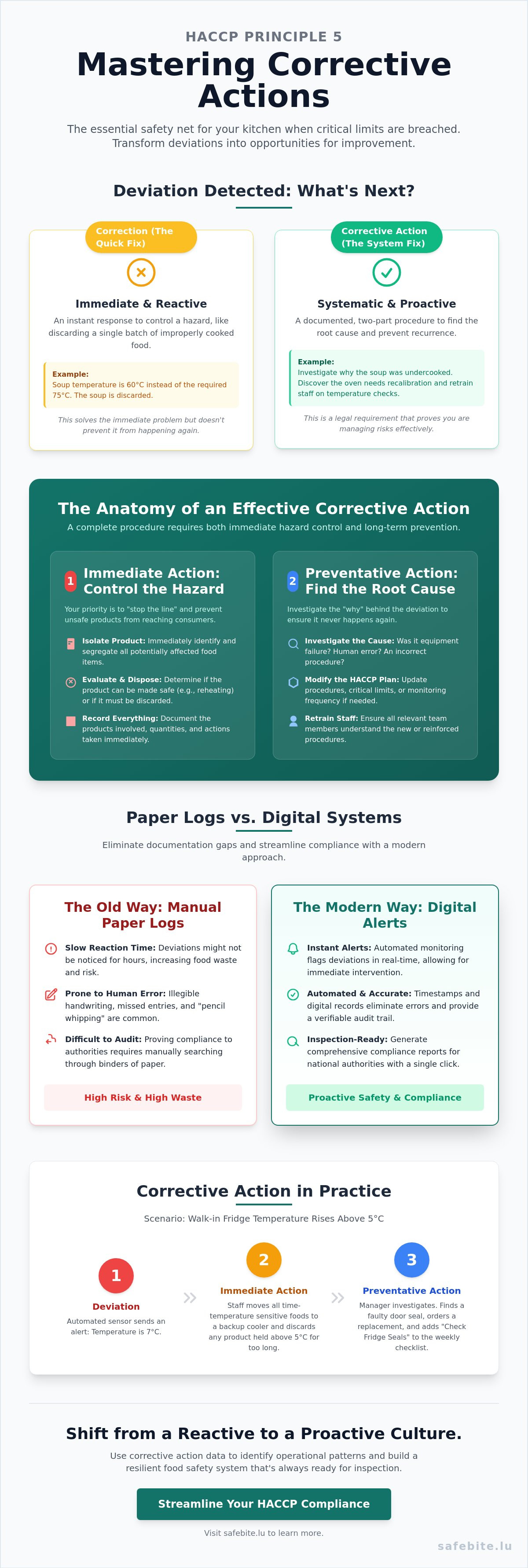
There is a vital distinction between a simple correction and a full corrective action. A correction is an immediate, reactive fix, such as discarding a batch of soup that didn't reach the required temperature. While necessary, it doesn't solve the underlying issue. A corrective action, however, is a deeper investigation into the root cause to prevent the problem from happening again. This might involve recalibrating equipment or retraining staff on specific protocols. In the eyes of national authorities, this distinction is critical. Following Luxembourg food safety regulations, documenting these actions is not just a best practice; it's a legal requirement to prove you're managing risks effectively.
The Role of Critical Limits and Deviations
A deviation occurs the moment a Critical Limit is missed. These limits are the absolute boundaries, such as a maximum storage temperature of 5°C, that separate safe food from potentially hazardous products. By setting clear, objective boundaries, you remove the guesswork for your staff. Instead of debating whether a product is "okay," they simply follow the protocol. Utilizing automated temperature monitoring allows these deviations to be identified instantly, giving your team the head start they need to intervene before a minor slip becomes a major liability.
Why Proactive Vigilance Trumps Reactive Fixing
True kitchen leadership is defined by calm authority during high-pressure moments. When you have pre-planned corrective actions, you eliminate the panic of "scrambling" to find a solution. Your team knows exactly who is responsible for what, which products are affected, and how to record the event. This structured approach transforms a potential crisis into a manageable event. It replaces uncertainty with a methodical process, ensuring that your kitchen remains compliant and your reputation stays intact. By asking yourself what are corrective actions in HACCP before a problem arises, you build a resilient operation that's always ready for inspection.
The Anatomy of an Effective Corrective Action Procedure
Building a robust response system requires more than just a quick fix. It's a disciplined approach that ensures food safety remains uncompromised. To truly understand what are corrective actions in HACCP, you must view them as a two-part requirement: immediate action to control the current hazard and preventative action to stop it from returning. Knowing exactly what are corrective actions in HACCP allows your team to act with confidence the moment a critical limit is breached. This dual-layered strategy protects your customers and shields your business from legal liability. A procedure is only considered complete once every step is documented and verified by a supervisor.
Immediate Action: Controlling the Hazard
The moment a deviation is detected, your priority is to "stop the line." This means halting production or service involving the affected Critical Control Point until the hazard is under control. You must identify and isolate all potentially unsafe products to prevent them from reaching the consumer. Depending on the severity, your steps might include reheating food to a safe internal temperature, rapidly chilling items, or disposing of the product entirely. If equipment failure is the culprit, such as a walk-in freezer rising above its limit, your protocol should include moving stock to a pre-verified backup unit. Following the FDA guidelines on corrective actions ensures these immediate responses are scientifically sound and effective.
Preventative Action: Eliminating the Root Cause
Once the immediate threat is neutralized, your focus shifts to Root Cause Analysis (RCA). This is where you investigate why the deviation occurred. Was it a mechanical failure, or did a staff member miss a scheduled check? If you find that inconsistent responses are the issue, implementing digital HACCP checklists can provide the structure your team needs to stay on track. Preventative actions might involve several strategic steps:
- Scheduling urgent maintenance for aging refrigeration units to prevent recurring temperature spikes.
- Updating staff training modules to address specific procedural gaps identified during the deviation.
- Modifying the HACCP plan to include more frequent monitoring during peak service hours.
Assigning responsibility for these long-term fixes to specific team members ensures accountability. It transforms a one-time error into an opportunity for operational refinement. By addressing the "why" behind the "what," you move beyond simple fire-fighting and toward a culture of proactive vigilance. This methodical approach ensures that your kitchen isn't just reacting to problems, but actively evolving to prevent them.
Paper Logs vs. Digital Alerts: Solving the Documentation Gap
"Documentation takes too much time" is a sentiment shared by many chefs during a frantic dinner service. While the pressure of the line is real, failing to record a deviation is effectively the same as not taking action at all when an inspector arrives. To truly grasp what are corrective actions in HACCP, you must recognize that they are only legally valid if they are traceable and verifiable. Manual paper logs are notoriously prone to "dry-labbing," where data is faked hours after the event, or lost entirely in the chaos of a busy kitchen. Digital timestamps replace these vulnerabilities with unalterable data, ensuring your records align with the FDA's official HACCP guidelines regarding Principle 5.
In Luxembourg, national authorities look for a clear "Audit Trail" that demonstrates a history of proactive vigilance. A folder full of stained, illegible papers doesn't project confidence. Instead, it suggests a reactive culture where safety is an afterthought. Digital systems solve this by using mandatory fields. If a temperature is recorded outside of the critical limit, the system won't allow the user to close the task until they've documented exactly what are corrective actions in HACCP protocols for that specific scenario. This forced compliance protects the business owner from the risks of human error and oversight.
The Risk of Manual Record-Keeping
Manual folders are a significant operational red flag. Lost pages or retroactive filling are the first things a health inspector will spot during a routine check. Beyond the regulatory risk, there's a heavy psychological burden on your team. Expecting a sous-chef to stop mid-service, find a specific pen, and locate a physical binder to record a fridge fluctuation is unrealistic. This friction often leads to skipped entries, leaving your business exposed to legal liability and potential food waste if a cooling failure goes unnoticed for hours.
Real-Time Oversight with Digital HACCP
Transitioning to a modern system turns a passive logbook into an active assistant. Automated alerts via SMS or push notifications ensure that no deviation goes unnoticed, even if you're off-site. For managers overseeing multi-site operations across Luxembourg, a centralized dashboard provides a bird's-eye view of compliance in real-time. Implementing digital food safety checklists allows you to set "smart reminders." These reminders guide staff through the exact steps required to resolve a breach, ensuring the response is consistent regardless of who is on shift. This level of oversight moves your kitchen away from the "scrambling" method and toward a disciplined, tech-forward standard of excellence.
Real-World Corrective Action Examples for Modern Kitchens
Moving from theory to practice requires a clear understanding of how protocols function during a live shift. When you define what are corrective actions in HACCP for your specific environment, you provide your team with a playbook for success. These examples illustrate how to close the loop on food safety deviations by combining immediate fixes with long-term preventative strategies. Every completed action must end with a verification step, where a manager confirms the process was followed correctly and the hazard is neutralized.
Case Study 1: Cold Chain Breach
Imagine a walk-in fridge temperature is recorded at 8°C during a mid-morning check, exceeding the critical limit of 5°C. The immediate action is to move all high-risk stock to a functioning backup unit. If the temperature has been elevated for over two hours, the affected food must be discarded to prevent the growth of pathogens. Upon investigation, the root cause is identified as a worn door seal that allows cold air to escape. The preventative action involves scheduling professional maintenance to replace the seal and implementing a "doors closed" policy during peak delivery times. To verify this, a supervisor must check the unit's temperature log 24 hours later to ensure it has stabilized below the 5°C threshold.
Thermal Processing: Under-Cooked Poultry
During a routine probe check, a batch of roasted chicken is measured at 68°C instead of the required 75°C. The immediate action is to continue the cooking process until the safe internal temperature is reached. The root cause analysis reveals a "cold spot" in the oven caused by a failing fan motor. The preventative action is to recalibrate the equipment and update the cooking log to include mandatory multi-point probing for that specific oven. Verification occurs when the chef de partie re-probes the chicken, achieves 75°C, and signs off on the digital entry.
Case Study 2: Cross-Contamination Event
A supervisor notices a staff member using a green vegetable board to prep raw poultry. This is a significant sanitation deviation. The immediate action is to stop production, discard any potentially contaminated ingredients, and sanitize the entire prep station using professional-grade chemicals. The root cause is often a training gap, perhaps involving a new hire who is unfamiliar with the kitchen's color-coded system. The preventative action involves conducting an immediate digital training session via kitchen management software to reinforce safety standards. Verification is completed through a follow-up hygiene audit of the prep area during the next shift.
Managing these complex scenarios becomes significantly easier when your team has instant access to the right protocols. If you're looking to eliminate guesswork and ensure every deviation is handled with precision, explore our digital HACCP checklists to streamline your kitchen's response system.
Beyond Compliance: Building a Proactive Food Safety Culture
Viewing food safety as a mere checklist for inspectors misses the larger strategic advantage. When you deeply integrate what are corrective actions in HACCP into your daily operations, you stop reacting to crises and start managing through data. This shift transforms your kitchen from a high-stress environment into a disciplined center of excellence. By tracking every deviation transparently, you move away from a culture of blame. Instead, you create a culture of continuous improvement where every mistake is a valuable data point used to refine your systems and protect your brand reputation.
Digital reporting provides the clarity needed to make informed, high-level business decisions. If your logs show that a specific refrigeration unit has triggered three corrective actions in a single month, you have the documented evidence required to justify a new equipment investment. This isn't just about safety; it's about operational efficiency and preventing costly food waste before it happens. SafeBite acts as your proactive partner, turning raw compliance data into actionable insights that improve your bottom line while ensuring you stay ahead of Luxembourg's evolving regulatory curve.
Empowering Staff with Clear Protocols
Uncertainty is the primary cause of anxiety and friction in a professional kitchen. When staff members aren't sure how to respond to a critical limit breach, decision fatigue sets in, which often leads to costly errors or ignored deviations. Establishing clear, digital SOPs for what are corrective actions in HACCP protocols empowers your team to act decisively and calmly. Our digital checklists provide "on-the-spot" training, guiding even your most junior members through the correct procedures in real-time. This builds a confident, capable team that views safety as a shared professional standard rather than a bureaucratic burden.
Data-Driven Management
Managing multiple sites across the country requires a bird's-eye view of performance that paper logs simply cannot provide. Monthly reports allow you to identify recurring issues, such as specific locations struggling with cooling protocols or recurring sanitation gaps. You can use these "SafeBite stats" to prove to national inspectors that your kitchen is under total control. Showing a history of proactive, documented responses is far more impressive to an auditor than a suspiciously perfect sheet of paper. Safety is a journey of precision, not a destination of perfection. By focusing on accurate documentation and consistent improvement, you ensure your business remains resilient, profitable, and ready for whatever the next inspection brings.
Future-Proof Your Food Safety Standards
Mastering the fifth principle of food safety transforms your operation from a reactive kitchen into a disciplined center of excellence. You now understand that defining what are corrective actions in HACCP provides your team with the clarity needed to handle deviations with confidence. By bridging the gap between immediate fixes and long-term preventative measures, you ensure your business remains resilient against operational risks and regulatory scrutiny.
Eliminating the friction of manual paperwork allows you to focus on what matters most: your guests and your craft. Digitize your HACCP corrective actions with SafeBite today. Our system is specifically designed for Luxembourg hospitality standards, featuring automated alerts for critical breaches and inspection-ready digital audit trails that satisfy national authorities. Precision in safety doesn't have to be a burden. With a proactive digital partner by your side, you can lead your team with quiet confidence and maintain a kitchen that is always ready for inspection.
Frequently Asked Questions
What is the difference between a correction and a corrective action?
A correction is an immediate, reactive step taken to neutralize a hazard, such as reheating a sauce that has cooled. A corrective action is a systemic response designed to eliminate the root cause of the problem. While throwing away spoiled produce is a necessary correction, repairing a faulty cooling fan is the corrective action that prevents the issue from happening again tomorrow.
Do I have to document every single time a temperature is slightly off?
You must document every instance where a Critical Limit is breached according to your specific plan. If your limit is 5°C and the unit hits 6°C, this is a formal deviation. Documenting these events is the only way to prove to Luxembourgish inspectors that your safety net is functioning. It shows that you are actively monitoring and responding to risks rather than ignoring them.
Who is responsible for taking corrective actions in a commercial kitchen?
Responsibility is typically assigned to the chef on duty or a designated food safety supervisor within your HACCP plan. While any team member can identify a deviation, a manager must verify the action taken. This ensures that the response was scientifically sound and that the documentation is accurate for future audits. Clear assignment of these roles reduces panic during busy service periods.
What happens if a corrective action doesn’t fix the problem?
If a corrective action fails to prevent a recurrence, you must re-evaluate your Root Cause Analysis and potentially update your HACCP plan. Persistent deviations are often a sign that equipment needs replacement or that staff training protocols are insufficient. Understanding what are corrective actions in HACCP helps you recognize when a simple fix isn't enough and when a more strategic operational change is required.
How long should I keep records of my HACCP corrective actions?
In Luxembourg, food safety records should generally be maintained for at least two years to remain compliant with national standards. However, requirements can vary depending on the shelf life of the products you handle. Utilizing a digital archive ensures these records stay legible and organized. This makes it much easier to present a complete history of compliance during unannounced inspections by health authorities.
Can a digital system automatically suggest corrective actions for my staff?
Yes, modern systems like SafeBite use pre-configured protocols to guide your team through the correct response steps instantly. When a temperature monitoring system detects a breach, the software can trigger a mandatory checklist. This ensures every employee knows what are corrective actions in HACCP for that specific scenario, eliminating the need for them to memorize complex regulatory manuals under pressure.
What are the legal consequences of failing to document deviations in Luxembourg?
Failing to document deviations can lead to significant fines, a lower hygiene rating, or even temporary closure by Luxembourgish health authorities. Without a traceable audit trail, you have no legal defense if a food safety incident occurs. Maintaining digital records is a proactive way to protect your business license and demonstrate that you prioritize the safety of your customers and the integrity of your brand.