Why does your kitchen staff continue to cut corners on safety protocols even after they've completed their annual training? It's a frustrating reality for many operators who feel trapped in a cycle of pencil-whipped logs and high turnover. You likely feel the weight of responsibility every time an unannounced health inspector walks through the door, wondering if your team is truly maintaining a proactive food safety culture in restaurants. With an estimated 48 million people in the U.S. getting sick from foodborne illnesses each year, the stakes for your brand's reputation have never been higher.
True safety isn't found in a set of rules; it's the behavior that happens when the manager leaves the room. We understand that you want a kitchen that manages itself, providing you with the confidence that every temperature is logged and every allergen is tracked. This guide promises to show you how to move beyond mere compliance to reach a level of proactive excellence. We'll debunk five dangerous myths currently circulating in 2026 and preview the digital transitions that are helping over 60% of food businesses achieve stress-free audit readiness.
Key Takeaways
- Understand why 2026 standards require a shift from reactive compliance to a proactive mindset driven by shared kitchen values.
- Identify why annual training alone fails to create lasting change and how to overcome the "forgetting curve" through daily reinforcement.
- Discover the hidden risks of the "paper paradox" and how to eliminate pencil-whipping to build a genuine food safety culture in restaurants.
- Learn a practical five-step framework for developing "Safety Champions" who maintain high standards even when management is away.
- See how digital checklists and automated monitoring systems serve as catalysts for operational consistency and stress-free audit readiness.
What is Food Safety Culture and Why Does it Matter in 2026?
Food safety culture in restaurants represents the collective mindset of your entire team. It's the set of shared values that dictates how a line cook handles a cross-contamination risk during a busy Friday night rush. While traditional food safety principles provide the necessary technical framework, culture provides the internal motivation to follow them consistently. In 2026, the industry has moved past reactive safety measures. We're seeing a shift where regulators and consumers alike expect a proactive stance. If your safety strategy only kicks in when an inspector arrives, your business is already at risk.
Maintaining a robust food safety culture in restaurants is no longer optional for those seeking long-term success. This culture acts as an "invisible ingredient" in your kitchen, directly influencing the quality of your service and the integrity of your brand. A team that values safety also values precision. This precision leads to better tasting food and fewer customer complaints. Operational resilience depends on this foundation. When safety is ingrained in your staff's daily habits, your business can weather high turnover and supply chain disruptions without compromising its standards.
The Four Pillars of a Strong Safety Mindset
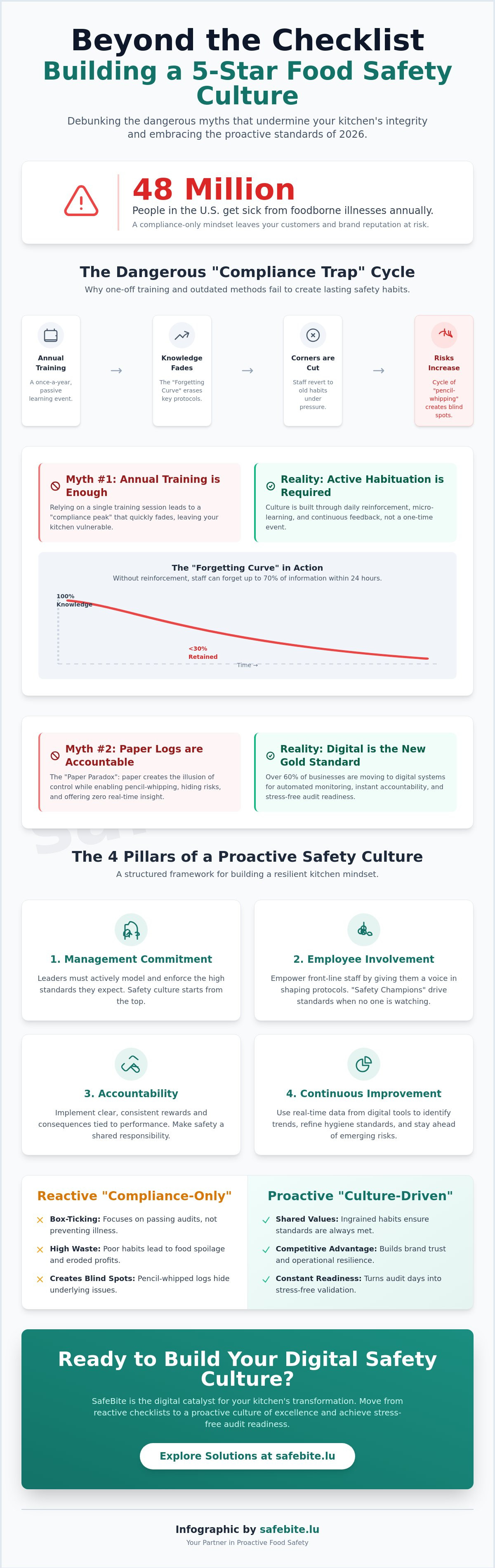
Building this mindset requires a structured approach. Management commitment is the first pillar; leaders must model the behaviors they expect. If a manager ignores a broken thermometer, the staff will too. Second, employee involvement ensures front-line staff have a voice in shaping protocols. Accountability follows, where clear rewards and consequences are tied to performance. Finally, continuous improvement uses real-time data to refine hygiene standards daily, ensuring your kitchen stays ahead of emerging risks.
The High Cost of a 'Compliance-Only' Approach
Treating safety as a box-ticking exercise creates dangerous blind spots. When staff only care about passing an audit, they ignore the underlying issues that cause illness. This also has a direct financial impact; poor storage habits lead to food waste that erodes profits. Understanding Luxembourg food safety regulations is easier when your team operates from shared responsibility rather than fear.
Investing in these cultural foundations transforms safety from a burdensome chore into a competitive advantage. It builds a resilient operation that protects both your customers and your bottom line. By prioritizing the human element of safety, you ensure that high standards remain the default setting for your kitchen, regardless of who is on shift.
Myth #1: Annual Training is Enough to Build Culture
Many operators mistakenly believe that checking off a yearly training requirement is the finish line. In reality, a one-off certificate rarely creates lasting behavioral change. Relying solely on annual videos leads to a "compliance peak" that quickly fades. This phenomenon is known as the "Forgetting Curve," where individuals often lose up to 70% of new information within just 24 hours if it isn't reinforced. In the high-pressure environment of a commercial kitchen, this memory loss translates directly into missed temperature logs and cross-contamination risks.
Building a true food safety culture in restaurants requires a shift from passive learning to active habituation. Watching a training video once a year is a passive exercise that staff often view as a hurdle to clear rather than a standard to live by. Contrast this with active habituation, where daily digital checks become a natural rhythm of the shift. When safety becomes a continuous conversation, it moves from the back of the mind to the forefront of every action. This transition ensures that standards are maintained even when the kitchen is at its busiest.
Moving from Certification to Competency
Knowledge doesn't always translate into action during a busy Friday night rush. To bridge this gap, modern kitchens are adopting micro-learning and daily reminders that reinforce core habits. Utilizing real-time food safety monitoring creates instant feedback loops for your staff. Instead of waiting for a quarterly review, employees receive immediate data on their performance. This constant stream of information transforms theoretical knowledge into practical competency. If you're looking for a way to streamline these daily habits, exploring a digital safety platform can provide the structure your team needs.
The Power of the 'Daily Huddle'
A simple, 2-minute safety brief integrated into every shift change can revolutionize your operation. These huddles keep safety top-of-mind without disrupting the flow of service. Use digital data to highlight "wins" from the previous day, such as a perfectly maintained cooling log or a flawless allergen check. This positive reinforcement aligns with National Restaurant Association guidance on maintaining a vigilant environment. Encourage your staff to report near-misses, like a fridge that felt slightly too warm, without fear of retribution. When your team feels safe reporting issues, you've achieved a mature food safety culture in restaurants that protects your guests and your business.
Myth #2: Paper Logs are the Gold Standard for Accountability
For decades, the clipboard was the symbol of kitchen diligence. However, paper logs often create a "Paper Paradox" where the appearance of compliance masks operational failure. Manual records are vulnerable to the psychology of "pencil-whipping," the practice of backfilling logs at the end of a shift or even days later. When staff fake data, they aren't just breaking a rule; they're signaling that safety is a performance rather than a value. This systemic dishonesty is the fastest way to erode a healthy food safety culture in restaurants.
Digital timestamps solve this problem by creating a culture of honesty. When a temperature is recorded, it's locked in with a verified time and user ID. This transparency replaces the "trust but verify" model with a "verify to trust" system. Beyond accountability, a paperless kitchen offers significant organizational benefits. You no longer need to store boxes of greasy, illegible binders for years. Instead, digital records are searchable, secure, and instantly accessible, reducing the physical clutter that often distracts from core kitchen duties.
Transparency vs. Surveillance
It's vital to frame digital tools as a support system for your staff rather than a "Big Brother" monitor. When you implement digital food safety checklists, you're actively reducing the mental load on your chefs. Automated reminders ensure they don't have to memorize every task during a rush. This shift allows management to use data to identify where staff need more support or better equipment, transforming safety from a disciplinary tool into a collaborative improvement process.
Audit-Readiness as a Constant State
The stress of an unannounced inspection usually stems from the frantic scramble to organize paper records. Digital adoption moves your kitchen into a state of permanent audit-readiness. Centralized dashboards provide general managers with peace of mind, especially when overseeing multiple sites. You can see at a glance if a fridge is failing or if a cleaning task was missed before it becomes a regulatory issue. In 2026, national inspectors increasingly trust digital records over paper because they provide a clear, unalterable trail of your commitment to food safety culture in restaurants.
How to Build a 5-Star Food Safety Culture
Transforming your kitchen from a state of reactive panic to proactive excellence requires a deliberate strategy. You can't simply demand a better food safety culture in restaurants; you have to architect it. This process starts by identifying "Safety Champions" within your line staff. These aren't always your managers. Often, they're the respected senior cooks or prep leads who naturally set the pace for the rest of the team. When these influential figures prioritize hygiene, the rest of the staff follows their lead. By empowering these individuals and using positive reinforcement to reward high compliance, you make safety a point of pride rather than a burden of oversight.
The role of technology in this transformation is to make the right choice the easiest choice for every employee. In an environment where 60% of food businesses have already transitioned to automated systems, those relying on manual effort are at a distinct disadvantage. When you align your human talent with efficient digital tools, you create a self-sustaining environment where high standards are the default. This synergy ensures that your team remains focused on quality and service, even during the most demanding shifts.
Step 1: The Baseline Audit
Before you can improve, you must understand your starting point. Conduct an honest assessment of current behaviors. Are cooks skipping handwashing because the sink is blocked by prep crates? Identifying why shortcuts exist allows you to fix the root cause rather than just treating the symptom. Set measurable KPIs for improvement, such as the percentage of correctly completed cooling logs or the speed of corrective actions taken when a fridge temperature drifts. This data-driven approach provides a clear roadmap for your cultural evolution.
Step 2: Implementing the Right Infrastructure
Technology should remove friction from the workday, not add to it. Choosing restaurant food safety software that staff actually enjoy using is critical for long-term adoption. Ensure that hardware, such as tablets and Bluetooth sensors, is accessible at the point of action. When a chef can complete a checklist in three seconds with a few taps, compliance becomes the path of least resistance. If you're ready to provide your team with the tools they need to succeed, discover how our digital dashboard simplifies multi-site management.
The remaining steps in this framework involve clear communication, consistent accountability, and iterative refinement. By sharing safety data with the team, you foster a sense of collective ownership. When every team member knows their specific role in maintaining the standard, the food safety culture in restaurants becomes an unbreakable foundation for business longevity. This structured approach protects your guests, your staff, and your brand's reputation from the risks of a compliance-only mindset.
SafeBite: The Digital Catalyst for Your Safety Culture
SafeBite represents more than a digital replacement for the traditional clipboard. It's a sophisticated cultural alignment tool designed to bridge the gap between policy and practice. By integrating Digital HACCP Checklists and a Temperature Monitoring System into the heart of your operations, the platform transforms the abstract concept of food safety culture in restaurants into a tangible daily habit. It shifts the managerial focus from reactive policing to proactive leadership. When safety protocols are embedded into a streamlined digital workflow, they stop being a series of chores and start being the natural rhythm of a high-performing kitchen.
This digital transition allows your team to operate with a sense of quiet confidence. Instead of wondering if a prep cook remembered to check the walk-in, managers can rely on a system that ensures every critical control point is monitored. This level of oversight doesn't just protect the guest; it protects the staff by providing a clear, unalterable record of their diligence. It creates an environment where precision is valued and excellence is documented in real-time, reinforcing the professional standards that define your brand.
Empowering Your Team with Real-Time Data
Instant notifications turn potential hazards into immediate coaching moments. If a refrigeration unit drifts outside of its safe parameters, the system sends an automated alert to the right person at the right time. This prevents safety from becoming an afterthought during a busy shift. By automating the most tedious parts of HACCP record-keeping, you significantly reduce staff stress and mental fatigue. Your chefs can focus on culinary execution while the technology handles the burden of monitoring, building a foundation of trust through verified, tamper-proof digital records.
Ready for the 2026 Regulatory Landscape?
The regulatory environment of 2026 demands a higher level of transparency and data integrity than ever before. For national groups and franchises, the challenge of maintaining consistency across multiple locations is solved through our Multi-site Management Dashboard. This tool allows executives to identify compliance trends across the entire organization, ensuring every site meets the same rigorous standards. Staying ahead of evolving national requirements gives your business a powerful competitive advantage and a "Safety First" reputation that diners trust.
The journey toward a self-managing kitchen starts with the right infrastructure. SafeBite provides the Allergen Management Tool and digital dashboards necessary to move beyond mere compliance. We invite you to transition from the stress of manual oversight to the ease of modern, proactive leadership. Discover how our intuitive platform can secure your operations and empower your team by scheduling a free demo of the SafeBite ecosystem today.
Securing Your Kitchen's Future
Transitioning from a compliance-only mindset to a proactive food safety culture in restaurants is the most significant investment you can make for your brand's longevity. You've seen how annual training fails to bridge the forgetting curve and why paper logs often hide more than they reveal. By empowering "Safety Champions" and implementing the right digital infrastructure, you transform safety from a source of stress into a point of professional pride. This evolution ensures your team is always ready for an unannounced inspection without the need for a last-minute scramble.
Success in 2026 requires tools that move as fast as your kitchen does. SafeBite replaces unreliable paper logs with verified digital timestamps and provides real-time alerts for temperature or hygiene non-compliance. Our system is designed for rapid staff adoption in even the busiest environments, making the right choice the easiest choice for every member of your team. Empower your kitchen culture with SafeBite's digital HACCP platform today. With the right mindset and the right technology, you can lead your team toward a safer, more efficient, and more profitable future.
Frequently Asked Questions
What is the primary difference between food safety compliance and food safety culture?
Compliance is the act of following specific rules to avoid penalties; food safety culture in restaurants is the shared commitment to protect guests because it's a core professional value. Compliance is often reactive and driven by the fear of an upcoming inspection. In contrast, a strong culture is proactive and ensures high standards are maintained even when management isn't present.
How can I tell if my restaurant has a poor food safety culture?
The most common indicator of a failing culture is the presence of "pencil-whipping," where staff fake logs at the end of a shift. You might also notice that protocols are ignored during busy periods or that staff don't feel comfortable reporting equipment failures. If your team only follows safety procedures when they're being watched, your cultural foundation is likely fractured.
Does a digital HACCP system really improve staff behavior?
Digital systems improve behavior by creating clear accountability through unalterable, time-stamped records. When staff know their actions are verified in real-time, the temptation to cut corners disappears. These tools also reduce the mental load on your team by providing automated reminders, which makes following the correct procedure the path of least resistance during a rush.
How long does it take to transform a kitchen's safety culture?
Cultural transformation is an ongoing process rather than a one-time project. Most operators begin to see significant behavioral shifts within three to six months of implementing structured digital tools and consistent management reinforcement. Lasting change requires daily commitment and the integration of safety into every shift huddle and performance review.
Can a strong food safety culture help with staff retention?
A disciplined and safe environment reduces workplace stress and helps retain high-performing employees. Professional chefs and kitchen staff prefer working in organized environments where standards are clear and consistently applied. By reducing the anxiety associated with unannounced inspections and manual paperwork, you create a more attractive and stable workplace for your team.
What should I do if my experienced chefs resist new digital safety tools?
Focus on how the technology protects their professional reputation and saves them time. Experienced chefs often dislike the tedious nature of paper logs and manual temperature checks. Demonstrate how automated sensors and digital checklists can save them thirty minutes of paperwork each day, allowing them to focus more on culinary execution and team leadership.
Are digital food safety records legally accepted during inspections in 2026?
Digital records are fully accepted and frequently preferred by regulatory bodies in 2026. These systems provide a more accurate and transparent history of your operations compared to manual binders. Inspectors value the ability to see a tamper-proof trail of data, which demonstrates a higher level of organizational control and a more reliable commitment to safety.
How do I reward staff for maintaining high food safety standards?
Use the data from your management dashboard to identify and publicly recognize "Safety Champions" during team meetings. Linking high compliance scores to performance bonuses or internal recognition programs reinforces the importance of a food safety culture in restaurants. Positive reinforcement for consistent accuracy is far more effective at building long-term habits than disciplinary action alone.